Vietnam reforms land law, expects better year ahead for troubled property market
Jamille Tran
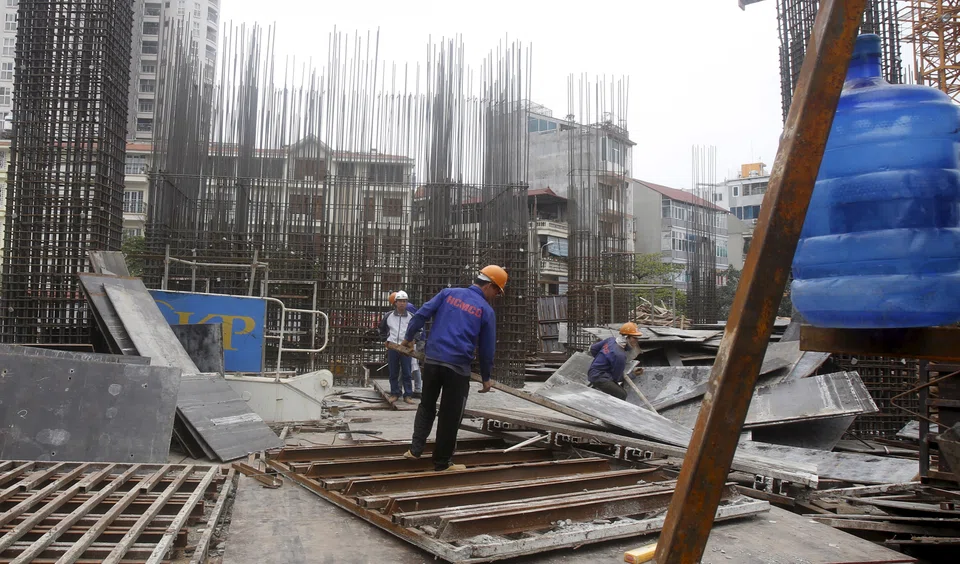
[HO CHI MINH CITY] Vietnam’s National Assembly – the highest legislative body in the country – has voted overwhelmingly to pass long-delayed revisions to the Land Law, which covers key areas such as market-based land pricing and land revocations.
On Thursday (Jan 18), 432 out of 477 lawmakers voted in favour of the amendments on the third and final day of an extraordinary parliamentary session.
The amendments also cover major updates on other issues such as the granting of land-use rights through public tender, land auctions, and the digitalisation of land data.
The changes – which took into account feedback and comments from citizens, scholars, organisations and other stakeholders – are scheduled to take effect from Jan 1, 2025, except for a few specific regulations that will be introduced immediately.
Among the biggest changes is one where land price bands are updated once a year to more accurately reflect movements in the market. The previous legislation, however, stipulated that these price bands are set every five years.
The revisions to the Land Law came just two months after lawmakers approved the revised Real Estate Trading Law and Housing Law, which will also be effective from Jan 1, 2025.
Do Thu Hang, a senior director of advisory services at Savills Hanoi, said the issuance of these important legislative documents provides clarity on previous bottlenecks and will be a “significant driver” to the supply of new real estate projects and products.
Su Ngoc Khuong, senior director of investment at Savills Vietnam, added that international developers have been awaiting more relaxed legal policies in the real estate sector.
“While gross domestic product growth in 2023 was modest at 5.05 per cent, Vietnam continues to be one of the strongest performers in the region. This has captured the attention of investors, especially during challenging periods,” he said.
Duong Thuy Dung, executive director of CBRE Vietnam, expects the amendments – and more stable policy interest rates – to lead to more positive buyer sentiment and facilitate a greater market recovery in 2024.
Challenging market conditions
Over the past two years, developers in Vietnam have been plagued with soaring interest rates and a liquidity crunch.
These challenges stemmed from tighter rules on private-placement bonds and diminishing market confidence amid numerous instances of financial scandals and housing projects’ legal entanglements.
Data from consultancy CBRE Vietnam released on Jan 11 showed that the supply of new homes in the capital Hanoi and Ho Chi Minh City reached a record low in the past 10 years.
Hanoi had nearly 10,300 condominiums and 2,600 landed property units launched last year, down 32 per cent and 84 per cent, respectively, from a year ago.
The Ho Chi Minh City market fared worse, with nearly 8,700 condo units and just 30 new landed property units launched – a year-on-year dip of 54 per cent and 98 per cent, respectively.
The sales of condos and landed properties in 2023 also fell by half compared with the previous year, with a total of around 22,000 units sold in the two cities.
A housing imbalance has also led to higher selling prices of condo units in Vietnam’s two biggest metropolises, which has in turn dented developers’ liquidity.
A large quantity of new supply last year was in the high-end segment, accounting for 75 per cent and 84 per cent of the total new launches in Hanoi and Ho Chi Minh City, as indicated by CBRE data.
Observers say that Vietnam’s challenges have some similarities to the problems seen in China in 2020, when Beijing enforced stricter measures against risky practices in the property sector. Many still believe, however, that Vietnam won’t experience the same extent of the downturn in China.
While China has an oversupply in its housing market, Vietnam’s market is facing undersupply with robust demand, said Pham Dinh Huy, the chief investment officer at Vietnamese developer Nam Long Group.
VinaCapital chief economist Michael Kokalari noted that the demand for housing units in Vietnam outstrips supply by a factor of about 2-to-1.
“The country does not produce anywhere near enough housing units every year to satisfy demand by emerging middle-class homebuyers,” he wrote.
Property analysts have said they do not expect a rapid rebound in Vietnam’s property market until the middle of 2024, when demand from homebuyers is set to pick up due to easing mortgage rates and the ongoing economic recovery.
Retail, office segments
In its report, CBRE also gave its take on other segments of Vietnam’s property market. The retail segment in Hanoi and Ho Chi Minh City in 2023 experienced solid rental growth and high occupancy in shopping malls, especially those in prime locations due to the entry and expansion of many international luxury brands.
In the office segment, both cities saw an increase in vacancy rates compared with the previous year as there was a spike in office supply – the most since 2019.
As for industrial estates, CBRE said this segment remained a bright spot despite headwinds in the global economy and the local property market.
The net absorption of industrial land in Vietnam’s north hit its highest level in the past five years with a year-on-year surge of 37 per cent. The figure in the southern region recorded a 32 per cent plunge, however, mainly due to the limited availability of industrial land banks.