Vietnam shifts gears to e-bikes, ignites fierce race among mobility platforms, EV makers to win over riders
Platform operators such as Grab and Be are fast-tracking partnerships with electric vehicle makers, who are also raising fresh funds to ramp up expansion

[HO CHI MINH CITY] Vietnam – one of the world’s largest two-wheeler markets, with some 77 million registered motorcycles – is readying itself for a big shift as its biggest cities move to phase out petrol-powered motorcycles.
Even before the switch takes effect, the prospect of the looming bans on internal combustion engine (ICE) motorcycles in Ho Chi Minh City and Hanoi is already sparking brutal competition among ride-hailing giants. The likes of Grab, Be and Xanh SM, for example, are all seeking ways to convert their rider-partners to make the pivot to electric vehicles (EVs).
Local EV makers, including VinFast, Selex Motors and Dat Bike, are also locked in a cut-throat race to capture the expected surge in demand, competing in product affordability, performance, infrastructure readiness and access to large funding.
Ho Chi Minh City, now still dominated by fossil-fuelled motorbikes, is considering banning all ICE motorbikes from providing ride-hailing and delivery services within the city from 2029; a road map for a gradual transition starting next year has been drawn up, and is awaiting the authorities’ approval.
Hanoi is also set to ban petrol-powered motorcycles in the capital’s innermost ring road (Ring Road 1) from Jul 1, 2026; the plan is to expand the restriction to Ring Road 2 by 2028.
Riders’ woes
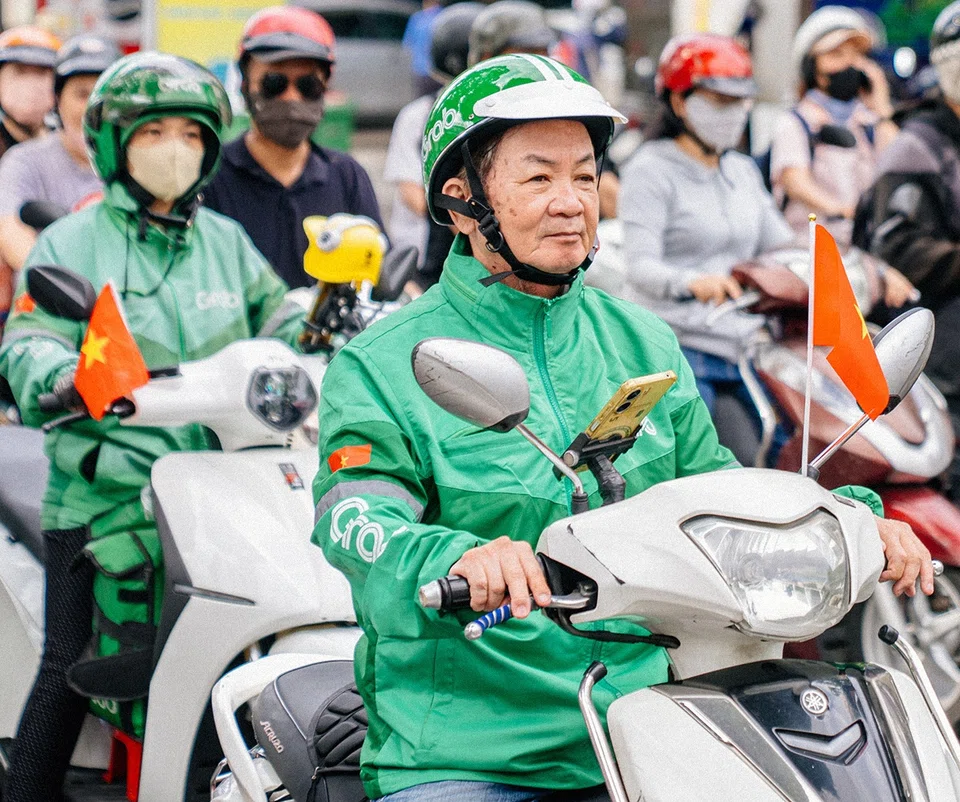
These sweeping policy shifts are sending shockwaves through Vietnam’s mobility ecosystem, where hundreds of thousands of platform bike riders – largely gig workers concentrated in major cities – are required to make the transition first.
“If they force us to switch to e-bikes, I may quit this job,” said Nguyen Trung Tien, a part-time GrabBike rider in Ho Chi Minh City. He bought his Honda ICE motorbike four years ago for around 40 million dong (S$1,920). It was, to him, a significant investment.
“Buying a new e-bike ends up costing about the same, so I’ll really need to think it through. I’m still waiting for more guidance and support from the platform.”
Market leaders such as Grab and Be that connect bike riders with customers through apps, and Xanh SM, which runs the largest ride-hailing fleet of VinFast EVs, are now playing the role of enablers for the ambitious mobility transformation.
Singapore-headquartered Grab said it has piloted partnerships to develop financial assistance programmes and EV models specially designed for delivery in Vietnam.
Its Vietnamese rival, Be Group, has launched a support centre offering vehicle leasing, purchasing, lending, insurance and fuel services for driver-partners, including those keen to switch to EVs.
In the meantime, turning to fleet owners such as Xanh SM appears to be a quick option for many riders, because most of the transition cost is borne by these platforms. Xanh SM currently provides VinFast e-bikes valued at around 50 million dong to riders, who pay a small refundable deposit to use the vehicle until the contract ends.
Home-based EV charging remains a key concern. Grab’s survey of 8,300 of its own driver-partners found that just a third of its driver-partners said they could charge EVs at home.
“Many landlords are reluctant to allow home charging,” said Nguyen Tuan Anh, a 33-year-old bike rider for Xanh SM. He cited homeowners’ concerns about recent home fires linked to the charging of EVs.
“When I could not find a suitable rented home, I had to leave the bike at public charging stations overnight and sleep nearby,” he said.
Hurried and harried
The draft programme for transitioning Ho Chi Minh City’s app-based riders to EVs was jointly developed by the city’s research institute and VinUni, the educational arm of Vingroup, whose chairman, Pham Nhat Vuong, also founded VinFast and Xanh SM.
Under the proposed road map, new petrol-powered motorcycles in the city would be barred from registering on digital transport platforms from 2026.
A package of government incentives, including registration fees and value-added tax exemptions, as well as low-interest loans, will be offered to support app-based bike riders – there are about 400,000 in Ho Chi Minh City alone – to make the switch to electric two-wheelers.
About 30 per cent are expected to make the transition by 2026, and 80 per cent by the end of 2027.
But such a timeline is raising concerns across the industry. Grab’s survey found that 62 per cent are not ready to convert, and nearly 80 per cent have never ridden an EV.
“An overly rushed conversion period could prevent many from converting their vehicles on time, especially given an unprepared EV support ecosystem, indirectly creating barriers to employment and income for hundreds of thousands,” a Grab representative warned, calling for a road map that offers support initiatives for at least five years before administrative measures kick in.
The EV infrastructure, however, is being actively developed, particularly through the rapid rollout of battery-swapping booths led by companies such as VinFast and Selex Motors. The model cuts traditional charging time to just minutes, minimising operational disruptions for delivery drivers.
A representative of Green and Smart Mobility, which operates Xanh SM, said: “Separating battery costs from vehicle costs allows drivers to better manage expenses, maintain stable income, and feel more secure in the long term.”
Within the next three years, Vuong’s EV charging station company V-Green plans to roll out 150,000 battery-swapping stations exclusively for VinFast vehicles.
Selex Motors aims to install 10,000 of such stations to serve about 70 per cent of the two-wheeler EVs on the road in Vietnam.
Ramping up
As one of the largest two-wheeler markets in the world, Vietnam has welcomed various EV manufacturers – both home-grown and foreign – who are anticipating surging demand in the local market in the coming period.
In the first half of 2025, VinFast delivered 114,484 e-scooters and e-bikes, mainly in Vietnam – an increase of 447 per cent from a year ago.
While sales figures for other comparable brands remain unclear, data from Motorcycles Data shows that VinFast – along with Chinese brands Yadea and Dibao – leads Vietnam’s electric motorbike market.
Of the more than 2.08 million motorcycles of all types sold year to August, the electric segment with engines over 50 cc jumped 197 per cent year on year.
“If the proposed policies come into effect, sales could grow by five to 10 times… I believe the market is reaching an inflexion point,” said Nguyen Huu Phuoc Nguyen, founder and chief executive of Selex Motors, a Hanoi-based maker of specialised e-scooters for delivery services.
The company, which primarily operates under a business-to-business and battery-swapping model, is currently raising new funds to support its growth. In recent years, it launched pilot programmes with e-commerce and express-delivery firms such as Lazada Logistics, GrabExpress, and ShopeeFood to integrate Selex e-scooters into their vehicle fleets.
However, competition is heating up, as these players are also exploring the use of EVs from other brands.
For example, Dat Bike, another home-grown electric motorbike manufacturer that secured a US$22 million Series B funding round on Sep 18, is one of the top choices for many GrabBike riders.
In July, Grab’s financial services arm, GFin, introduced a new instalment plan for Dat Bike’s Quantum S2 e-scooter, offering flexible payment terms of up to 15 months.
Dat Bike said it turned a monthly profit for the first time in August, and expects its revenue in 2025 to be 10 times higher than in the previous year. The company also plans to increase production from 30,000 units annually to about 100,000 units per year by the end of 2026.
Instead of producing specialised EVs for delivery services or heavily investing in public charging infrastructure, it focuses on developing e-bikes that match the performance and price point of ICE models, which are capable of travelling long distances and operating for a full week without needing to recharge.
“If 30 per cent of app-based drivers can already charge at home, it means we can convert these drivers today without any further infrastructure built,” said Dat Bike founder and chief executive Nguyen Ba Canh Son. “We just need to build a very good product for them.”