



Vietnam takes first leap into chip fabrication with Viettel-led fab
The new plant is expected to begin pilot production of semiconductors by end-2027

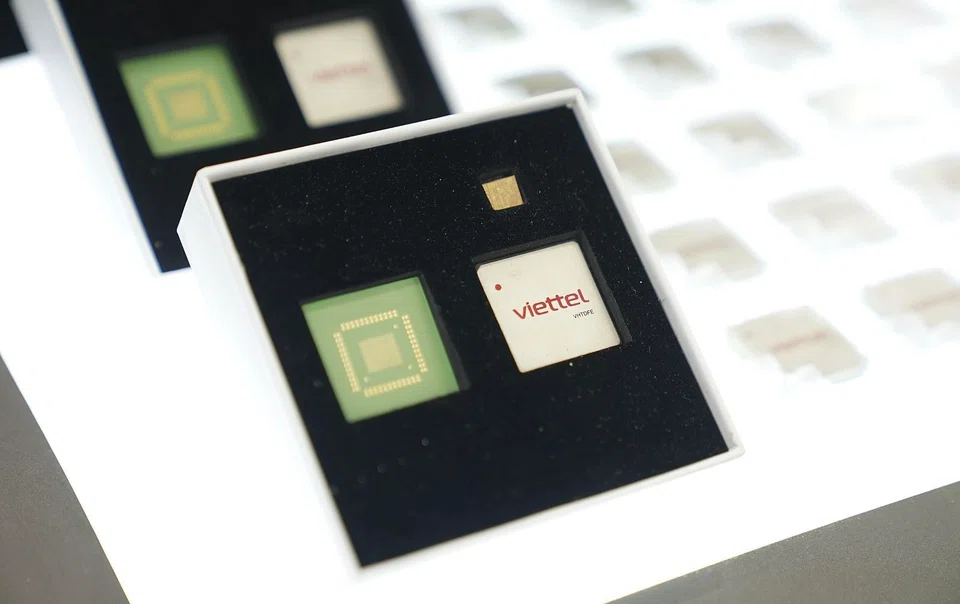
[HO CHI MINH CITY] Vietnam’s military-run industry and telecoms giant Viettel Group broke ground on the country’s first semiconductor wafer fabrication plant on Friday (Jan 16), marking a costly but symbolic step forward in Hanoi’s goal of building a chipmaking ecosystem and moving up the global technology value chain.
The plant, developed under a mandate from the Ministry of National Defence, occupies 27 hectares (ha) in Hoa Lac Hi-Tech Park on the outskirts of Hanoi.
Viettel aims to pilot the production of 32-nanometre chips by the end of 2027, after completing construction, technology transfer and initial installation at the facility in the coming years.
From 2028 to 2030, the group plans to optimise processes and improve operations in line with industry standards, to lay the groundwork for research into more advanced chipmaking technologies.
While Vietnam has gradually built capabilities across most stages of the chip supply chain – primarily chip design and back-end manufacturing of assembly, packaging and testing – it has so far lacked the ability to fabricate chips domestically.
Front-end chipmaking
Wafer fabrication – commonly known as “fab” – is the most complex, capital-intensive and highest-value stage of semiconductor manufacturing, involving the transformation of silicon wafers into integrated circuits through dozens of precision processes.
Industry executives have warned that building and running a semiconductor fab can cost anywhere from US$10 billion to US$50 billion, depending on scale and technology node. There are long payback periods and intense global competition dominated by players such as Taiwan Semiconductor Manufacturing Co and Samsung Electronics.
“A fab built today will almost certainly lose money – it’s burning cash,” said Nguyen Thanh Yen, general director of the Hanoi branch of South Korean chip design firm CoAsia Semi and founder of the Vietnam Microchip Community.
“But a fab also plays the role of infrastructure, like building roads. If Vietnam wants to go down the semiconductor path, it has to be done sooner or later,” he added.

Viettel’s fab would push the country into front-end manufacturing. Once operational, the plant is expected to supply chips for national priority sectors such as aerospace, telecommunications and automotive manufacturing.

National strategy
The project aligns with Vietnam’s national semiconductor industry strategy unveiled in September 2024, which set a target for at least one domestic small-scale semiconductor fab by the end of 2030.
By the end of this decade, Vietnam aims to host another 10 packaging, assembly and testing factories, and around 100 chip-design companies, employing about 50,000 chip engineers and specialised workers.
The longer-term goal is building a self-reliant semiconductor ecosystem by 2050, including at least three fabs, 20 packaging, assembly and testing plants, and 300 chip-design companies, generating about US$100 billion in annual revenue.
Based on government estimates from May 2024, Vietnam had around 40 firms involved in chip design, and five foreign-invested packaging and testing factories run by multinationals such as Intel, Amkor and Hana Micron. About nine companies producing semiconductor equipment are also active in the country.
Hanoi has offered various incentives to support the sector, including a national programme to train semiconductor engineers, and the Investment Support Fund to provide cash grants covering operational and initial investment costs for high-tech projects, particularly in semiconductors and artificial intelligence.
In the past few years, local tech champions have also moved into semiconductors. Viettel rolled out self-designed chips for 5G base stations; FPT Corp debuted power-management chips for healthcare Internet-of-Things applications; and CT Group developed a domestic assembly, packaging and testing plant.
Based on data from the Observatory of Economic Complexity, Vietnam exported US$32.4 billion in integrated circuits in 2023, ranking eighth globally and mainly shipping to China. Its US$7.9 billion in semiconductor device exports, largely destined for the US, made it the world’s fifth-largest exporter.
Investor optimism
Viettel’s new semiconductor fab helped lift sentiment in Vietnam’s tech and telecom sector, with stocks surging on the Ho Chi Minh City Stock Exchange and Unlisted Public Company Market on Friday.
FPT and its telecom arm hit their daily limits of 7 per cent and 15 per cent, respectively, as the rally was further supported by the company’s groundbreaking of a nearly 200-ha Digital Technology and Mixed-Use Park in Hanoi on the same day.
Investor optimism was further bolstered by a visit on Thursday from Eduard Stiphout, senior vice-president of strategic sourcing and procurement at Dutch chip equipment giant ASML. He toured the capital city to explore opportunities to expand the company’s supply chain in Vietnam.
ASML, the world’s largest maker of photolithography systems for computer chip manufacturing, is also reportedly seeking to collaborate on establishing training and research and development centres, set up an official local presence, and supply equipment to potential customers in the South-east Asian country.
Decoding Asia newsletter: your guide to navigating Asia in a new global order. Sign up here to get Decoding Asia newsletter. Delivered to your inbox. Free.
Copyright SPH Media. All rights reserved.
TRENDING NOW

KKR founders among investors buying 42% of Peter Lim’s Valencia; club valued at US$1.4 billion

Singapore’s central gas buyer affirms Indonesia’s role as ‘important partner’ amid export review warning

Why the biggest business decision about AI isn’t which model to choose

NEA issues notices to 10 Singapore-based companies, including Wilmar and APP, over haze

