



Vietnam taps fuel fund to steady prices amid risks of shortages
The government begins disbursing money from its fuel price stabilisation fund starting midnight on Tuesday
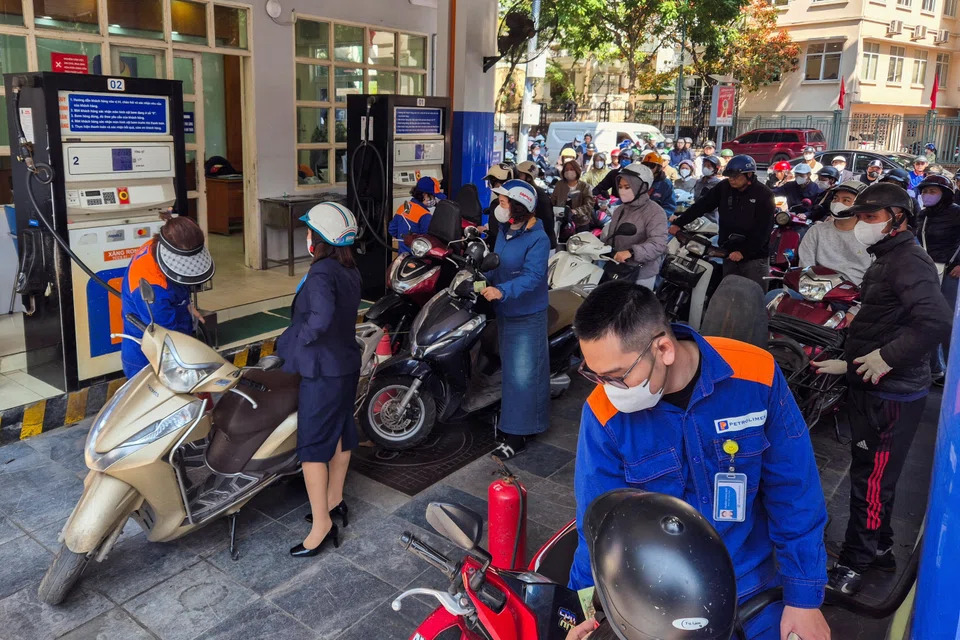
[HANOI] Vietnam moved to cushion consumers from a sharp jump in fuel costs as the Middle East conflict stoked growing concerns over global energy supplies.
The government began disbursing money from its fuel price stabilisation fund from midnight on Tuesday (Mar 10), using as much as 5,000 dong (S$0.24) per litre to soften retail price increases, according to a statement on its website.
As a result, the price of RON-95 petrol rose 7.66 per cent, while diesel increased 1.58 per cent and kerosene fell 7.71 per cent, respectively.
Without the intervention, RON-95 would have climbed about 22.45 per cent, while diesel and kerosene prices would have risen 18.12 per cent and 3.69 per cent, respectively, according to government calculations.
“We estimate the fund could sustain this level of intervention for roughly three-four weeks,” Pham Luu Hung, chief economist at SSI Securities wrote in a note to investors.
Prime Minister Pham Minh Chinh ordered officials to “absolutely prevent energy shortages in any circumstance”, according to another statement on the government’s website. Vietnam’s energy situation, though, remains “under control”, Chinh said.
Disruptions in the Persian Gulf, home to some of the world’s largest oil and gas producers, have been a major headache for import-dependent Asia, especially for more price-sensitive emerging economies such as Vietnam that immediately experience pain from higher costs and have less flexibility to draw on emergency supplies.
Vietnam’s trade ministry on Tuesday encouraged people to work from home and use public transport to reduce fuel consumption.
The government on Friday said that domestic supply remains “basically secured”, but warned that if the conflict continues into April the “market may face more difficulties”.

The prime minister ordered officials to diversify crude oil sources and increase imports to ensure 30 per cent of the nation’s fuel needs are met from overseas suppliers, the statement said. Chinh also instructed the Ministry of Finance to immediately propose a plan to slash the environmental protection tax on fuel to zero and report to the government on Mar 12.
The temporary cut in the environmental tax could lower retail fuel prices by as much as 2,000 per litre in future adjustments, SSI’s Hung said.
Vietnamese electric-vehicle taxi operator Green & Smart Mobility, which is owned by the country’s richest man, Pham Nhat Vuong, announced an immediate 10 per cent reduction in fares in Vietnam and Indonesia till Mar 31. BLOOMBERG
Decoding Asia newsletter: your guide to navigating Asia in a new global order. Sign up here to get Decoding Asia newsletter. Delivered to your inbox. Free.
Share with us your feedback on BT's products and services
TRENDING NOW

Once staunchly pro-China, Malaysian Chinese businesses are now distancing themselves from Beijing

Looking beyond looming CEO succession, should UOB potentially pursue a transformative merger?

Could stablecoins be the future of money?

Grab CEO’s wife Chloe Tong on life with Anthony Tan and finding her purpose

