Vietnamese dong rises on intervention, yet remains Asean’s worst performer
This follows the central bank’s move to sell US dollars via cancellable forward contracts

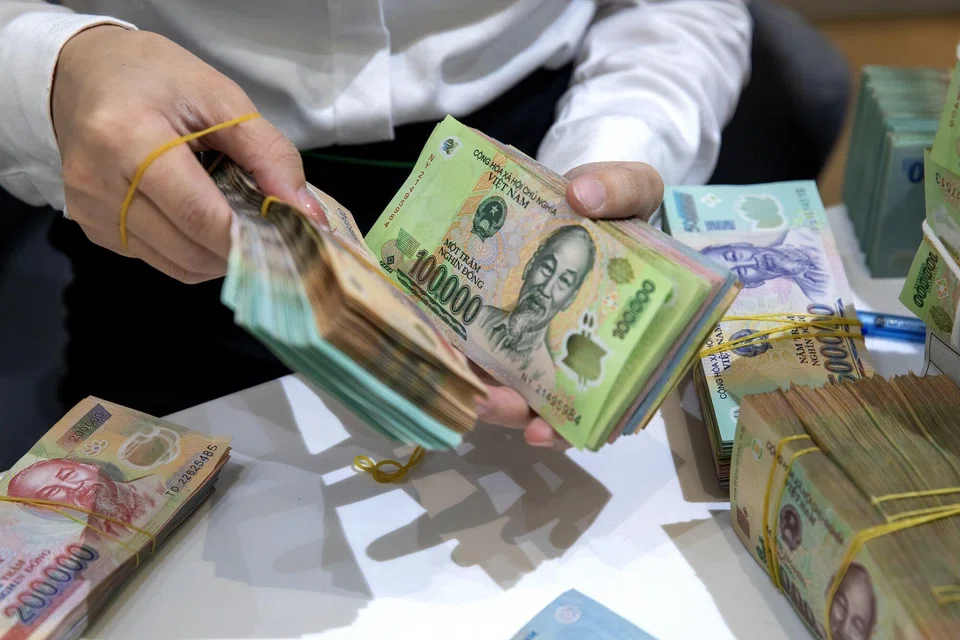
[HO CHI MINH CITY] The Vietnamese dong rose after the State Bank of Vietnam (SBV) began selling US dollars to credit institutions on Monday (Aug 25) through so-called “cancellable” forward contracts, in an effort to stabilise the foreign exchange (FX) market.
While the regulator’s move is viewed as a measure to ease the upward pressure on the USD/VND exchange rate, analysts expect these gains to be limited, with the dong continuing to underperform against major and regional currencies.
“I think the latest move by SBV... should slow the pace of Vietnamese dong depreciation, but is unlikely to change the path and direction,” noted Michael Wan, senior currency analyst at MUFG Bank.
The intervention, conducted from Aug 25 to 26 through 180-day forward contracts at a fixed rate of 26,550 dong per US dollar, contributed to a decline in spot prices last Friday, when the announcement was made.
This fall continued into Monday, to around 26,300 from 26,400 previously, indicated data compiled by Bloomberg.
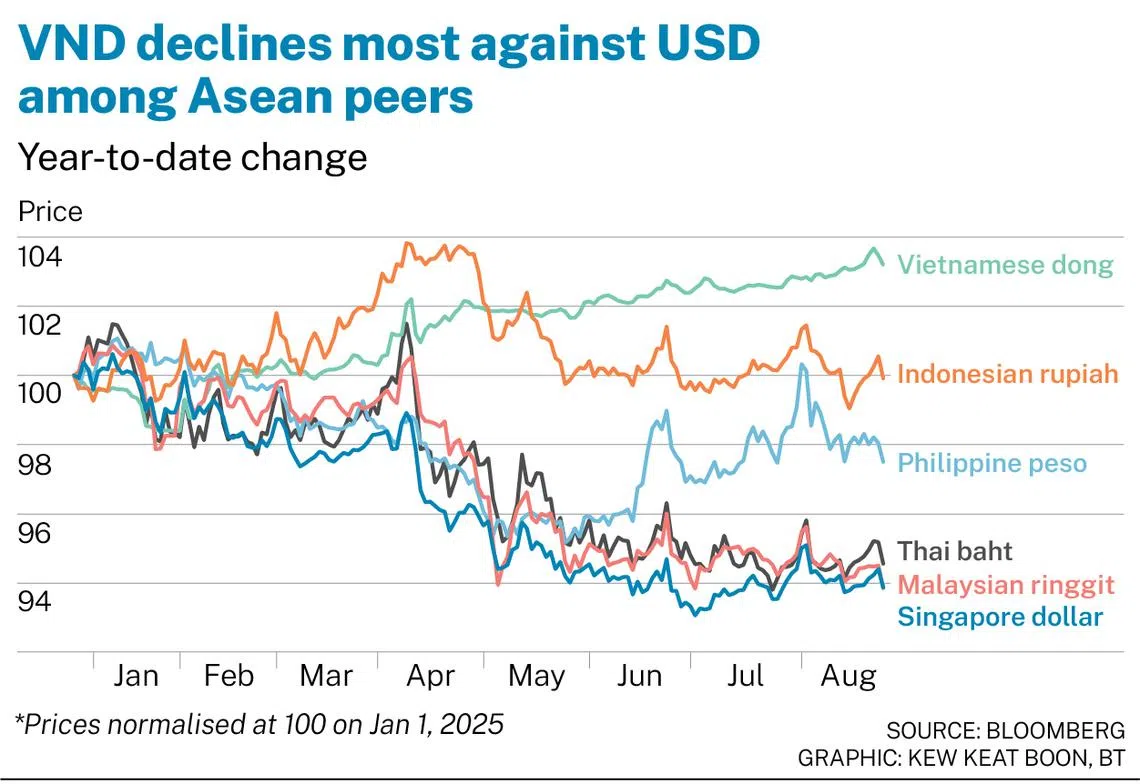
The Vietnamese currency has depreciated by more than 3.2 per cent against the greenback since the beginning of the year, even as the US dollar index has fallen by around 10 per cent year to date. It remains the worst-performing currency in Asean thus far.
The use of forward contracts with an option to cancel before the maturity date could help SBV, the country’s central bank, manage expectations of one-way Vietnamese dong weakening, Wan added.
Since this move does not involve an immediate outright sale of US dollars by the regulator, it is unlikely to impact the country’s FX reserves, which stand at around US$80 billion – equivalent to less than three months’ worth of imports.
“It also allows SBV to sell its US dollars only when Vietnamese dong weakness has gone past a certain threshold, (saving) the central bank’s ammunition for when it is most needed,” he said.
Coping with new tariff rates
Based on its announcement, SBV will also sell foreign currency only to credit institutions and foreign bank branches with negative FX positions and demand for the greenback.
The maximum amount sold to each institution in a single transaction is capped at the level needed to bring its FX position back into balance.
The central bank conducted a similar intervention in January this year, selling the greenback at 25,450 dong per US dollar through cancellable forward contracts, replacing the outright spot sales previously used, which had injected about US$9.4 billion into the market in 2024.
SBV has signalled its intention to keep the Vietnamese dong on a weakening basis against the US dollar. The reference rate, within which the currency is allowed to trade at banks at up to 5 per cent on either side, was raised considerably by 0.79 per cent in July. It also hit a record high of 25,298 last Friday.
“USD/VND could be allowed to rise (so Vietnam can) cope with the new tariff rates,” noted Saktiandi Supaat, head of FX research at Maybank. “Even as the US dollar weakens on a quarterly basis, we suspect the Vietnamese dong’s gains will be limited for now.”
External risks, domestic factors
Vietnam clinched a deal with the US to cut the reciprocal tariff rate to 20 per cent, from the 46 per cent threatened earlier.
However, the new levy, which came into effect on Aug 7, is still significantly higher than the average effective tariff rate of about 4 per cent that the US applied to Vietnam prior to the “Liberation Day” tariffs, a report by Allianz Trade indicated.
Uncertainty surrounding the sustainability of Vietnam’s strong export and foreign direct investment persists, driven by a lack of clarity over the scope and severity of US tariffs on transhipped goods, as well as subsequent trade investigations in sectors such as furniture and electronics.
These external risks, combined with domestic factors – including increased import demand tied to accelerated infrastructure spending, a narrowing current account surplus, and stronger credit growth to support economic expansion – have contributed to the Vietnamese currency’s depreciation to date.
“I still view the path of least resistance for USD/VND to continue rising modestly into 2026, implying continued underperformance against (Group of 10) and Asian currencies,” Wan said.