Vietnamese tech talent in hot demand as the world goes digital

Claudia Chong

[HO CHI MINH CITY] Singapore startup Redoc used to get 30 to 40 applications upon listing software engineer jobs in Vietnam.
That was three to four years ago. These days, they count themselves lucky if their online job posting stays on page one for more than a day.
Intense competition for tech talent across industries and stages has squeezed startups like Redoc, to the point where it now gets a tenth of the applications that it used to.
The squeeze hasn’t stopped companies all over the world from wanting to build their teams there. Vietnam is home to one of the hottest hubs for software engineering, owing to its vibrant workforce and obsession with science and maths education. The government spends the equivalent of more than 4 per cent of GDP on education, higher than neighbouring countries.
Rapid digitalisation of companies over the past five years has drastically changed the landscape for tech hiring. Salary increases are outpacing other industries, and moonlighting – taking side gigs outside of full-time jobs – is common. The tech fever has apparently pushed some American companies to skip formal interviews, so long as an engineer has the right certifications.
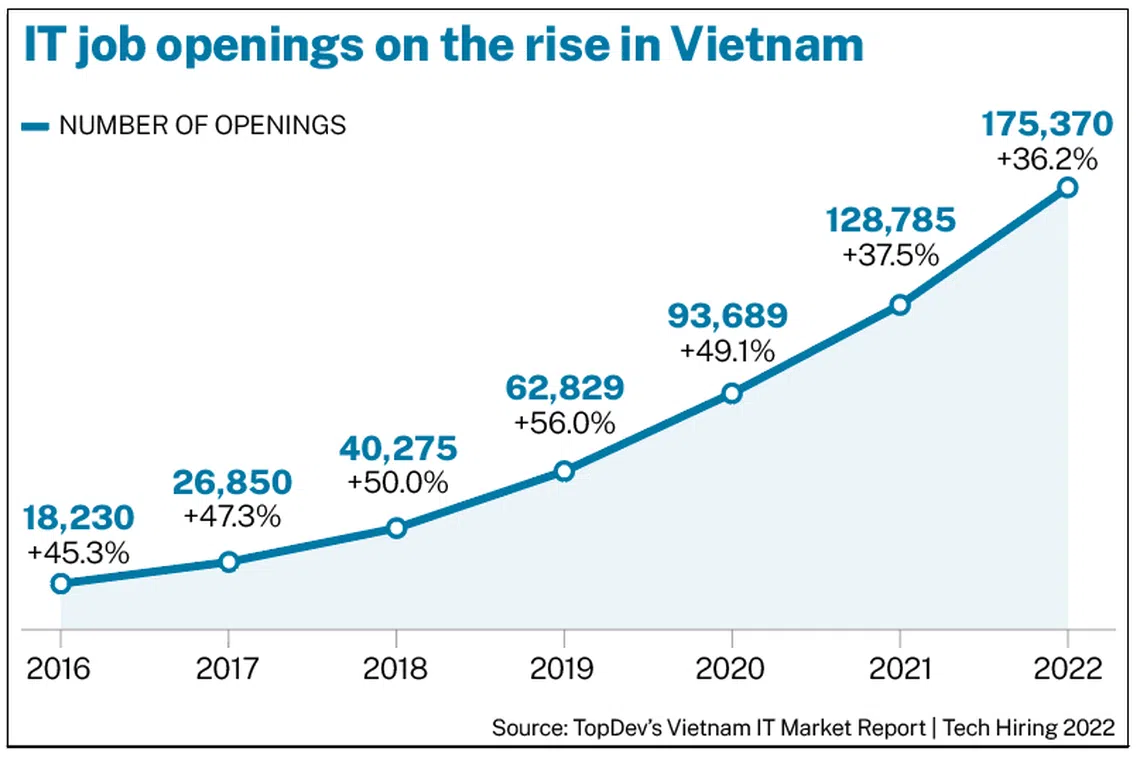
Since 2017, IT job openings in Vietnam have grown more than five times, an analysis by Vietnamese IT recruitment platform TopDev found.
“Candidates can move with a 20 to 40 per cent increase in salary. So when that happens for a prolonged period, like two or three years, all of a sudden you realise the average salaries have gone up,” said Rory Mitchell, a Vietnam-based recruiter at Michael Page.
Web3’s explosive growth and a step-up in remote working have been recent drivers of tech hiring. JobHopin, a talent search platform powered by artificial intelligence, analysed resumes across the market this year and found that those with blockchain-related skills had grown 660 per cent from 2021.
“A smart contract developer with two to three years of experience could make a minimum of US$15,000 (a month) in the US. But in Vietnam, you can hire one for US$3,000 to US$4,000 – about a third of the cost,” said Kevin Tung Nguyen, co-founder of JobHopin. “That’s why there’s a huge arbitrage in terms of tech talent.”
From outsourcing site to tech hub
For years, some of the world’s largest companies developed their core products by outsourcing work to places such as India, China and, to a lesser extent, Vietnam. Since 2017, the country has ranked among the top 10 outsourcing locations by consulting firm Kearney.
More companies turned their attention to Vietnam when it emerged a winner from the US-China trade war and pandemic supply chain crisis. Multinational corporations, such as Apple, shifted some of their manufacturing there to avoid being caught in the crosshairs.
These global organisations are also seeing the country’s potential in software development. The local subsidiary of German company Bosch employs over 3,000 programmers, according to German business newspaper Handelsblatt. South-east Asian tech heavyweights Grab and Sea have built engineering teams in the market over the years.
But even Vietnam’s supply of developers can’t keep up with global demand. TopDev’s report forecasts a shortage of 150,000 to 195,000 engineers annually from 2022 till 2024, when demand is expected to hit 800,000. Each year, only 57,000 students graduate with a major in software development.
Local company CoderSchool is attempting to help fill this gap. Since 2015, over 2,500 people have been through its six-month bootcamp to pick up skills in web development or data science. Doctors, accountants, ministry workers and people of all backgrounds seek out the company for a chance at an early career switch.
“They want to find something different because if you’re an engineer nowadays, you’re not limited by boundaries,” said CoderSchool’s chief of staff Vo Duy Anh. The company is so confident of its graduates’ employability that if any of them fail to find a job within six months of completing the course, they get to take their money back.
Hiring woes
While many companies seek out Vietnamese talent for their quality, one of the biggest hiring challenges continues to be the language barrier.
This has spurred high demand for bilingual product managers who bridge the communication gap between engineers and business development units, said JobHopin’s Nguyen.
Tech JDI, which aids companies with market expansion in Vietnam, has helped clients offer English-language scholarships to software developers. Workers typically have to stay at the companies for one to two years after completing the course.
On the other hand, these companies have some learning to do as well, said Daryl Chung, business development director at JDI.
“We always advise our new clients not to treat their Vietnam team like an outsourcing team. It’s not a client-vendor relationship,” said Chung. “You can’t throw specs at them and constantly chase deadlines. You have to treat them like your colleagues, too. That’s one common mistake – or you won’t be able to retain them.”
The co-founder of Redoc, the Singapore startup, said he is cognizant of this as well. The company has a team of about 20 in Vietnam working on systems to digitalise real estate documentation and transactions.
Communicating with the team had not always been smooth-sailing, but Redoc had always found a way, said co-founder Ivan Lim.
“Our first couple of engineers did not speak so well, but they improved. If they’re not comfortable, it’s about making them comfortable,” said Lim.
“If not, in the worst-case scenario, just draw. I did that when I communicated with my first developer – I drew out everything and how I envisioned it to be. You have to start somewhere. At the end of the day, it’s just communication.”
This story is part of an ongoing BT regional series on South-east Asian markets. In the coming months, BT journalists will head to different countries in the region to bring you the latest from the ground.