Vietnam’s clean energy transition slowed by inadequate regulation and grid despite solar boom

Sharon See
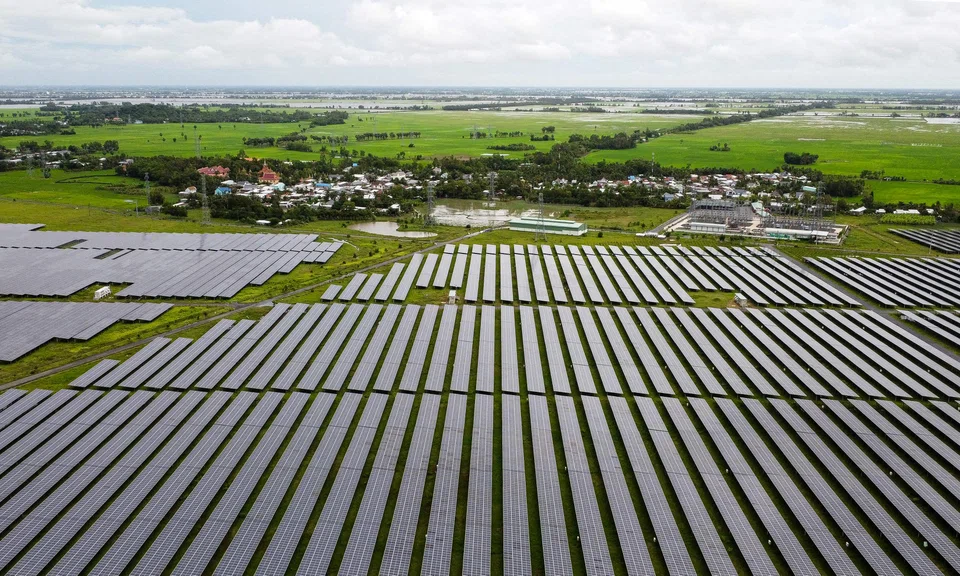
WHILE Vietnam has made striking progress in the last five years to jumpstart its solar energy generation capacity to the point that it is now the leader in Asean, watchers said the country’s transition to a clean energy future is hindered by underdeveloped regulations and grid inadequacy.
Vietnam catapulted to pole position in South-east Asia in 2019 with solar capacity reaching 4,750 megawatts (MW), from just 86 MW in the previous year, according to data compiled by researchers Thang Nam Do and Paul Burke.
Thailand, which up until then had the largest capacity for solar power generation in the region, stood at 2,987 MW the same year.
By end-2020, Vietnam’s capacity had more than tripled to 16,500 MW, exceeding even the Vietnamese government’s solar target for that year at 850 MW.
The country’s meteoric rise was driven by a generous feed-in-tariff (FIT) that quickly drew widespread interest from both large and small project developers.
But despite Vietnam’s exponential pace in capacity building, the country’s transition to using clean energy has taken place much more slowly.
Tepid transition
In 2021, solar power accounted for slightly over 10 per cent of the country’s electricity generation, up from 2.25 per cent in 2019, according to data from Glasgow-based energy think tank Ember. Nearly two-thirds of Vietnam’s electricity comes from coal and gas.
One reason is that most coal-fired power plants in Vietnam were developed under a build-operate-transfer (BOT) programme, Tran Van Trung, director and head of power at KPMG in Vietnam, told The Business Times (BT).
This means that relevant BOT documents, including power purchase agreements, are fixed for 25 to 30 years with certain government guarantee of undertaking.
“For the time being, there has been no clear pathway for this, but recently we understand that the Asian Development Bank is studying to buy and then retire BOT plants earlier than their BOT term,” he said.
Reducing coal dependency may require nothing short of a “complete overhaul” of the power system to accommodate a significant shift in capacity mix towards greater reliance on renewable energy, said Achmed Shahram Edianto, Asia electricity analyst at Ember.
But a known challenge with renewable energy is that its stability is dependent on external factors, such as the weather or season, industry watchers said.
“Vietnam already had difficulty connecting all their transmission networks across the whole country,” said Tan Wooi Leong, energy and industrial managing director at Surbana Jurong. “Now we’re adding another dimension of difficulty – the intermittency and seasonality – into the grid.”
This would inadvertently create more challenges in terms of the stability and reliability of the grid, he said.
Hence, any replacement for coal would need to be a power source that is considered stable, said Tran, adding that liquefied natural gas (LNG), the cleanest form of fossil fuel, is being considered.
But the current fuel crisis has caused LNG prices to spike, he said. “If such high prices are prolonged, it will have significant impact on the transition plans of Vietnam.”
Dr Edianto said other supply-side issues could stymie the level of renewable energy penetration. These include the lack of flexible capacity to accommodate rising outputs from variable wind and solar capacity and domestic electricity market oversupply.
Solar energy producers have reportedly been asked to turn off their solar panels as transmission lines that connect these projects to the national grid could not deal with the glut, Aljazeera reported in May.
Surbana Jurong’s Tan said there is a need to take a holistic approach in any green energy transition, even if Vietnam’s FIT programme was “well-designed”.
“The generation is only one piece, there’s also the transmission and distribution, and also the application,’ he said.
While state-owned power company Vietnam Electricity (EVN) is paying attention to this, said Tran, there has been limited resources and progress, particularly since the private sector cannot invest in transmission lines.
“This issue indeed has significant impact on the renewable investment environment, but it should not hold back the transition plan of Vietnam,” he said
He believes the upcoming Power Development Plan 8 (PDP8) policy draft is likely to address the issue and map a clear pathway forward.
The researcher Dr Do, a research fellow at the Crawford School of Public Policy in the Australian National University, said it is necessary to strengthen EVN’s technical capacity in handling a higher penetration of both solar and wind power.
He added that such curtailments and associated bankability issues of power purchase agreements have posed high investment risks, and that lowering these risks would significantly open up financial sources for renewables.
More robust regulation
To remain attractive for long-term investors, Surbana Jurong’s Tan believes the solar industry also needs a stronger regulatory framework.
During the initial boom, there was a “mad rush” among many players to enter the market, which he said had a very low barrier to entry.
Typically, a resource assessment needs to be done ahead of a project to show the energy yield expected from the renewable assets over, say, a 25-year period.
Surbana Jurong, as an urban development consultancy, then does technical due diligence for lenders to assess the accuracy of these assessments while it also lends its technical expertise to local governments.
“Some of these assets are not performing to what the results yield was showing at the beginning,” said Tan.
This could be due to various reasons, including the climate crisis, which may have affected the seasonality of wind or solar irradiance, he said, and such externalities need to be taken into consideration from the start.
In some cases, he reckons the technical assessments may not have been done properly at the beginning during the “mad rush”.
“It is not just about designing a solar project, it is about looking at the whole life cycle of the whole project. You need to understand the operability and maintainability of the project in the long run,” he said.
This has led to a number of “sell-offs” of renewable assets, while lawsuits may be on the horizon for others, he said.
Seasoned investors that prioritise environment, social and corporate governance (ESG) as well as those lured by promises of carbon neutrality to build factories in Vietnam would be on the lookout for any possible greenwashing, he added.
But profit-hungry businesses may have other ideas, said Lee Wei Yik, chief executive and co-founder of Advanced Vision Analytics (AVA), a Singapore-based firm that uses a combination of drones, Internet of Things and data analytics to inspect the health and performance of solar panels.
Lee told BT he used to be a project manager whose bosses demanded solar panels that are of “German quality, the best one that you can find in the market”.
But after starting his own business, he realised this may not be the case for cost-conscious businesses, and it depends on whether they are taking a short-, medium- or long-term view.
“(Some businesses) only think, ‘I build a plant today, and I want to sell tomorrow’. So why would they spend a lot of money for it to last 20 years? It’s definitely not his concern, and it’s a very business mindset,” he said.
Surbana Jurong’s Tan said this is why a strong regulatory framework is needed to oversee the way solar assets are designed, built and operated.
“As long as they have this regulatory framework in place, then it is very difficult for any developer to just come in and try to show that they are just building and building, and then they run or sell off,” he said.
This story is part of a new BT regional series on South-east Asian markets. In the coming months, BT journalists will head to different countries in the region to bring you the latest from the ground.