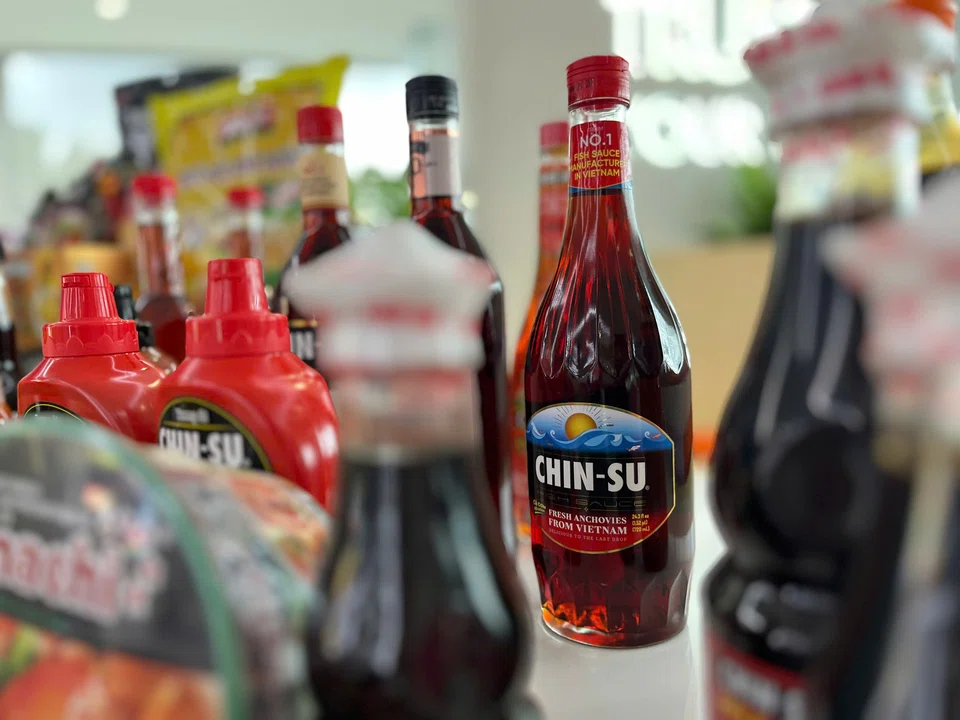
Vietnam’s condiment king Masan Consumer wants to spice things up in South-east Asia, China
The maker of household brands such as Chinsu, Nam Ngu and Omachi aims to double global revenue share in three years

[HO CHI MINH CITY] With its move to the big league – the Ho Chi Minh City Stock Exchange (HoSE) – slated for this month, Vietnam’s leading condiment maker Masan Consumer is saucing up its global expansion.
It is strengthening marketing and distribution efforts for multi-brand entry in neighbouring markets from Laos, Myanmar and Cambodia to southern China.
“These markets share Asian consumer habits and tastes, as well as a similar consumption level and purchasing power with Vietnam,” said Masan Consumer chief executive Truong Cong Thang at a recent roadshow on its upcoming upgrade to the main bourse.
The fast-moving consumer goods (FMCG) giant is known as a “cash cow” and a “precious family gem” of Masan Group – one of Vietnam’s largest private conglomerates.
The local champion in the FMCG space dominates the market of more than 100 million people with five major household brands: Kokomi and Omachi instant noodles, Chinsu condiments, Nam Ngu fish sauce, and Wake Up 247 energy coffee drinks.
“We are expanding our portfolio of five strong brands, each generating over US$100 million in revenue, to 16 by 2030. Some of these brands will be taken global,” said Thang.
The five brands, which are fixtures in almost every kitchen, collectively contributed 70 per cent of Masan Consumer’s total revenue growth last year.
Apart from Asia, Masan is also entering countries with large Vietnamese communities such as the US and Europe.
However, he added that efforts to expand will be measured in markets where local brands have already established a strong foothold.
Last year, international business accounted for 4 per cent or US$51 million of total revenue. The consumer juggernaut wants to crank that up to 10 to 15 per cent by 2028 to 2030. This year so far, the international segment has contributed 5 per cent of total revenue.
Operating margin from international business came in at an impressive 30 per cent in 2024, Thang said, adding that it’s not just about exporting products to the over 25 countries the group has a presence in but building strong global brands for Vietnam’s coffee, noodles and sauces.
Masan Group’s “cash cow”
Founded in 1996, Masan Consumer has transformed from a small business exporting food products to Russia in the late 90s to a powerhouse in the domestic consumer goods industry today.
Its annual revenue stood at US$1.2 billion in 2024. This amount is more than a third of the group revenue, which also comes from Masan Group’s other businesses in retail, mining, telecommunications and financial services.
Masan Consumer’s shares, currently listed on the smaller bourse, the Unlisted Public Company Market (UPCoM), are among Vietnam’s top 10 counters in terms of market capitalisation, with about 226 trillion dong (S$11.1 billion) as at Monday (Dec 8).
According to a 2024 report by Frost & Sullivan, Masan Consumer is a leader in Vietnam’s spice market, with a 68.8 per cent share in fish sauce, 67 per cent in chilli sauce, and 52.9 per cent in soy sauce.
It also holds a 30 per cent market share in instant noodles and 17 per cent in instant coffee drinks.
Like China a decade ago
Masan Consumer has been undergoing a transformation initiated in 2020, focusing on product premiumisation, out-of-home consumption and a “go global” strategy.
The first two shifts are specifically crafted for the local market, reflecting the view that Vietnam is at a stage similar to China’s 10 years ago, said Nguyen Truong Kim Phuong, Masan Consumer’s chief marketing officer, during the roadshow.
The premium and mid-range segments currently account for roughly 50 per cent of Vietnam’s overall market, while they have grown to 80 per cent in China over the past decade.
With Vietnam’s per capita gross domestic product of around US$5,000 per year, Phuong believes this is one of the early signs for the shift towards premiumisation and ready-to-eat food, in which consumers are increasingly prioritising quality and convenience.
Deputy chief executive Le Thi Nga, who oversees Masan Consumer’s research and development (R&D) team of more than 150 people, said the company has also set a goal for R&D to generate 10 per cent of its annual revenue, as well as achieve gross margins of 42 per cent and above for any newly created products.
“As the success rate for innovation in the sector is quite low – in Asia, only about five out of 100 new products succeed – we need to move faster and stay ahead of the curve,” she added.
Nga noted that Masan Consumer launched about 1,200 products from 2002 to 2024, with 20 per cent attaining sustained revenue growth and profits. New products generated about one-fifth of the firm’s total revenue between 2017 and 2024.
Fish sauce for steak?
Masan established its largest fish-sauce fermentation factory in Phu Quoc in 2007, introducing modern quality-control standards to a traditionally artisanal industry and pushing for consistency in every bottle. Today, the facility supplies about 83 million litres of fish sauce concentrate a year.
While coffee and noodles can be more universal to global tastes, fish sauce – locally known as “nuoc mam” and made from a fish and salt mixture – is a niche product that is often associated with South-east Asian cuisine in Vietnam and Thailand.
Much like how Coke complements a burger in Western culture, fish sauce is essential to Vietnamese dishes such as pho and spring rolls, be it as a dip, marinade or seasoning.
Masan Consumer’s overseas research has driven it to tailor fish sauce to local tastes. In Russia, for example, it is developing a milder version that chefs can use to lift dishes such as beef steak without overpowering their flavour profiles.
“Even with just a drop of fish sauce, diners can’t quite put their finger on it, but they’ll say, ‘there’s something special here, something unusual’,” Nga said, describing how foreign consumers might come to appreciate the distinctive savoury depth and umami of Vietnam’s fish-sauce traditions.
Shift to larger bourse
Since 2017, Masan Consumer’s shares have been traded on UPCoM, a small bourse seen as a transit station before official listings on HoSE.
Masan’s leadership said the planned bourse shift will improve Masan Consumer’s market liquidity and margin trading, strengthen corporate governance and provide a more robust platform for attracting international investors.
The company has no immediate plans to raise capital through new share issuances following its HoSE listing, but remains open to bringing in strategic investors who can support Masan Consumer’s “go global” ambitions.
The listing is also expected to lift valuations for both Masan Consumer and its parent, Masan Group, whose HoSE market capitalisation of about 113 trillion dong is currently about half of Masan Consumer’s value on UPCoM.
For the first nine months of FY2025, Masan Consumer reported a 16.2 per cent fall in net profit to 4.6 trillion dong, on the back of a 3.1 per cent drop in net revenue to 21.3 trillion dong.
For the most recent third quarter ended September, the company’s net profit fell 19.1 per cent to 1.7 trillion dong. It attributed the slowdown to a strategic transformation in its general trade channels with a “retail supreme” distribution model to connect directly with retail outlets.
This was aimed at reducing traditional intermediary layers while improving inventory control and market responsiveness.
“This is the short-term decline… We have seen some early signals of a return to growth from the fourth quarter as direct coverage roll-out was completed nationwide,” said Huynh Viet Thang, chief financial officer at Masan Consumer’s community day in October.
TRENDING NOW
Grab CEO’s wife Chloe Tong on life with Anthony Tan and finding her purpose
He built the Vingroup empire. Now South-east Asia’s richest man is handing some key roles to his sons
HDB reviewing ‘jumbo’ flat scheme after Telok Blangah unit listed for sale at S$2.18m
What role can Japan play in Asean’s future?