Asean Business logo
SPONSORED BYUOB logo

Vietnam’s e-commerce last-mile war: Why Ninja Van and LEX bowed out

Next battleground is the race for parcel volumes outside giants like Shopee, TikTok Shop

Summarise
Jamille Tran
Published Thu, Mar 19, 2026 · 03:50 PM
    • Logistics companies are losing grip on demand, service standards and pricing to major e-commerce platforms, eventually leading to just a few large players standing.
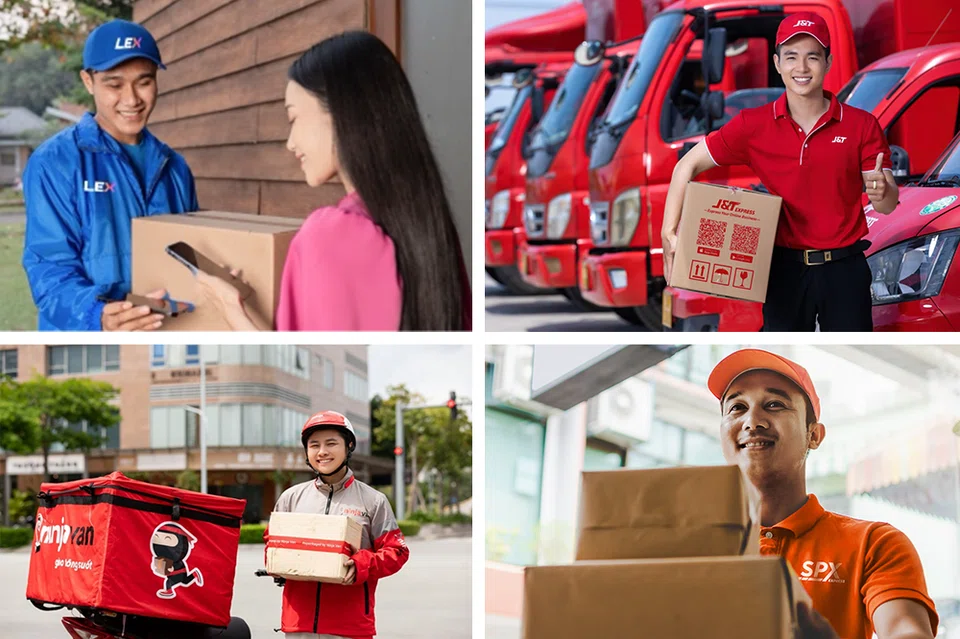
    • Logistics companies are losing grip on demand, service standards and pricing to major e-commerce platforms, eventually leading to just a few large players standing. PHOTOS: LEX, J&T, NINJA VAN, SPX

    [HO CHI MINH CITY] After years of breakneck expansion and intense competition, Vietnam’s e-commerce logistics sector appears to be entering a cold season of consolidation.

    Two high-profile logistics players – Singapore-headquartered Ninja Van and, more recently, Flex Speed (LEX), the logistics arm formerly under Lazada – have exited Vietnam’s express and last-mile delivery services, respectively, within a span of six months.

    Ninja Van’s Vietnam country head Yeung Kin Lok told The Business Times that “concentration risk” was one of the main challenges in Vietnam’s e-commerce logistics. The Singapore firm ceased its express delivery service – tied mostly to e-commerce platforms – in the country last September, ending a nearly decade-long presence in this segment.

    “We always need to be prepared for a price war or further consolidation, especially if platforms begin prioritising in-house (arms),” said Yeung.

    The retreat of the delivery specialists, both backed by Chinese e-commerce giant Alibaba, signals a deeper shift.

    As Vietnam’s more than S$20 billion e-commerce market consolidates into a duopoly – Shopee, the marketplace unit of Singapore’s Sea, and TikTok Shop, the social commerce platform developed by China’s ByteDance – the power is slipping away from many independent couriers.

    Consequently, two South-east Asian-origin logistics firms are handling most of the sought-after parcel volumes – SPX Express (formerly Shopee Express), which serves as the primary backbone for its associate platform Shopee, and J&T Express, whose growth is fuelled by a tight partnership with TikTok Shop.

    “The situation in South-east Asia is that the platforms themselves allocate parcels to logistics partners... (based on the) most competitive price and service level,” said Li Jianggan, founder and chief executive officer of Momentum Works, a Singapore-based digital commerce advisory firm. 

    This differs from China, where sellers on the platforms typically choose their delivery providers.

    As a result, logistics companies are losing grip on demand, service standards and pricing to major e-commerce platforms, eventually leading to just a few large players standing.

    That is shifting the battleground – it is no longer about who can build the largest network to serve the major marketplaces, but who can secure parcel volumes outside the so-called walled gardens of the dominant platforms.

    Platforms set the rules

    Vietnam’s e-commerce boom has driven rapid growth in parcel volumes. But it has also concentrated power upstream.

    In 2025, revenue across the country’s four largest platforms – Shopee, TikTok Shop, Lazada and Tiki – reached an estimated 429.7 trillion dong (S$20.9 billion), up nearly 35 per cent year on year, based on data platform Metric.

    Shopee and TikTok Shop now collectively control about 97 per cent of the total revenue on Vietnam’s e-commerce platforms, making them the primary sources of the most valuable demand: large, dense and predictable order flows that determine cost efficiency for logistics providers.

    Nguyen Van Linh, whose firm Duc Long Transport and Express was a logistics vendor for Ninja Van in Vietnam from 2018 to 2025, noted a gradual decline in parcel volumes from other marketplaces such as Sendo, Tiki and Lazada. This was alongside the rise of deep-pocketed logistics players able to sustain low pricing over extended periods.

    This shift has weighed on the throughput Duc Long handled via its partnership with Ninja Van, he pointed out.

    His firm’s fleet utilitisation, involving more than 120 vehicles – including about 100 trucks owned by Ninja Van – has fallen alongside declining loads per trip, particularly since last year.

    “Amid fierce competition, transport companies must meet multiple requirements simultaneously, including faster delivery times and lower fees over time,” he said, noting that this comes even as fuel and labour costs continue to rise annually due to inflation and shifting market conditions.

    “We were unable to adjust transport rates and service fees upward since 2022.”

    Fragile e-commerce logistics models

    The industry’s dominant logistics models are showing structural weaknesses.

    SPX and LEX, linked to Shopee and Lazada, respectively, appear to have an edge over independent players, as they can secure large volumes and tightly align operations with demand.

    But the in-house model has limits.

    LEX’s pullback in Vietnam’s last-mile delivery highlights the difficulty of sustaining a massive logistics infrastructure without sufficient scale from its associate platform. Lazada, once a market leader, now holds less than 3 per cent market share in the country.

    In a move to diversify away from their related marketplaces, LEX, and even larger players such as SPX, face a structural ceiling: rival platforms are unlikely to route big volume through a competitor’s logistics arm, Momentum Works’ Li pointed out. That leaves platform-linked networks dependent on the very ecosystems they serve.

    A second model – neutral, multi-platform logistics – has proven even more fragile.

    Players such as J&T and Ninja Van built their businesses by serving logistics needs of various marketplaces. But as the market consolidates around a few dominant players, neutrality becomes harder to sustain, especially if TikTok Shop eventually develops its own delivery arm.

    The fallout has widened.

    Linh told BT that his company is now on the brink of collapse following Ninja Van’s pullback. Duc Long has also filed legal action against Ninja Van over unpaid service fees totalling about 28 billion dong.

    In an e-mail response to BT, Ninja Van CEO Chang Wen Lai confirmed the contractual dispute with a vendor in Vietnam, saying certain obligations under the agreement were not fulfilled, directly affecting the sums in question.

    Ninja Van and its investors have borne large losses over time. The company has raised a total of about US$1 billion in disclosed funding. As at June 2024, it was still in the red with an accumulated loss of S$468.8 million.

    Christopher Beselin, chairman of Intrepid Asia, an e-commerce and digital solutions provider headquartered in Singapore, highlighted the vicious circle of the capital-intensive e-commerce logistics game in South-east Asia.

    “If you don’t have the volume, you can’t offer competitive prices. If you can’t offer competitive prices, you’re never going to get the volume,” said Beselin, who was also CEO and co-founder of Lazada in the 2012-to-2014 period. 

    “It’s capacity utilisation versus volumes, versus how much funding you have,” he added.

    That combination has effectively reset market benchmarks, forcing other logistics providers to either match those metrics or risk exiting the market.

    The off-platform battle

    But profitability is not elusive amid the price war and funding intensity, particularly for some efficient players.

    As J&T’s parcel volume across South-east Asia surged about three times during the 2022-to-2025 period, its unit cost per parcel also fell by about a third, based on data compiled by Momentum Works. The company achieved its first full-year net profit in 2024.

    “Better margins will not come from actually charging higher prices,” Li said. “It comes from density and cost optimisation.”

    But platform-driven demand, though essential, is constraining. According to industry practitioner Nguyen Phuc, who helps Vietnamese shop owners manage deliveries to buyers, local merchants are becoming less reliant on e-commerce platforms.

    “Due to updated tax rules and buyers’ abuse of return and refund mechanisms, many sellers in Vietnam are no longer keen on operating through those e-commerce marketplaces,” he added. “Platform commissions are also too high these days.”

    As a result, logistics providers are increasingly pursuing off-platform volumes to diversify and mitigate concentration risks.

    Phuc noted that SPX has aggressively expanded beyond Shopee, and has highly competitive rates to capture external demand. The logistics firm also offers attractive policies and pricing for sellers with large order volume outside platforms.

    “SPX is performing well not only in pricing, but also in the delivery time – the most important factor affecting sellers’ choice of delivery provider,” Phuc added.

    Ninja Van, meanwhile, is pivoting towards business-to-business (B2B) contracts and cross-border logistics, where margins tend to be higher, clients are stickier, and demand aligns more closely with Vietnam’s growing industrial and manufacturing sector. 

    While maintaining certain involvement in e-commerce logistics in Vietnam, the Singapore firm has effectively exited the business-to-consumer e-commerce segment in the country, giving up what was once a major source of its revenue.

    Yeung noted that other major logistics players serving the biggest e-commerce platforms are also working to strike a balance between e-commerce and B2B services.

    “I think Vietnam is one of the markets where its supply chain is moving beyond e-commerce logistics,” said Yeung. “The diversification has begun at the point when we all realised that e-commerce wouldn’t go on forever... We have been constantly looking for areas to hedge ourselves against.”