



Vietnam’s e-scooter makers ride on growing demand from delivery giants
Jamille Tran
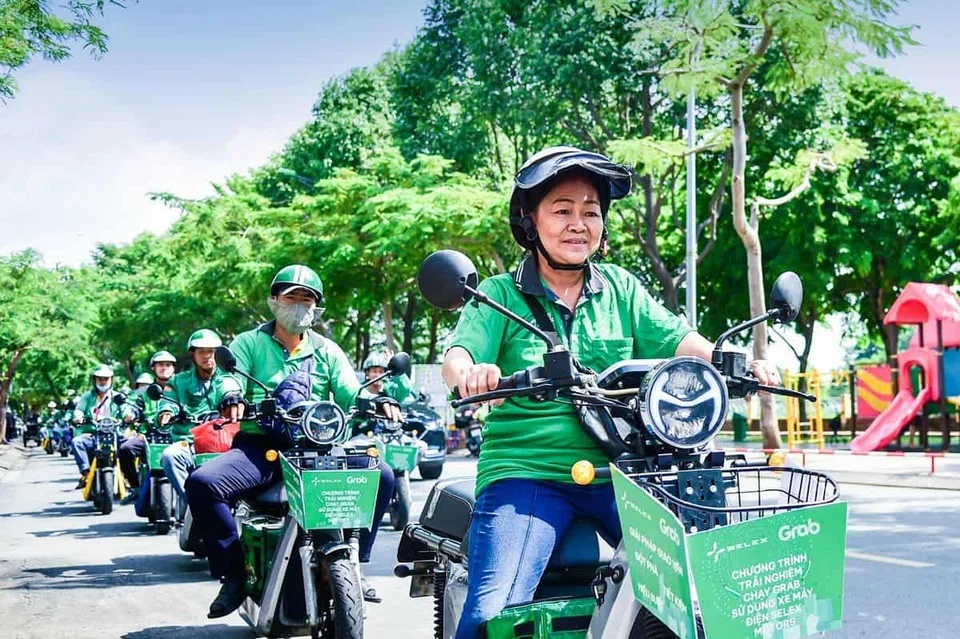
[HO CHI MINH CITY] Walk along any busy street in Vietnam these days and chances are you will see delivery workers zipping on motorbikes as they transport food and all sorts of parcels to homes and offices.
Take a closer look, however, and many of these bikes are actually electric models. Of late, several of the country’s delivery giants have launched pilot projects with electric vehicle (EV) makers, as they weigh the benefits of using electric motorbikes amid growing pressure to go green.
The likes of Grab and Gojek, as well as local players such as Be and AhaMove, have been busy rolling out their electric fleets in recent months.
Last September, AhaMove and EV maker VinFast launched AhaFast – the first electric-motorbike-based delivery service in Vietnam – in the central city of Da Nang. AhaMove purchased an initial fleet of 150 motorbikes from VinFast for delivery workers to rent, and the company wants to grow this number to 1,500 by this year.
Earlier this year, Be launched an app feature for their customers to book a ride or a delivery using VinFast electric motorbikes, while Lazada Logistics started using such vehicles for deliveries in Nov 2022. Lazada Logistics said the size of its electric fleet in Vietnam had grown to 100 as at the end of April.
Accelerating the transition
Indonesian ride-hailing and delivery service giant Gojek in May announced a tie-up with Vietnam’s Dat Bike to use the latter’s electric motorbikes for transportation, logistics and food deliveries. Grab has previously said that an electric motorbike’s operating costs are roughly a quarter of a petrol model’s.
Son Nguyen, the chief executive of Dat Bike, said in May that this project with Gojek is part of his company’s goal to convert all petrol bikes to electric ones in Vietnam and eventually South-east Asia.
“Through this pilot, Dat Bike aims to persuade more users, including tech platform drivers, about the power and convenience that electric motorbikes can offer. It also aims to accelerate the transition to greener transportation for a better environment,” he said.
Separately, Grab’s delivery service GrabExpress and South Korea-based food delivery service Baemin also announced their pilot programmes with Selex Motors, a Hanoi-based e-scooter maker with a battery-swopping ecosystem.
“The pilots have resulted in favourable feedback from our driver-partners and promising reduction of gas emissions,” Grab Vietnam’s representative told The Business Times after the company completed a six-month trial with Selex’s e-scooters in Hanoi in May. “In order to scale up over time, more partnerships should be explored and more pilots have to be done to better understand the benefits and challenges.”
The spokesperson said that Grab Vietnam’s transition to EVs is still at an early stage, with hurdles such as a lack of affordable EV models, inadequate charging infrastructure and a shortage of battery-swopping stations.
Apart from Vietnam, several other countries in South-east Asia are also experiencing a greater shift towards using EVs when it comes to delivery services.
In Indonesia, for instance, Gojek in 2022 partnered Taiwan-based EV maker Gogoro to operate up to 5,000 e-scooters and at least four battery-swopping stations in Jakarta.
Singapore-based Grab has also been busy growing its EV fleet in Indonesia over the last four years, which currently stands at 8,500 units. In 2019, it introduced its first batch of EVs in collaboration with Hyundai, Astra Honda Motor and Indonesian e-scooter marker Gesits. In 2021, Grab placed an order for 6,000 e-scooters with manufacturer Viar Motor Indonesia.
Switching to electric
On the whole, there seems to be a growing embrace of electric motorbikes. As indicated by figures from data-tracking platform Motorcycles Data, sales of electric motorbikes in Vietnam grew by 10 per cent year on year in 2021.
For South-east Asia as a whole, GWI – a London-based consumer data platform – noted in a recent report that sales of electric motorbikes are also on the rise.
The report found that 5 per cent of consumers in South-east Asia purchased an e-scooter in the last three to six months, which translates to about 14.7 million e-scooters across the six key Asean markets of Indonesia, Thailand, Vietnam, the Philippines, Malaysia and Singapore.
Around 8 per cent of consumers in the region indicated their intention to buy an e-scooter in the next two quarters, which GWI said would grow the e-scooter market to 24 million units.
TRENDING NOW

Government to bring forward raising of retirement age, give employers more financial support to create flexi-load jobs

If Europe goes to war, the fallout will be felt in East Asia

Indonesia stocks suffer worst plunge in nearly 30 years as MSCI proposes standalone status

Vietnam’s northern provinces, not Hanoi or Ho Chi Minh City, are powering near 10% GDP growth

