Vietnam’s exports fall further in August; growth outlook weak
Jamille Tran
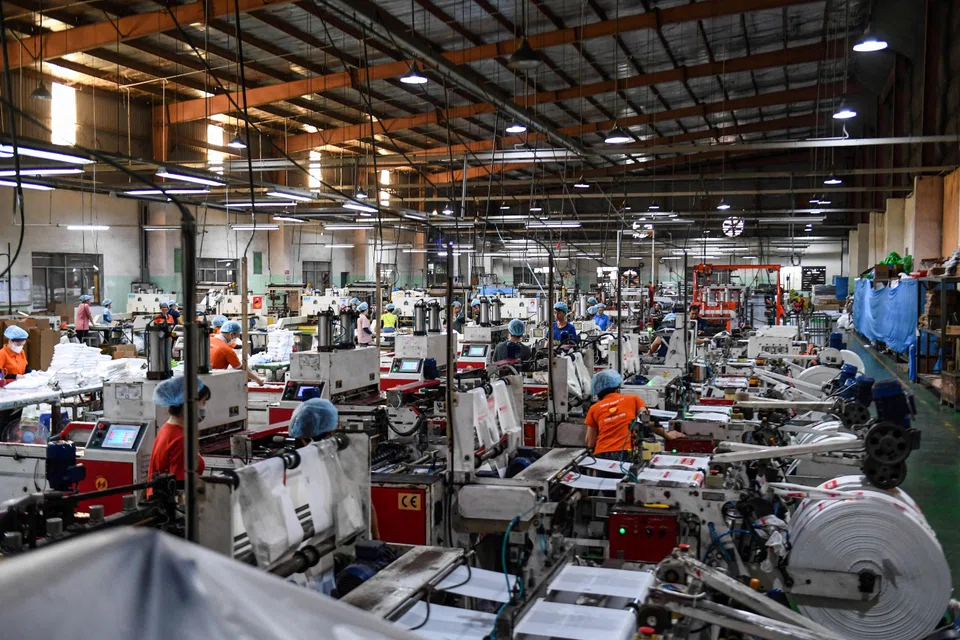
[HO CHI MINH CITY] In August, Vietnam’s exports extended their longest slump in 14 years and retail growth slowed, suggesting a weak growth outlook alongside other figures from the General Statistics Office (GSO) on Tuesday (Aug 29).
Exports fell 7.6 per cent year on year, in the sixth straight month of decline, as growth stayed soft in key markets such as the US and China. This was a worsening from July’s 3.5 per cent decline.
Imports fell 8.3 per cent, easing from the previous month’s 9.9 per cent contraction.
The major export category of computers and electronics grew 10.8 per cent, down from 32 per cent in July. Another major category, telephones and components, saw a 14.6 per cent decline, narrowing from 18.4 per cent.
Year to date, exports are down 10 per cent from the year-ago period, at US$227.7 billion. Imports are down 16.2 per cent, at US$207.5 billion.
Dragging growth down
“Vietnam’s trade weakness is not over yet and will continue weighing on growth,” noted Tan Theng Theng, assistant economist at Oxford Economics.
The trade-reliant economy is vulnerable to continued soft growth in key trading partners, he added.
The hope for an export boost from China has “almost disappeared”, as China struggles with weaker economic momentum post-reopening.
Some other figures released on Tuesday showed improvement, though year-to-date growth stayed weak.
Industrial production “maintained its positive trend” in August, said the GSO, with growth rising to 2.6 per cent year on year and 2.9 per cent month on month. But it is still down 0.4 per cent year to date.
Retail sales grew 7.6 per cent year on year, faster than in July and June. Yet for the first eight months, the retail sales growth rate of 10 per cent is lower than the 19.2 per cent rate in the year-ago period.
Throughout the year, month-on-month retail sales growth has plateaued or barely picked up, signalling cautious consumer sentiment amid labour market softness, analysts said.
Missing targets
The government’s full-year growth target is 6.5 per cent. Prime Minister Pham Minh Chinh has said that the aim is for growth of about 9 per cent in the second half.
This is after growth of 4.14 per cent in the second quarter – improving from 3.3 per cent in the first quarter, but much slower than the 7.72 per cent rate in Q2 2022.
Maybank economists said full-year growth was likely to fall significantly short of the target, instead forecasting it at 4 per cent. Oxford Economics’ forecast is 3.9 per cent.
“With the unfavourable outlook of exports and domestic demand, the main driver for the second half’s economic expansion is public investment, which is expected to be accelerated further until the end of the year,” said Long Pham, chief economist at Ho Chi Minh City Securities Corporation.
In the first eight months, investment capital realised from the state budget was estimated at 352.1 trillion dong (S$19.7 billion). This is 49.4 per cent of the planned full-year figure, and up 23.1 per cent from the same period last year.
Registered foreign direct investment capital was estimated at US$18.15 billion as at Aug 20, up 8.2 per cent from the year-ago period.
Upside risk to inflation
While growth prospects remain weak, inflation has slowed. In August, the consumer price index (CPI) rose 2.96 per cent year on year, up from the previous month’s 2.06 per cent rise.
Core inflation – which strips out the costs of food, fuel, healthcare and education services – edged down to 4.02 per cent, from 4.11 per cent before.
For January till August, average consumer prices are up 3.1 per cent from the year-ago period, while average core inflation is 4.57 per cent. The government aims to cap full-year inflation at 4.5 per cent.
However, the CPI rose 0.88 per cent on a month-on-month basis, the strongest growth since January, due mainly to rising prices of transport, education and food.
In the past four months, Vietnam’s inflation has picked up in month-on-month terms, and analysts expect continued pressure from rising global food and energy prices.
Upside risks to headline inflation may complicate the State Bank of Vietnam’s (SBV) upcoming monetary decisions, noted Tan. The SBV has cut key policy rates four times this year, and Oxford Economics expects it to cut the discount and refinancing rates by another 50 basis points each by end-2023.
Other analysts believe the regulator will hold off on another rate cut as the Vietnamese dong fell by 2 per cent against the US dollar compared to its level at the start of this year. However, Hoang Cong Tuan, chief economist of MB Securities, sees it as “unlikely that the SBV will reverse its accommodative monetary policy” as recent exchange rate volatility “has not put pressure on the macroeconomic stability”.
Decoding Asia newsletter: your guide to navigating Asia in a new global order. Sign up here to get Decoding Asia newsletter. Delivered to your inbox. Free.
Copyright SPH Media. All rights reserved.