



Vietnam’s growth push squeezed as inflation hits six-year high, trade gap at 30-year peak
The latest data, amid a softening currency, could pile pressure on policymakers, analysts say

[HANOI] Vietnam’s window to support a double-digit growth target is narrowing as inflation accelerated to a six-year high in April and the trade deficit widened to its largest in nearly three decades.
The latest data could pile pressure on policymakers, already grappling with a softening currency.
“Monetary policy headroom is quite limited in the current context,” said Dinh Quang Hinh, head of macro and market strategy at Hanoi-based brokerage VNDirect Securities. “I believe the responsibility of supporting growth is increasingly shifting to fiscal measures.”
Vietnam’s consumer prices rose 5.5 per cent in April from a year earlier, up from 4.7 per cent in March and the highest since January 2020, according to data from the National Statistics Office of Vietnam on Sunday (May 3).
The increase comes against a backdrop of rising global energy costs amid geopolitical uncertainty, particularly linked to tensions in the Middle East, which have disrupted supply chains and pushed up transportation expenses.
Higher energy costs, with Brent crude prices staying mostly above US$100 per barrel since the Iran war broke out in end February, also contributed to Vietnam’s widened trade deficit, which hit US$3.28 billion in April – the largest shortfall on record since the series began in 1997.
That brings the deficit for the first four months of the year to US$7.11 billion, compared with a surplus of US$4.3 billion a year earlier, adding pressure on the country’s foreign exchange reserves and the balance of payments.
Stronger import growth amid robust domestic demand
Analysts said this trade imbalance also reflected stronger import growth amid robust domestic demand – underpinned by measures to sustain high economic growth – as well as continued strength in export-oriented manufacturing inputs amid a more stable external tariff environment.
However, the combination of rising inflation and a widening trade deficit is complicating the policy outlook. This is more so as the Vietnamese dong shows signs of softening as the State Bank of Vietnam (SBV) prioritises system liquidity and interbank rate stability through open market operations (OMO).
In the first four months of 2026, Vietnam’s banking system saw a broad-based rise in both deposit and lending rates. This was led by intensifying competition for funding and persistent liquidity pressure as credit growth continued to outpace deposit mobilisation.
“The near-term policy response to these price and currency pressures is likely to be liquidity tightening via reduced OMO injections and higher interbank rates,” Oxford Economics’ economist Adam Ahmad Samdin wrote in a note on Monday.
While newly appointed central bank governor Pham Duc An has called for lower interest rates among commercial banks to support business activity and broader economic growth, VNDirect’s Hinh expects meaningful easing to be unlikely in the near term.
“We may have to wait until the second half of 2026 – when inflation stabilises and energy prices cool – before expecting more meaningful reductions in commercial lending rates,” he added.
In terms of policy rates, Maybank economists Brian Lee and Chua Hak Bin expect SBV to keep them unchanged and maintain a stable interest rate environment.
“Despite the elevated inflation environment, the SBV places higher priority on sustaining economic growth in accordance with government expectations,” they noted in an analysis on Monday.
Meanwhile, analysts suggest that the government could also continue rolling out targeted fiscal support for households and businesses, particularly as state revenues through April well exceeded expenditures, leaving room for further stimulus measures.
For example, on Apr 12, Vietnam’s National Assembly extended the zero-rate tax policy on petrol and selected fuel products until the end of June 2026, as part of measures to stabilise domestic fuel prices amid volatile global energy markets.
Infrastructure investment also has further room to accelerate, supported by a pipeline of transport, logistics and energy projects.
“This will support domestic demand, although elevated energy and building material costs will crimp margins,” the Maybank economists added.
Price pressures broaden
Still, price pressures have spread quickly across the economy, raising concerns about second-order effects and a slower dissipation of price hikes.
Transport costs last month jumped 11.1 per cent from a year earlier, while housing and utilities rose 8 per cent, largely reflecting higher fuel prices.
Core inflation – which strips out volatile items – also climbed to 4.66 per cent, the highest since March 2023, suggesting underlying price pressures are building.
For the first four months of the year, inflation averaged 3.99 per cent from a year earlier.
Analysts said the latest data points to faster-than-expected spillovers beyond fuel and food, with inflation in recent months exceeding the country’s target level of 4.5 per cent and likely to remain above it through the second and third quarters of the year.
“The main upside surprise came from food away from home... despite food inflation remaining contained,” Oxford Economics’ Samdin wrote, noting that the eating-out component in Vietnam’s consumer price index rose 8.3 per cent from a year earlier in April.
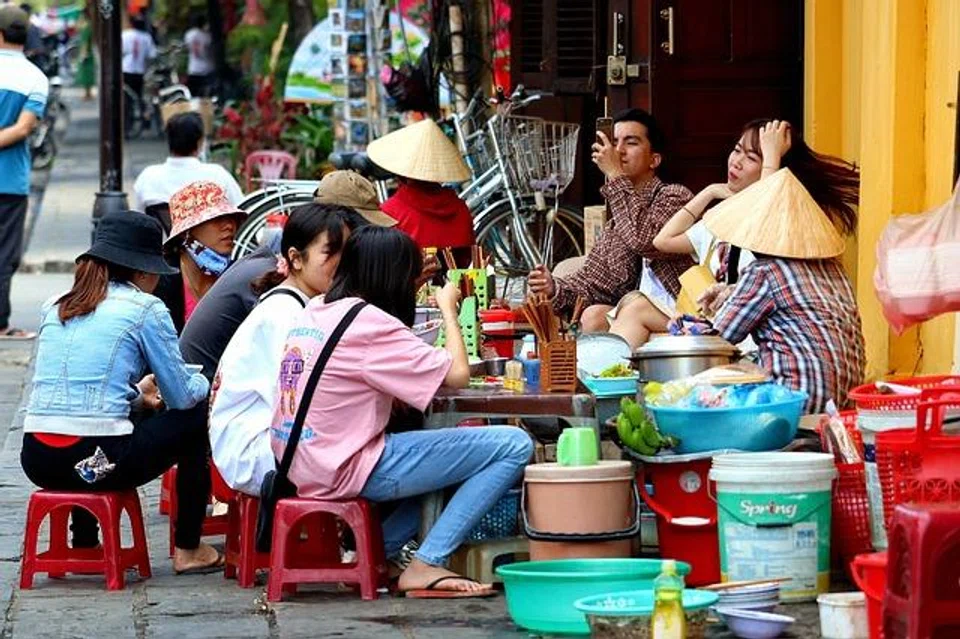
The country’s statistics office attributed the increase to higher input costs – particularly gas – alongside rising labour, rent and operating expenses, forcing businesses to raise prices. Tighter regulation of street-side and pavement-based food businesses in some localities has also contributed to higher selling prices, it said.
“The pricing-up psychology among household businesses is a fairly risky factor in the current environment, because once prices are raised, it tends to create a new price level that is difficult to reverse, even if energy prices ease later on,” Hinh said.
Food price risks may also intensify later in the year, analysts pointed out. Rice planting for the summer-autumn crop in southern Vietnam has been lagging last year’s pace due to higher fertiliser and fuel costs, crop switching and weather concerns, raising the prospect of tighter supply in the second half of 2026.
Rising cost pressures are also feeding into Vietnam’s manufacturing sector.
In an April survey on manufacturing activities, S&P Global found that Vietnam’s purchasing managers’ index, while remaining in expansionary territory, eased to a seven-month low of 50.5 last month, from 51.2 in March, with firms reporting the fastest increase in input costs in 15 years.
Higher fuel and logistics costs weighed on both supply and demand, with new orders contracting for the first time in eight months and export sales declining more sharply, the report pointed out.
Still, surveyed firms remain cautiously optimistic, expecting output to increase over the coming year on hopes of a recovery in new orders and a more stable business environment.
Official trade data also points to still-strong external flows even as momentum softens. Exports last month fell 2 per cent from March but rose 21 per cent year on year to US$45.5 billion in April, stronger than first-quarter growth of 19.1 per cent.
“Looking ahead, export growth should remain resilient owing to strong artificial-intelligence-related electronics demand, with electronics accounting for about 30 per cent of overall shipments,” Maybank economists said.
Decoding Asia newsletter: your guide to navigating Asia in a new global order. Sign up here to get Decoding Asia newsletter. Delivered to your inbox. Free.
Copyright SPH Media. All rights reserved.
TRENDING NOW
LTA proposes combining car COE categories, adding rebate-surcharge system

StarHub to acquire MyRepublic’s mobile business amid ongoing telco consolidation

DBS, OCBC, UOB rout lops billions off STI as inflation, rate concerns spook investors

Grab CEO’s wife Chloe Tong on life with Anthony Tan and finding her purpose

