



Vietnam’s manufacturing sector drawing many Singapore companies to set up shop
Jamille Tran
[HANOI] When foreign investors look at opportunities in Vietnam, the data shows they are typically drawn to the country’s vibrant manufacturing sector.
The latest available figures from the country’s Ministry of Planning and Investment showed the processing and manufacturing industry accounted for just over 60 per cent – or US$16.8 billion – of Vietnam’s foreign direct investment (FDI) of US$28 billion last year.
By flow, Singapore’s investment of US$6.46 billion – accounting for almost a quarter of the total foreign capital investment in 2022 – makes it Vietnam’s largest foreign investor for the third straight year.
And in the first 10 months of 2023, investors from Singapore poured the largest funds of some US$4.65 billion into Vietnam, accounting for slightly under a fifth of the US$25.76 billion in total FDI capital registered in the country.
The Singapore Business Federation (SBF) has been active in Vietnam this year. The apex business chamber brought its flagship Regional Business Forum event overseas for the first time, staging it in the capital Hanoi in July.
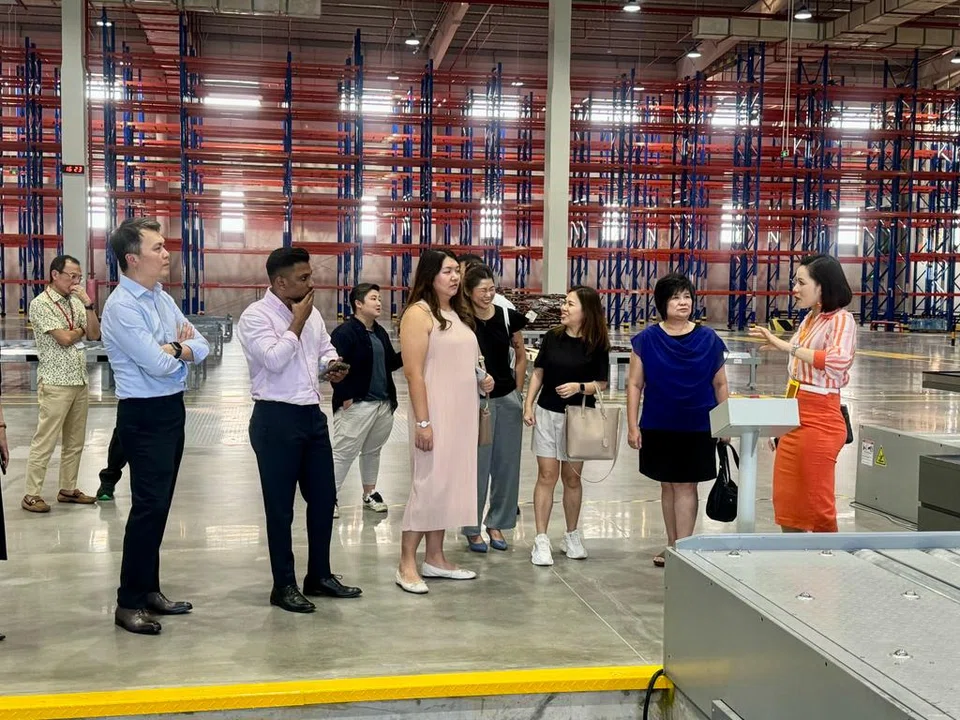
SBF also organised two business missions to Vietnam – the first was in conjunction with the July forum, and the second took place over five days earlier this month. Both trips saw healthy participation from Singapore companies, many of which were startups and small and medium-sized enterprises.
Amy Wee, SBF’s country head in Vietnam, said: “If (companies) don’t want to put all their eggs in one basket and produce everything in China, the next best place (to be in) is obviously Vietnam. Singaporeans also know there is currently a good supply of industrial parks for manufacturing in Vietnam.”
The latest business mission took the participants to Hanoi, as well as Hai Phong (a major port city in north-eastern Vietnam) and Vinh Phuc (a mountainous province north-west of Hanoi).
Wee, who has been bullish on the investment prospects in northern Vietnam, spoke highly of the conducive environment to set up manufacturing facilities there due to the abundant supply of skilled labour and lower production costs.
Among the Singapore companies that are betting big on Vietnam is the electric vehicle (EV) maker Charged Asia, which intends to set up a new factory in the country to produce electric motorcycles. The firm already has a “zero-energy” production facility in Indonesia.
“We see the proximity of northern Vietnam to China as an advantage in terms of our manufacturing and assembly processes, as we have a number of important components from our technology partners in China,” said Charged Asia executive chairman Soh Chun Bin.
The company in August announced a capital raise of up to US$40 million from Singapore Exchange-listed energy provider Geo Energy . Charged Asia plans to sell 10 million electric motorcycles over the next decade in South-east Asia, with Vietnam and Indonesia being its main markets.
“In the long run, it makes more sense to have our own plant in Vietnam to supply and serve the market,” added Soh. “Both Vietnam and Indonesia are good export bases to the rest of South-east Asia and the world.”
Another company that joined the business mission was automotive company Dickson Group. It wants to explore partnership opportunities to bring Vietnamese EVs to Singapore, and expand its live auction system for used cars in Vietnam.
Other participants included IT Technologies and Asher Lechem, which are both hunting for manufacturing sites in northern Vietnam for their respective products of scientific instruments and washing machines.
Vengkatesh Danapalan, the business development manager of IT Technologies, said that the visit to Hai Phong helped convince the company to build a small manufacturing plant in northern Vietnam.
Hai Phong, which is home to 29 industrial parks, hosts the production bases of many multinationals such as South Korean electronics giant LG, Apple’s second-largest Chinese supplier Pegatron, Japan’s leading tyre maker Bridgestone, and Vietnam’s EV manufacturer VinFast.
The city is about 100 km east of Hanoi and an important node of the “Two Corridors, One Circle” connectivity initiative between China and Vietnam.
Hai Phong People’s Committee vice-chairman Hoang Minh Cuong welcomed more Singapore companies to set up shop in the port city, given its long track record of industrial success over the years.
He cited the easy access to materials and diverse modes of transport, a developed infrastructure with vast land area, a reliable electricity supply, and the availability of various investment incentives.
SBF’s Wee said that there is plenty of scope for Singapore and Vietnam companies and investors to partner one another to reap the benefits. “Vietnamese can bring in the local knowledge and network, Singaporeans can bring in the frameworks and standards of how things should be done. That, as a whole, will eventually help Vietnam progress into a first world in no time,” she added.
TRENDING NOW

Things to know about DBS’ incoming chairman Anthony Lim

DBS eyes prime brokerage business as Q3 profit falls 5% on weaker trading income

Royal Group and Sunset Hospitality abandon plans to open Casa Mett hotel off Orchard Road

George Yeo adds 100,000 Wilmar shares at S$2.97 apiece, taking stake to over 1 million shares

