Vietnam’s political strongman Nguyen Phu Trong dies; spotlight turns to potential successors
The Communist Party chief had held the post since 2011 and his tenure was marked by his ‘blazing furnace’ anti-graft campaign and ‘bamboo diplomacy’
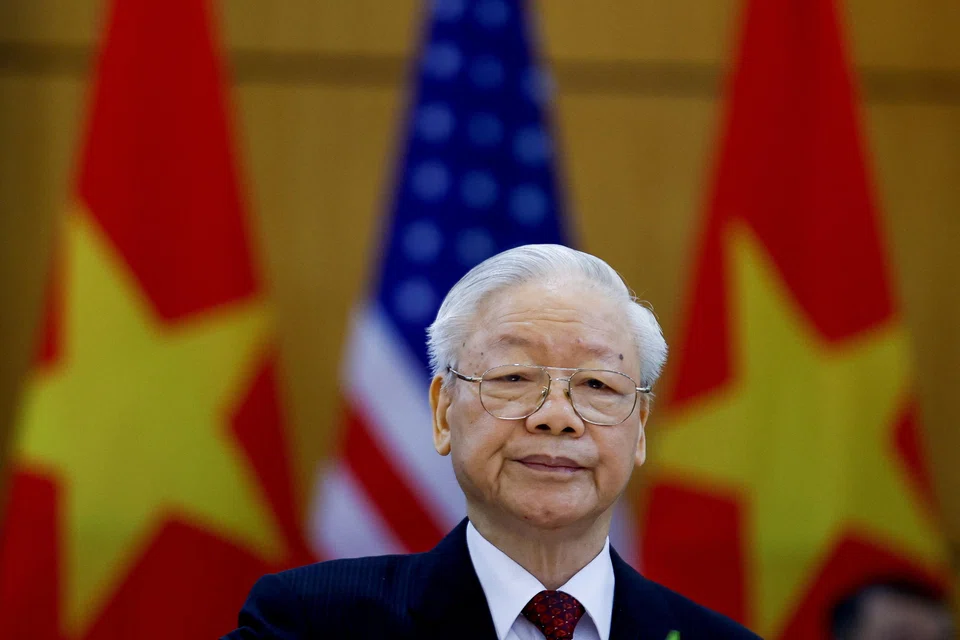
GENERAL Secretary of the Communist Party of Vietnam Nguyen Phu Trong died on Friday (Jul 19) following a serious illness, putting an end to his 13-year tenure as the nation’s most powerful figure. Trong’s death will leave a void difficult to fill given his lengthy tenure, authority and chutzpah, experts say.
This change in the country’s most powerful seat is unfolding amid a politically unstable environment, marked by an unprecedented series of high-level resignations. The departures of two state presidents and a parliament head have upended Vietnam’s longstanding reputation for stable politics.
While, officially, their exits were said to be related to “violations” and “shortcomings” amid Trong’s sweeping anti-graft crackdown dubbed the “blazing furnace”, there are rumblings that they were the result of infighting in the Communist Party.
“Vietnam could potentially face a succession crisis,” noted Le Hong Hiep and Nguyen Khac Giang, fellows at the Vietnam Studies Programme of Singapore-based Iseas-Yusof Ishak Institute.
“Trong’s unparalleled authority, derived from his clean reputation, seniority and long stewardship, creates a void that would be difficult to fill,” they added in a commentary.
News of 80-year-old Trong’s death may not have come as a big surprise, given that he was suffering from age-related issues and had missed several top-level meetings since the beginning of the year.
His departure marks the third major shake-up in the country’s most influential political posts in just four months.
It was only in May that two of the highest-ranking roles – president and National Assembly chairman – changed hands to General To Lam, a former top security official, and Tran Thanh Man, respectively, following the string of key resignations.
On Thursday, the party had announced that President Lam would temporarily take over Trong’s duties as party chief so that the latter could focus on an unspecified health treatment.
Lam, seen as a hardliner aligned with Trong, also serves as deputy head of the anti-corruption committee and is a key enforcer of Trong’s anti-corruption drive.
Since 2021, more than 5,500 people have been indicted across nearly 2,200 graft cases, including several arrests of high-profile business figures and prosecutions of politicians such as a former health minister and a deputy foreign minister.
“The current campaign against corruption and negative phenomena will continue without pause by the new minister of public security under the direction of Lam,” said Carl Thayer, emeritus professor at the University of New South Wales in Australia.
Rise to power
Trong was born on Apr 14, 1944, into a family of “poor peasants” from Vietnam’s capital, Hanoi, according to his official biography.
He majored in philology at the Vietnam National University (then called University of Hanoi) and earned a doctorate in party-building after studying in the Soviet Union from 1981 to 1983.
He dedicated 13 years to working at the party’s Communist Review magazine, eventually becoming editor-in-chief in 1991. Trong had been a member of the Vietnamese Communist Party since 1967 and was known as a frugal politician who prioritised the nation’s interests above all.
Prior to being the party leader, he served as the chairman of the National Assembly from 2006 to 2011.
Trong was once voted to concurrently hold the largely ceremonial post of Vietnam’s president from 2018 to 2021, following the death of his predecessor Tran Dai Quang due to serious illness.
This made him the first person since founding father Ho Chi Minh to hold both top roles in Vietnam’s “balanced leadership” model, where collective political power is vested in the so-called “four pillars” – the general secretary, president, prime minister, and chairman of the National Assembly.
In 2021, the parliament re-elected Trong as party chief for an unprecedented third term, solidifying his grip on power and cementing his status as one of the most powerful leaders in Vietnam’s history.
The appointment was out of the ordinary, as party rules limit the post’s tenure to two consecutive terms and set an age ceiling of 65 years, making Trong seemingly unqualified at the time.
Following the parliament vote, Trong, then 76, appeared as a reluctant leader, telling reporters he was “old and not in good health”, and preferred to retire but felt obligated to perform his duty as assigned by the party.
Tough stance
Trong’s tenure was marked by the “blazing furnace” anti-graft campaign and the introduction of new rules regarding the party’s personnel to improve domestic governance.
His crusade against corruption gained steam during and after his second term in 2016 as he called for the “timely” removal of incompetent and corrupt officials, especially after two major graft cases that shocked the country in 2022.
Under Trong’s steadfast leadership, over 139,000 party members were disciplined over the last eight years.
The hardline approach paid off, as Vietnam has climbed 30 places in the Corruption Perceptions Index since 2016, reaching the 83rd rank out of 180 countries last year.
Relations with China, Russia
Trong was also known for his friendly stance towards China, Vietnam’s largest trading partner, and Russia, the country’s biggest supplier of military equipment.
However, his historic visit to Washington in 2015 signalled an intention to deepen ties with the West, marking him as the highest-ranking Vietnamese leader to visit the United States since the end of the war between the two former foes in 1975.
Under a unique “bamboo diplomacy”, Vietnam has adeptly managed geopolitics and balanced the country’s ties with the world’s superpowers, as well as promoted a foreign policy of independence, self-reliance, flexibility and diversification of relations.
In the past year, the country has strengthened its relations with the US, Japan and Australia through comprehensive strategic partnerships. This means there are seven nations, including China, Russia, South Korea and India, at the top tier of the South-east Asian nation’s diplomatic hierarchy.
Shaky politics
The recent wave of leadership upheavals has sparked concerns about escalating political infighting and threatens to tarnish Vietnam’s reputation for political stability – a key selling point.
Dr Zachary Abuza, who focuses on South-east Asian politics and security and is a professor at the National War College in Washington, DC, noted that 44 per cent of Vietnam’s powerful 18 Politburo members elected in 2021 have been turned over. “That has really undermined Vietnam’s offer of political stability to investors,” he noted.
Dr Abuza said that President Lam is now the strongest candidate for the country’s top job at the next party congress in 2026, when leadership posts will be renewed.
Despite his public security background, Lam is seen as advocating a friendly policy and fostering strong ties with the US, as well as supporting business interests, noted Pham Vu Thang Long, head of macro research at Ho Chi Minh City Securities.
Though Lam currently holds supreme authority, a new Politburo decision is needed to officially appoint him as acting party chief.
“In the short run, I expect very little change in economic or foreign policies,” said Dr Abuza, acknowledging that these decisions are made by consensus within the Communist Party’s collective leadership. THE BUSINESS TIMES