



Vietnam’s semicon ambition cramped by talent shortage; packaging, design segments hold promise
Jamille Tran
[HANOI] Vietnam’s growing importance in the global semiconductor supply chain is turning up some gaps, predominantly in the availability of talent. Industry watchers have said the country may be better off focusing its efforts in chip design and packaging, which have lower barriers to entry.
This past week, news broke that the country is hoping to build its first wafer fab. Some industry executives have warned that doing this would be expensive – anywhere from US$10 billion to US$50 billion; others say that talent shortages would hamstring the exercise.
Vietnam’s domestic electronics industry is small, but it is drawing interest from semiconductor companies that are diversifying their production bases beyond China. Major semiconductor players such as Intel and Amkor have built facilities in the country, and are planning to do more.
Semiconductor Industry Association (SIA) chief executive and president John Neuffer, speaking at a semiconductor summit in Hanoi last Sunday (Oct 29), said: “Vietnam is well-positioned to benefit from this new wave of investments from chip companies working to build stronger, better supply chains around the world.”
This increased interest is prompting movements in both the public and private sector.
Nguyen Thien Nghia, deputy director of the information and communications technology industry authority under Vietnam’s Ministry of Information and Communication, said that the country intends to respond by engaging closely with established players.
A wafer fab, which typically represents the highest-value and most expensive part of the semiconductor manufacturing process, would be the country’s end-goal.
“Our view is that joining global semiconductor supply chains does not mean we need to have our own chips right away,” he added. “We can participate in the ecosystems of larger multinational corporations, focusing on the low-end and middle segments, in which our chip-design engineers and services are still very cost-competitive.”
Nguyen Anh Thi, head of the board of management of Saigon Hi-tech Park in Ho Chi Minh City, where Intel operates its plant, said that a wafer fab would require significant scale, which Vietnam does not have yet.
While the country should prepare to have a wafer fab by grooming talent in the fields of semiconductor materials and chip manufacturing, Thi said that the lower-hanging fruit for Vietnam would be the knowledge-intensive fields of chip packaging and design technologies.
Robert Li, Taiwan and South-east Asia vice-president of sales in chipmaking-solutions company Synopsys, narrowed this field further to integrated circuit (IC) design. Vietnam’s large pool of software and electronics engineers make it “the best location to do IC design”, he explained.
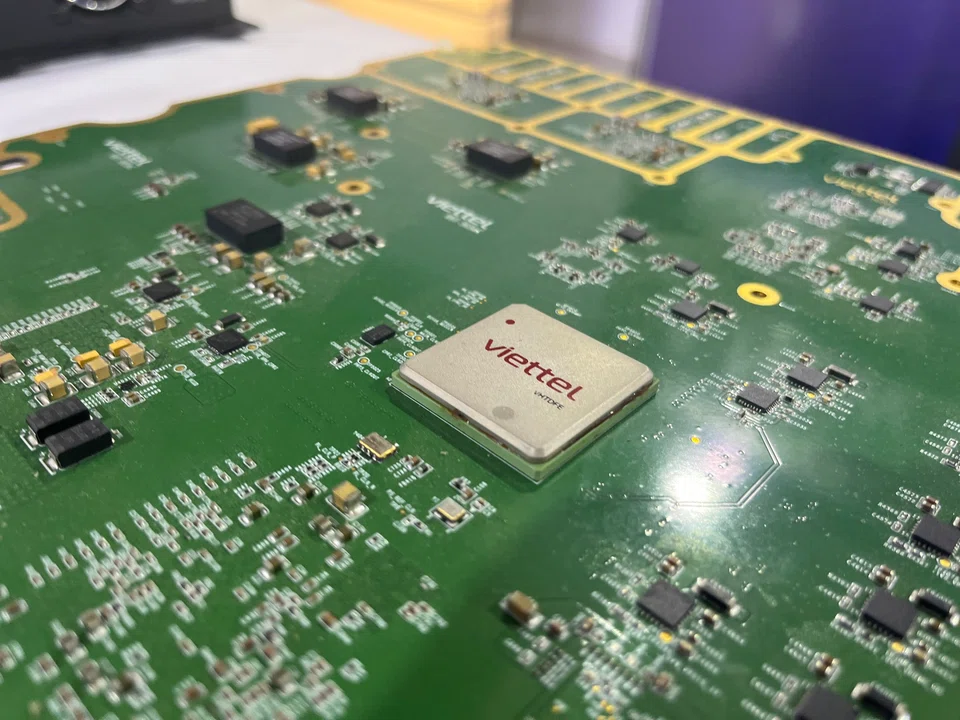
Domestic tech companies, including FPT and Viettel, have managed to get their self-designed chips into some devices and equipment, though production is still outsourced to partners in South Korea and Taiwan.
To level up, Vietnam could incorporate cutting-edge technologies such as AI-driven chip design.
“It is even more important to ride on the wave of advanced chip design and seize the moment of this paradigm shift in chip design based on AI,” said Michael Shih, corporate vice-president of sales for the Asia-Pacific and Japan at software company Cadence.
Talent remains a top concern. It has been estimated that the current manpower in Vietnam meets only about a fifth of the semiconductor industry’s needs. In September, the United States pledged seed funding of US$2 million to train Vietnamese workers in chip assembly, packaging and testing.
Vietnamese policymakers are also asking universities to build specialised training programmes and recruit students to resolve the talent scarcity by the end of this decade. They are also looking to upskill and reskill the existing 350,000 software and electronics engineers to swiftly fill the gap.
”Competing on talent is a very smart move,” noted SIA’s Neuffer. “Vietnam’s plan to produce 50,000 more chip engineers is absolutely the right objective and encouraged to be achieved as soon as possible.”
TRENDING NOW

Once staunchly pro-China, Malaysian Chinese businesses are now distancing themselves from Beijing

Britain’s mansion tax shows the difficulty of targeting wealth

Three hats, one goal: How Ng Kian Swan runs sustainability at NUHS

COE review: The gap between luxury and mass-market cars isn’t the only one worth bridging

