Vietnam’s upcoming subsea cables may draw more investors to the country
But the current shortfall in connectivity could hamper its potential as a regional digital hub as competition intensifies

[HO CHI MINH CITY] Vietnam is relatively late in the race to cast itself as one of the region’s top digital hubs, but it may still have a shot if plans to upgrade its bandwidth capacity by constructing more undersea Internet cables proceed as planned.
If these plans materialise – coupled with Vietnam’s competitive energy and labour costs – the country could attract greater interest from foreign players in the cloud computing and data centre sectors.
This could further intensify competition among South-east Asian countries as they vie to position themselves as key digital hubs in the region.
Singapore-headquartered ST Telemedia Global Data Centres (STT GDC), for one, is watching the developments in Vietnam closely; it is set to join forces with a local partner to develop a data centre in Ho Chi Minh City.
A spokesperson from the company said it was eyeing the market as a potential platform to grow its global footprint of data centres, given Vietnam’s push to tackle the shortfall in submarine cable connectivity.
In recent years, international data centre players have made forays in Vietnam. Some notable ones include a 20-megawatt (MW) facility in a high-tech park in Ho Chi Minh City by Hong Kong private equity firm Gaw Capital.
Singapore-based Worldwide DC Solution is developing a 30 MW project, while Japanese telecom giant NTT and local IT firm QD.TEK are co-developing a US$70 million data centre.
Cable woes
Vietnam’s total international bandwidth capacity has been significantly disrupted in the past two years, due to costly outages and faults in several of its existing undersea cable systems.
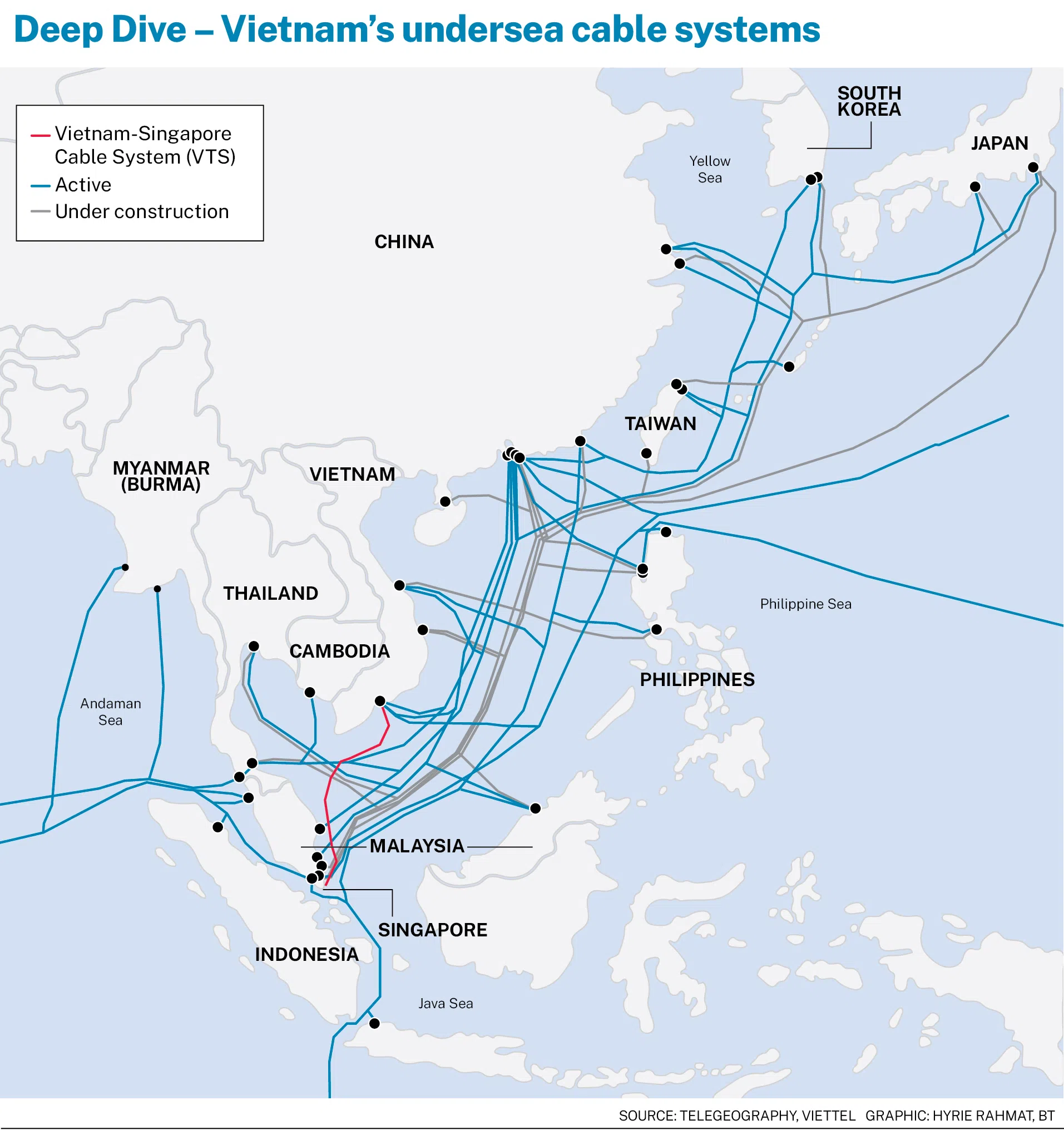
With just five cable systems, Vietnam lags Indonesia, which has 58; Malaysia, with 23; and Thailand, with eight, as at end-2023. This was based on a global submarine cable map provided by US market research firm TeleGeography.
There are 26 subsea cables landing in Singapore and at least 12 more in the pipeline, putting the city-state in a strong position to remain a major connectivity hub in the region.
The submarine cable systems, which carry over 90 per cent of the world’s Internet traffic, are important to ensure ample bandwidth, high-speed connection, and information security for data management and transmission.
These facilities, coupled with local access networks and data centres, are key components of a country’s digital infrastructure.
That said, there are ongoing efforts to aid Vietnam’s progress in this space.
In April, Vietnam’s largest telecommunications operator, Viettel, and Singapore’s Singtel jointly announced plans to develop a submarine cable system directly linking the two countries.
The Vietnam-Singapore Cable System (VTS), deployed with the latest advanced bandwidth technology, is set to go live by the second quarter of 2027.
It will add hundreds of terabits per second to Viettel’s total international connectivity capacity and complement Vietnam’s five existing subsea cable systems and three others underway.
Digital goals
In January, Vietnam unveiled a national plan for digital infrastructure, with an emphasis on expanding its cloud computing market.
The government intends to deploy and invest in two to four additional international subsea fibre-optic cables by 2025, with up to six in total by 2030, alongside one or two regional data centres to provide services domestically and internationally.
The Ministry of Information and Communication also laid out a strategy to increase Vietnam’s total number of submarine cables to a minimum of 15 by 2030. Among them, it aims for Vietnam firms to take ownership of at least two cable systems that connect directly to major digital hubs in Asia.
The stakes are high, said analysts.
“The country’s limited access to high-bandwidth cables has so far weighed on Vietnam’s effort to become a more significant player in the global market landscape,” noted BMI, a Fitch Solutions company.
“(VTS) is likely to provide upside to our Vietnam cloud computing outlook as it will reassure domestic and international ventures of the viability of establishing high-performance computing resources in this emerging market,” BMI added.
The research unit said international investment in data centres, which host cloud computing resources and services, would be key to transforming Vietnam into a strategic regional hub such as Singapore, as domestic resources alone are insufficient to support the expected digital growth in Vietnam in the next few years.
Cloud computing spending in the country is projected to increase at a compound annual growth rate of 31.3 per cent to reach US$8.1 billion by 2030, in line with the robust demand for connectivity and the rapid adoption of digital services in Vietnam, according to the BMI report.
The country is also forecast to be the fastest-growing digital economy in South-east Asia until at least 2025, according to recent reports by Google, Temasek and Bain & Company.
Race to the top
Vietnam faces stiff competition from around the region. Malaysia, Thailand and the Philippines are also vying to establish themselves as regional digital hubs to attract higher quality foreign investments as they seek to grab market share away from Singapore.
“This discrepancy (between Vietnam’s subsea cable infrastructure and that of other countries) persists even with upcoming submarine cable projects slated to land in Vietnam in the near term,” said the spokesperson from STT GDC.
Nguyen Dinh Tuan, manager of the technical department at Viettel IDC, the data centre and cloud service arm of Viettel, said that Vietnam has several advantages to attract foreign investments in data centres.
“Vietnam still offers relatively competitive energy and labour costs compared to its regional peers,” he told The Business Times on the sidelines of an industry conference in April.
He added that cable routes such as the one linking Singapore and the southern cities of Vietnam including Ho Chi Minh City are also exempted from the geopolitical risks related to the contested waters of the South China Sea.
Tuan emphasised the importance for Vietnam to focus on securing ample land reserves and power resources, particularly renewable energy sources, to accommodate the influx of energy-intensive data centres.
According to a report by real estate consultancy firm Savills Vietnam, as at the end of 2023, Vietnam has over 40 businesses providing cloud computing services and 28 data centres with an overall capacity of 45 MW.
The government is driving efforts to foster a thriving local cloud and data centre market in Vietnam. This includes raising utilisation of domestic cloud computing services, aiming for 100 per cent adoption by state agencies and state-owned enterprises, and 70 per cent adoption by Vietnamese firms by the end of 2025.
Also, Vietnam’s laws require all local companies and certain foreign firms store specific data types within Vietnam for a minimum of 24 months. The country also allows 100 per cent of foreign investment in data centre services, though market access restrictions are in place if the firm provides network connectivity services.