



Viettel-Singtel consortium breaks ground on submarine fibre-optic cable connecting Vietnam, Thailand, Singapore
It will be the shortest submarine fibre-optic cable link between Vietnam and Singapore

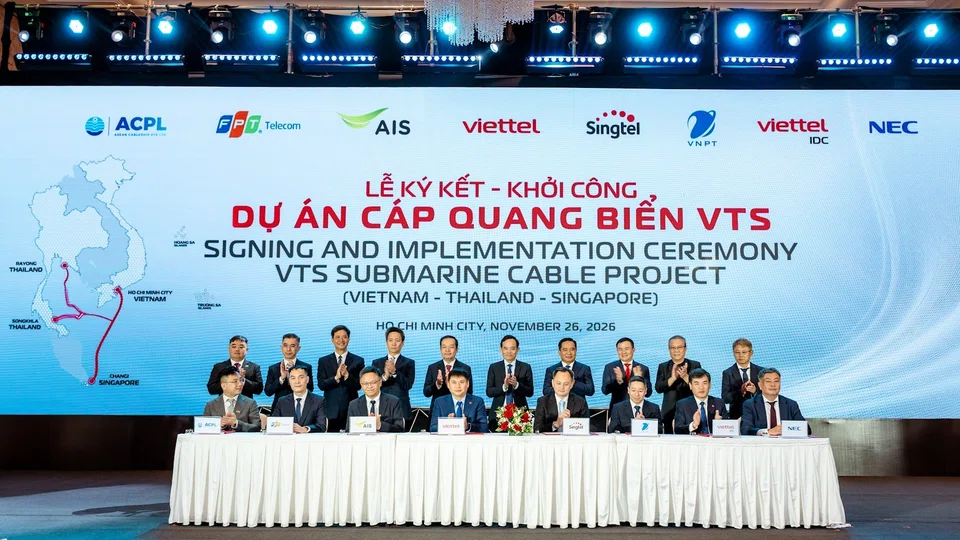
[SINGAPORE] A consortium co-chaired by Vietnam’s Viettel Group and Singapore’s Singtel has begun construction of a submarine fiber-optic cable system connecting Vietnam, Thailand, and Singapore. The cable system offers the the highest bandwidth among all submarine cable routes connecting Vietnam to Singapore.
This marks the first international submarine cable project initiated and led by a Vietnamese enterprise, said Viettel in a press release on Thursday (Nov 26). The project by the consortium, VTS, is expected to be completed in the fourth quarter of 2030.
An event to mark the signing of commerical and construction contracts with Japan’s NEC Corporation and Singapore cable system company Asean Cableship was held in Ho Chih Minh City, Vietnam on Thursday. Both companies are the contractors for the project.
The entire cable system will span 2,500 km with a design capacity of 600 terabits per second (Tbps). The segment between Singapore and Vietnam will cover about 1,200 km and offer a capacity of 240 Tbps, or roughly 2.5 times the total capacity of all international cable systems currently in use by Vietnam. By following a direct route, VTS will be the shortest submarine fiber-optic cable link between Vietnam and Singapore.
Once the cable is up, the round-trip data transmission time, or latency, between the two countries is expected to be 12 milliseconds, approximately 50 per cent lower than the current average for existing routes.
This low latency will enable smoother performance for applications such as financial transactions and artificial intelligence.

The project builds on a memorandum of understanding signed between Viettel and Singtel in April 2024 to develop a direct submarine cable connection between Vietnam and Singapore.
Viettel, which is run by the country’s military, said that it directly led the route planning and design of the cable. These included deciding the landing points, system configuration, and overall performance.
The cable gives Vietnam an additional international connection route. This helps to reduce the country’s reliance on existing routes. Should one route encounter an issue, traffic can be rerouted to another, ensuring that Internet, banking and business services face minimal disruption, said Viettel in its release.
Lieutenant General Tao Duc Thang, chairman and general director of Viettel, said that Viettel proactively initated the cable system project as it does not want the development of Vietnam’s digital economy to remain overly dependent on factors beyond its control.
“Constructing a subsea fibre-optic cable system takes many years; we cannot wait until we face a capacity shortage to begin investing,” he said.
In a separate press release, Singtel said that by strengthening connectivity between Vietnam, Thailand and Singapore, the upcoming cable system will support businesses’ growing cross-border requirements and create greater opportunities for digita linvestment and innovation across South-east Asia.
Said Ng Tian Chong, CEO of Singtel: “The additional connectivity and network resilience it provides will also complement Asean’s ambitions under the Digital Economy Framework Agreement to deepen regional digital integration and facilitate cross-border data flows.”
Decoding Asia newsletter: your guide to navigating Asia in a new global order. Sign up here to get Decoding Asia newsletter. Delivered to your inbox. Free.
Copyright SPH Media. All rights reserved.
TRENDING NOW

Nvidia halts chip shipments to 4 countries in South-east Asia, including Singapore: FT

Should Keppel swoop in to snare Mapletree Investments?

OCBC opens 100-tonne gold vaulting facility to meet growing institutional demand
‘Very disappointed’: Singapore disagrees with US tariff rationale, to seek lower levies

