VinFast delays launch of US factory, revs up debut of Asian plants
Its move comes amid a price war in the EV market and the rise in China-made EVs, among other factors. Analysts say the pivot is financially prudent
[HO CHI MINH CITY] Vinfast’s revised plans to delay its US factory launch by three years and to expedite the opening of its two Asian facilities in 2025 could optimise capital expenditure as the Vietnam-based automotive company navigates tough market conditions in the US, say analysts.
“While the delay in VinFast’s US plant will slow its entry into the North American market, it is for the best. It will buy some time and improve its ability to weather the ongoing EV market conditions,” said BMI’s senior automobiles analyst Joshua Cobb.
He remarked that the carmaker had stretched its resources too thinly with its hasty plans to set up three plants abroad before ironing out its production and software woes.
VinFast had previously planned to allocate US$1.4 billion to the setting up of the North Carolina plant in the US, and US$400 million in initial investments into two other plants in Indonesia and India.
This year, VinFast’s capital expenditure is planned at US$1.5 billion, even as accumulated losses at the end of last year hit US$7.7 billion, according to the company’s filing in late March.
Sharp declines in EV prices, fuelled by a price war and rising exports from Chinese carmakers, could prove tough for VinFast to control its current cash-burn rate, said Cobb.
VinFast’s latest moves are also unfolding amid a slowdown in battery EV sales growth in the US and Europe. Over in South and South-east Asian countries, however, EV adoption levels are low – which points to plenty of room for growth.
Barry Weisblatt, head of research at Vietnam-based VNDIRECT Securities, said: “It’s a good move to delay the large capex planned for the US, and to instead focus on these Asian markets. The cost of the Indonesia and India plants is much lower than the one in the US.”
Shifting market conditions
Demand for VinFast’s vehicles in the US may also be hobbled because buyers there are ineligible for the country’s tax credits. The 2022 Inflation Reduction Act gives these tax breaks only to vehicles assembled in North America, analysts said.
They also cautioned that the shifting political landscape in the US, with the ongoing presidential election, calls for a more cautious approach.
Colin Richardson, founder and principal at Canada-based firm Omni-Channel Automotive Solutions, said that VinFast vehicles may be subjected to additional tariffs if Donald Trump secures another presidency and puts the current tariff scheme under scrutiny.
The US market has already proven challenging for VinFast to penetrate; the brand received a lukewarm reception last year following some initial poor reviews and software glitches.
Last year, the automaker sold only 265 cars in the world’s second-largest auto market, based on EV registration data.
This year is bringing some improvements, with 927 units sold in the first quarter of 2024, accounting for more than 10 per cent of VinFast’s total deliveries during this period.
The VinFast stable offers seven models ranging from mini cars to full-size E-class SUVs, as well as several models of electric motorcycles and buses.
VinFast, which aims to distribute its cars across 50 countries by the end of the year, could seize opportunities in Asian markets as governments in the region roll out incentives to build local supply chains and boost EV adoption.
The EV penetration rates last year in India and Indonesia were at about 6.4 per cent and 1.7 per cent, respectively, much lower than the global level of 18 per cent.
VinFast broke ground on its Indonesian plant in Subang, a town in West Java, earlier this month. That plant, and the one in India’s Tamil Nadu, are expected to be operational next year, with each able to churn out 50,000 vehicles as their initial annual capacity.
Lukas Neckermann, managing director of Neckermann Strategic Advisors, a London-based mobility-focused consultancy, said: “It’s quite clever for VinFast to seize on these opportunities, although it remains to be seen if the market itself delivers on the considerable promise that VinFast sees.”
These new outputs will not only serve domestic markets.
VinFast said EVs produced in its India plant will be exported to South Asia, the Middle East and Africa, while the one in Indonesia will supply right-hand-drive EVs to countries like Thailand, Singapore, Malaysia and Australia.
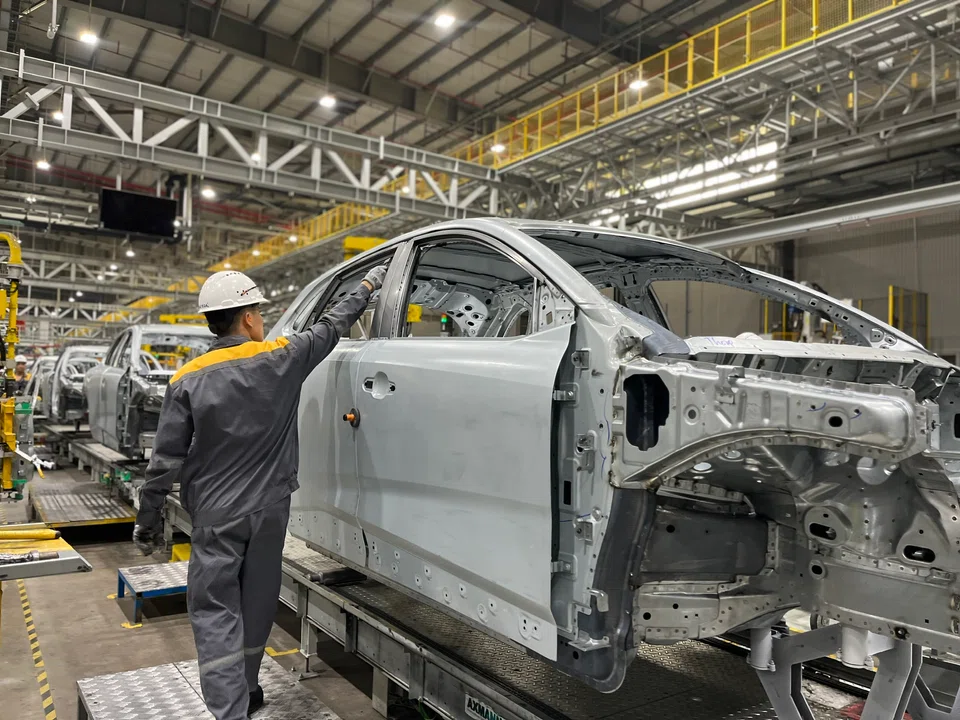
As things stand, the firm’s revised full-year sales target of 80,000 units – down from the initial goal of 100,000 units – can still be fulfilled by VinFast’s central manufacturing facility in Hai Phong which can produce up to 300,000 EVs a year.
Last year, VinFast fell short of its target, selling fewer than 35,000 cars – only 12 per cent of its full production capacity.
Show me the money
Between 2017 and 2023, its parent Vingroup, affiliate companies, external lenders and the group’s billionaire founder Pham Nhat Vuong, injected a total of US$11.4 billion into VinFast.
Reuters reported in January that the Vietnamese EV maker aims to attract more investors by increasing its free float on the Nasdaq to 10 to 20 per cent by the end of this year, up from the current 2 per cent.
VinFast’s shares have dropped by more than 95 per cent since its price peak last August, when its market capitalisation exceeded that of legacy US carmakers Ford and GM. The firm is currently valued at around US$9.5 billion.
The challenging outlook forced the carmaker to roll out various strategies to optimise its capital expenses in the last year.
Since the last quarter of 2023, VinFast has moved away from a capital-heavy direct-to-consumer distribution model to a capital-light hybrid dealership network. It aims to have 400 points of sale across the world by the end of 2024.
Last October, tycoon Vuong, the group’s founder, donated his battery company VinES to VinFast. The acquisition is expected to result in cost savings of 5 to 7 per cent on batteries, the priciest component in electric vehicles.
In a move to help reduce VinFast’s capital expenditure on infrastructure, the billionaire, who is also the chief executive of the EV maker, also established V-Green, a spin-off from VinFast’s charging station development division.
Noteworthy is that more than three-quarters of VinFast’s US$1.1 billion vehicle sales last year came from its affiliate taxi company, also owned by Vuong.
Last May, during a shareholder meeting, he remarked: “If it were just for business and making money, the Vingroup leadership would not be foolish enough to venture into a difficult field like car manufacturing.” He went on to stress that Vingroup created VinFast out of “patriotism” and “social responsibility”.