



Weak rupiah, capital outflows could complicate Indonesia’s redenomination plan: analysts
The country’s plan to simplify the rupiah’s nominal value has resurfaced repeatedly over the past decade

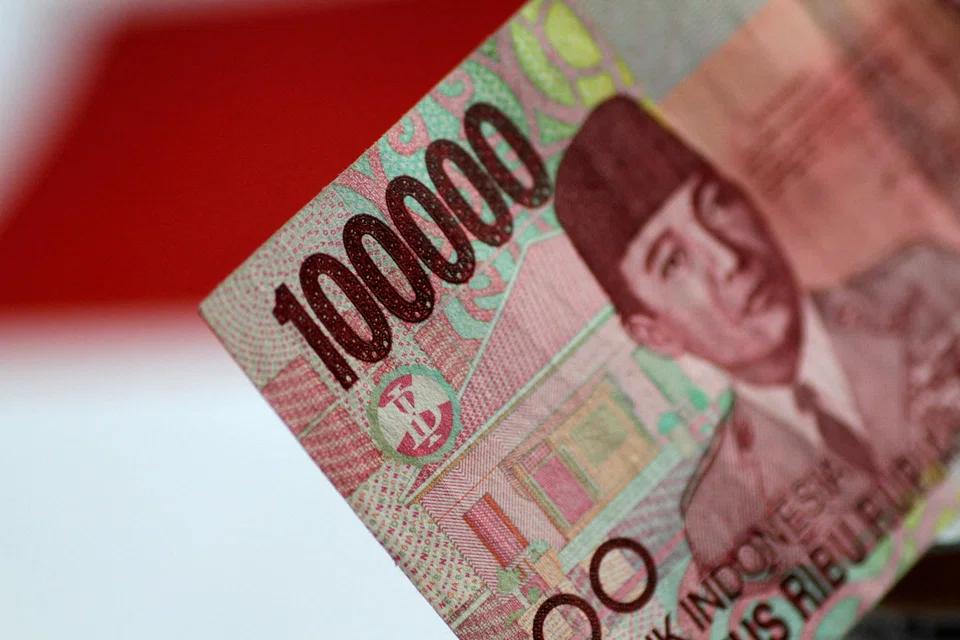
[JAKARTA] Indonesia wants to give the rupiah a face lift by removing three zeroes, but with the currency still sliding and investor confidence delicate, economists say now may not be ideal for the country to embark on its long-stalled currency redenomination.
While they welcomed the government’s intention to improve efficiency at a time when Indonesia’s inflation and growth remain broadly stable, they warned that weak currency conditions and persistent capital outflows could derail efforts to modernise South-east Asia’s largest economy.
The country uses 100,000 rupiah banknotes, the second-highest denomination in Asia after Vietnam’s 500,000 dong notes.
Tauhid Ahmad, a researcher at the Institute for Development of Economics and Finance (Indef), said that rupiah redenomination – without altering its purchasing power – could enhance efficiency in financial transactions, both administratively and in accounting.
But the plan could backfire if implemented prematurely, and cause heightened volatility. He noted: “Redenomination makes sense in the long term, but for now, the government should prioritise strengthening the rupiah first.”
The rupiah has hovered around 16,600 against the US dollar and weakened by more than 3 per cent in the year to date, making it one of Asia’s weakest currencies.
Foreign investors sold US$1.8 billion in Indonesian bonds in October, based on Bloomberg data, taking two-month outflows past US$4 billion amid concerns over central bank independence and fiscal discipline.
“That shows the exchange rate is not yet stable. If the weakening trend continues, this isn’t the right time,” Tauhid added.
On the other hand, Indonesia’s inflation has remained low in 2025 – still within Bank Indonesia’s 1.5 to 3.5 per cent target range. This has allowed the central bank to cut rates by 125 basis points since last year without stoking inflation fears.



With inflation hovering around 2 per cent, the impact of redenomination on Indonesia’s economy should be modest, supported by stable inflation and credible fiscal policy, said Claudio Piron, Asia-Pacific foreign exchange and rates strategist at Bank of America Securities.
“There is less likelihood of ‘money illusion’, where changing the nominal value of a currency would affect inflation expectations,” he added.
Will the plan finally see light?
Central bank data shows that Indonesia’s banking assets totalled 11,460 trillion rupiah (about S$894 billion) as at June this year.
The nation’s plan to simplify the rupiah’s nominal value has resurfaced several times in the past decade.
The last formal proposal that was submitted to parliament was in 2013, and aimed to remove three zeroes. But it was shelved amid volatile inflation and weak public understanding.
Finance Minister Purbaya Yudhi Sadewa has recently revived the idea with a new Bill aimed at boosting economic efficiency, maintaining stability and strengthening the rupiah’s credibility, with completion targeted for 2027.
Indonesia first implemented a redenomination policy in 1965, removing three zeroes from the currency, but the measure was short-lived due to the economic instability at the time.
Inflation soared to 635 per cent in 1966, even after the government redenominated the currency in December 1965 from 1,000 rupiah to one rupiah without adjusting prices, Bank Indonesia’s History of Monetary Policy report showed.
The method, called “sanering” – a Dutch term for reorganisation – reduced the currency’s purchasing power; the new one rupiah notes were worth a thousandth of the old ones, the report said.
Costly for businesses
Experts worry that the redenomination could be costly for businesses. Updating accounting systems, replacing ATMs and recalibrating pricing and contracts would require substantial investment, they said.
Indef’s Tauhid flagged potential inflationary expectations during the transition, as well as logistical costs associated with printing new banknotes.
“Who will bear those costs? The government or private institutions like banks and rural lenders? That must be clarified,” he said.
David Sumual, chief economist at Bank Central Asia, said that both the government and banks would need time to prepare systems, educate the public, and implement a dual-currency transition where old and new rupiah notes circulate simultaneously.
“Changing core banking systems can’t be done in one or two years,” he added. “If rushed, it could disrupt financial stability.”
Communication is key
Over the past decade, Zimbabwe has redenominated its dollar three times, joining countries such as Brazil, Romania, Turkey and Venezuela in removing zeroes from their currency denominations.
Sumual agreed that strong public communication will be essential to avoid confusion between redenomination and devaluation.
“In countries like Turkey and Brazil, successful redenomination depended on clear messaging and gradual transition,” he said. “Indonesia should take a similar path.”
Andry Asmoro, chief economist at Bank Mandiri, cautioned that “moral hazard and high implementation costs” remain key risks that must be addressed through a clear and measurable road map.
Decoding Asia newsletter: your guide to navigating Asia in a new global order. Sign up here to get Decoding Asia newsletter. Delivered to your inbox. Free.
Copyright SPH Media. All rights reserved.
TRENDING NOW

Once staunchly pro-China, Malaysian Chinese businesses are now distancing themselves from Beijing

Looking beyond looming CEO succession, should UOB potentially pursue a transformative merger?

Could stablecoins be the future of money?

Grab CEO’s wife Chloe Tong on life with Anthony Tan and finding her purpose

