‘We’re not a bubble tea brand’: Chagee aims to double Asia-Pacific footprint to 600 stores by 2027
Localisation and securing prime store locations are key priorities as the brand expands in the region, says its Apac CMO

[SINGAPORE] Global Chinese tea chain Chagee is aiming to double its store count in the Asia-Pacific (Apac) to 600 over the next year, as it seeks to modernise the tea-drinking experience for the 21st century.
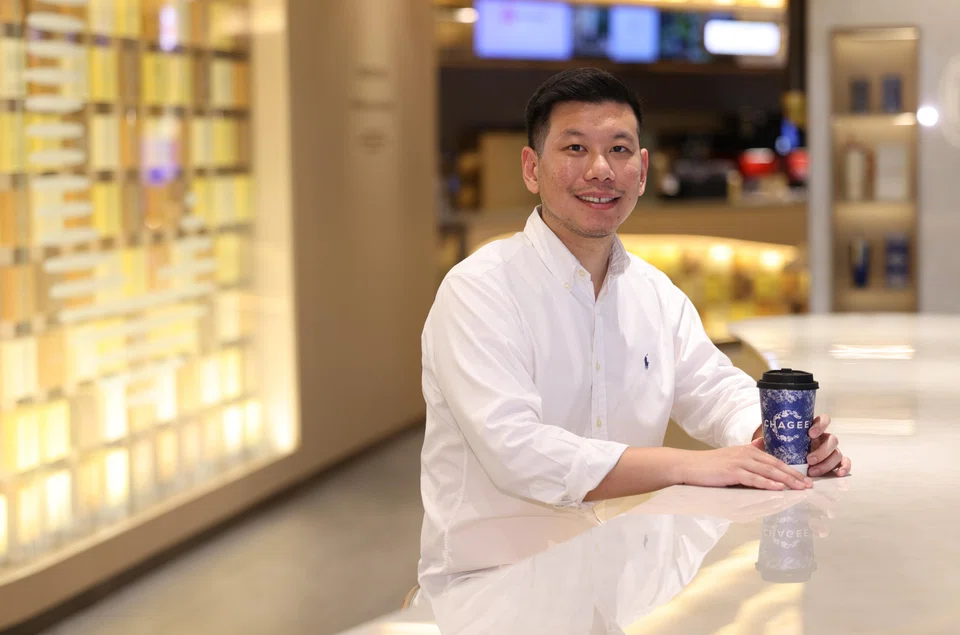
Beyond China, the region represents “the lowest hanging fruit” for Chagee, given its strong tea-drinking culture, said Eugene Lee, chief marketing officer of Chagee Apac.
“Apac holds huge potential for us, because it’s a big market where customers are looking for a premium experience when it comes to tea,” he told The Business Times in an interview.
Chagee now operates in seven Asia-Pacific markets, four of which it entered in the past year: Indonesia, the Philippines, Vietnam and South Korea. It opens its first three outlets in Seoul on Thursday (Apr 30).
While the Nasdaq-listed company does not disclose revenue contributions by region, Lee noted that in terms of Chagee’s sales, “China continues to anchor the business, with Apac growing rapidly and the US currently in its early stages.”
The brand made its North American debut in mid-2025, with its first store in Los Angeles.
The recent expansions took Chagee’s total gross merchandise value in overseas markets for the fourth quarter of 2025 to 371.9 million yuan (S$69.4 million) – a jump of 84.6 per cent.
As Lee sees it, the current gap in the market is clear: Even though tea is the second most consumed beverage in the world, it has not experienced “the same lifestyle elevation or premiumisation” that coffee has.
“It was Starbucks that single-handedly brought coffee to where it is today; 20 to 25 years ago, it was still a commodity,” he said, citing the American coffeehouse chain’s influence in shaping cafe culture.
Conversely, tea still carries a traditional image, often associated with being poured from a pot and enjoyed more by older generations.
Chagee thus aims to elevate “everything surrounding a cup of tea” through every aspect of its brand: from its menu offerings and the packaging of its beverages to the ordering experience and store designs.
But Lee is quick to highlight that Chagee is not a “bubble tea brand” – a perception that persists among consumers.
Unlike many bubble tea brands – which he noted rely on powdered tea and powdered milk – Chagee’s beverages are brewed with real tea leaves and fresh milk.
“What we serve is premium tea, and we don’t really have any toppings in our drinks… It’s a very different product,” he said, adding that the brand’s goal is to be recognised as a “tea expert”.
From grab-and-go to “third place” store formats
Founded in Yunnan, China in 2017, Chagee now has more than 7,400 stores globally, including more than 300 in the Asia-Pacific and nine in the US and Canada.
The brand’s playbook has evolved over time. Today, it prefers to retain tighter control over its operations in newer markets for three to five years, before considering franchising opportunities. This includes Singapore, Vietnam, the Philippines and South Korea – where all stores are company-operated – as well as Indonesia and Thailand, where Chagee has joint ventures to tap local expertise.
Said Lee: “In markets where we’re very young, we want to have more control over the menu, the experience, and how we show up to customers… We need to first grow the brand there.”
This is a shift from its earlier approach. When the brand first entered Malaysia and Singapore in 2019, it did so under a master franchise model.
Following a strategic regroup to reclaim control over its operations, it exited Singapore in January 2024, and then re-entered the market in August 2024.
However, the brand stayed on with its existing operating base in Malaysia, where there was stronger consumer familiarity with tea beverages, said Lee.
Malaysia is now the only market in the Asia-Pacific where the brand still runs partly on a master franchise model. It has over 220 outlets there.
“Chagee is more mature in Malaysia, having been there six, seven years already – that’s when you have the opportunity to start franchising, because people recognise the brand,” he said.
Another significant change is the brand’s move towards “third place” store formats, under its push for a premium positioning.
In urban design parlance, the “third place” refers to a vital social setting outside home (“first place”) and work (“second place”); it is where people gather and build community.
Making Chagee outlets a third place is a departure from the brand’s original grab-and-go model, which is still in place in legacy stores in its China and Malaysia outlets.
“The smaller, grab-and-go format was great for scaling, but not great for building a relationship with the customer,” Lee said.
As a result, most of Chagee’s new stores – ranging from 100 to more than 300 sq m in size – now include seating areas; some contain merchandising zones to retail Chagee products.
Prioritising quality over quantity
In 2026, Chagee plans to expand into “a few more markets” in South-east Asia, said Lee, but he declined to elaborate.
Without specifying a timeline, his longer-term goal is to exceed 1,000 Chagee stores across the Asia-Pacific; in Singapore, the aim is to double Chagee’s store count to 70 in three years.
But he said the brand will prioritise “quality over quantity” of stores, even as it scales up in the region. This means securing high-profile store locations, which remains challenging.
Not only do sites need sufficient seating space, they need to be located on the ground floor for visibility and accessibility – especially critical for newer markets where brand recognition is not as strong, he added.
Localisation will also be central to Chagee’s growth strategy across the region.
About 80 per cent of its menu is consistent across markets; the remaining 20 per cent is tailored to local tastes. Said Lee: “We don’t want to be a brand that just comes in; we want to be a brand that really integrates into the local culture.”
The brand will place more focus on expanding its core menu offerings, as opposed to limited-time offers – a common marketing strategy in the beverage industry.
“By growing your core menu, you grow your baseline sales more sustainably,” said Lee. “This is compared to (limited-time offers) where players launch new items every two to three weeks. Sales spike, but drop once the drink is removed.”
In Malaysia, for instance, Chagee offers a wider selection of fruit teas as consumers lean towards healthier, lower-sugar beverages.
In South Korea, a market with one of the highest per capita coffee consumption rates globally, Chagee has expanded its range of “teaspressos” – tea beverages brewed using espresso-style techniques to extract the maximum flavour from tea leaves.
Opening “hyper-localised” concept stores across the Asia-Pacific also allows the brand to cater to the needs of local communities.
These include a pet-friendly outlet in the Philippines’ Eastwood City, a district known for its pet-friendly amenities and establishments.
In another example of localisation, South Korea’s flagship store in Seoul’s Gangnam district incorporates softer fabrics and more greens to create a “calm and relaxing oasis” for its harried urbanite customers, said Lee.
From breakfast tea sales, to “tea experience” bars
As Lee sees it, there are untapped opportunities for Chagee to further erode coffee’s market share.
One lies in driving tea intake during the breakfast hours. Coffee still rules as the preferred beverage of choice.
Noting that customers primarily consume Chagee’s beverages at lunch, tea time or dinner, he said: “Most people still consume coffee as their first cup of the day or take it away to the office. Why can’t that be tea?”
As a trial in March, Chagee introduced a range of breakfast pastries to pair with its beverages in 10 of its Singapore stores in the Central Business District.
Beverage and food sales in the morning have doubled since then, he noted, and added that the breakfast range could be expanded to all 37 Singapore stores, depending on customer response and operational considerations.
Another upcoming concept is “tea experience” bars, where tea baristas make tea-based mocktails and serve them in special cocktail glasses. This is unlike Chagee’s other beverages, which are prepared in automated machines.
“Automation ensures that you get the perfect cup,” said Lee. “But for our tea experience bars, it’s about connection and human interaction.”
Selected stores in the region will be upgraded to accommodate these bars, which will open in Malaysia and Thailand by June, and in Singapore by Q4.
Still, regional expansion is only the beginning, he said. Chagee’s bigger ambition is to bring Chinese tea culture to the rest of the world, with Europe and the Middle East as longer-term targets.
He quipped: “As Chagee moves into other parts of the world, my job will be done when I hear a British person say their favourite tea is a Tie Guan Yin (a type of Chinese oolong tea).”
Decoding Asia newsletter: your guide to navigating Asia in a new global order. Sign up here to get Decoding Asia newsletter. Delivered to your inbox. Free.
Copyright SPH Media. All rights reserved.
TRENDING NOW
Grab CEO’s wife Chloe Tong on life with Anthony Tan and finding her purpose
HDB reviewing ‘jumbo’ flat scheme after Telok Blangah unit listed for sale at S$2.18m
He built the Vingroup empire. Now South-east Asia’s richest man is handing some key roles to his sons
Singapore judge raises doubts iron ore trader Radiant World is owed US$1 billion