



What to look out for ahead of US’ decision on Vietnam’s market-economy status
The signs are that Vietnam will make the cut as a market economy, but some say the upside to this is limited
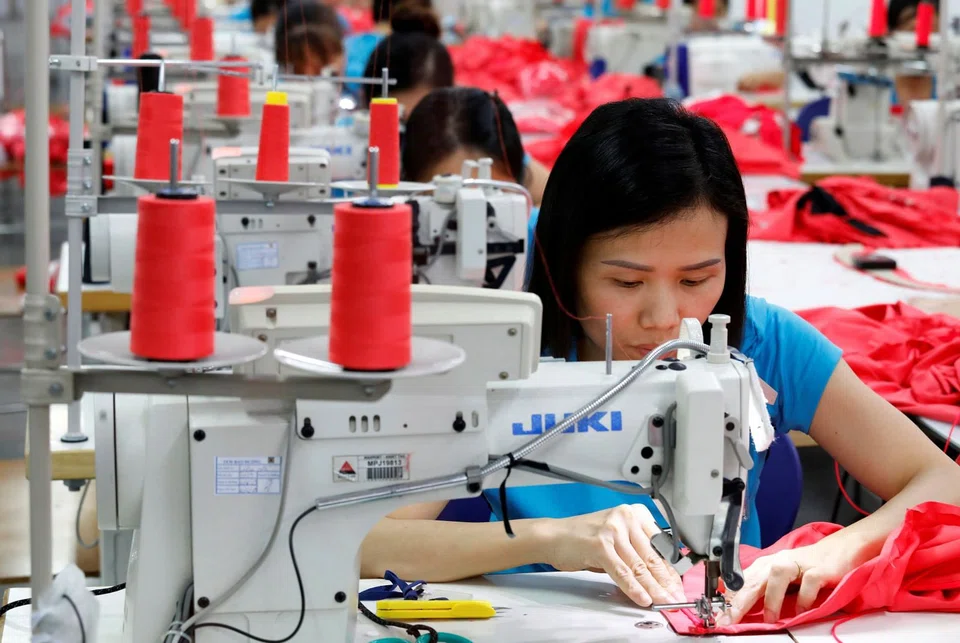
[HO CHI MINH CITY] The United States is set to make a decision on Friday (Aug 2) on whether to recognise Vietnam as a market economy – a status that means lower US tariff rates on the South-east Asian country’s goods and an elevation of its attractiveness as a growing export powerhouse.
Allianz Research’s analysis of the six criteria used in the assessment point to the outcome likely being in Vietnam’s favour, though geopolitical considerations may go beyond economic rationale and affect the final decision.
The Munich-based research centre wrote in a Jul 25 note: “Vietnam’s rising dependence on imports from China and the risk of tougher trade policy following the US elections could still hold back Vietnam’s long-term progress.”
In 2002, the US designated Vietnam among the 12 “non-market” economies – alongside Russia, China and nine former Soviet republics; this was shortly after it extended normal trade relations status to the country. The “non-market economy” classification was based on perceived high state involvement and lack of adherence to market principles regarding costs and prices.
As a result, Vietnam’s goods shipped to the US, which account for about a third of the country’s total exports, are generally subject to higher duty rates in anti-dumping cases. The US determines a Vietnamese product’s fair-market value through the use of surrogate costs from comparable market-economy producers in countries such as the Philippines and Indonesia, rather than by using data provided by the company itself.
Last October, shortly after the US and Vietnam inked a historic partnership in Hanoi, the US Department of Commerce started a nine-month-long review of Vietnam’s economic status, sparking opposing views among various interest groups.
Attractiveness boost to Vietnam
In response to Vietnam’s economic reforms made in recent years, 72 countries have already recognised the South-east Asian nation as a market economy. These include large economies such as the UK, Canada, Australia, Japan and South Korea.
Vietnam has also established trading relationships with about 160 countries, 60 of which have taken part in free trade agreements bilaterally and multilaterally with Vietnam.
Phan Minh Hoa, associate lecturer of economics at The Business School of RMIT University, Vietnam, said: “The recognition by the US will clear obstacles to Vietnam’s exports and motivate the remaining trading partners to recognise Vietnam as a market economy.”
Vietnam’s economic growth relies heavily on trade, which is about twice the nation’s gross domestic product.
The country is now the 23rd-largest exporter in the world, and could jump to 10th position in 2034, given the growth trends observed since 2017 by Allianz Research economists.
However, they estimate that the immediate direct impact of a reclassification will be limited, in that the potential decrease in tariff rates for goods could be equivalent to only 0.7 per cent of Vietnam’s GDP.
As for the stock market, analysts say investors are also not showing strong optimism in response to the news.
Dinh Quang Hinh, head of macro and market strategy at VNDirect Securities, said: “Should the US opt to maintain the current classification, I believe there will be no adverse effects on the ongoing trade relations between the two nations.”
Looming trade tension
Recognising Vietnam as a market economy also does not guarantee smooth trade relations with the US in the coming period, especially if Donald Trump wins the US presidential election in November.
Maybank analysts wrote in a Jul 5 note: “Trump has pledged to crack down on tariff evasion and trade diversion, which could result in collateral damage on Asean and discourage Chinese manufacturing investments in the region...
“Vietnam may be more vulnerable as a third-country target,” they added.
Vietnam has been able to benefit most from China’s trade diversion and global supply chain relocations. Data from macroeconomic data provider CEIC showed that the proportion of foreign direct investment to Vietnam from China and Hong Kong hit a four-year high of 25 per cent in 2023.
China also accounts for a third of Vietnam’s total imports, up from about a quarter a decade ago. This suggests Vietnam’s high dependency on intermediate imports from China for export-oriented production.
From the start of the US-China trade war in 2018 to 2023, Vietnam’s trade surplus with the US more than doubled to US$104 billion in 2023, the fourth-highest after China, Mexico and the European Union.
During the period, there was a US$112 billion drop in US imports from China, contrasted with a US$65 billion increase in imports from Vietnam.
The market share of Vietnamese exporters has also grown significantly in the US over the past decade, particularly in sectors like footwear, textiles, leather, machinery and electrical.
If Vietnam is granted market-economy status, economists expect a growth in rule-of-origin disputes, as Chinese exporters could increasingly reroute their products through Vietnam to bypass higher US tariffs.
In May, the US announced additional tariffs on US$18 billion worth of Chinese imports, covering key and strategic industries such as electric vehicles, solar panels and semiconductors.
TRENDING NOW

Looking beyond looming CEO succession, should UOB potentially pursue a transformative merger?
MAS holds monetary policy settings, pausing after two straight tightenings

Once staunchly pro-China, Malaysian Chinese businesses are now distancing themselves from Beijing

Stocks to watch: Kore US Reit, Parkway Life Reit, Raffles Education, Vin’s Holdings

