



Where the flood line meets the bottom line for storm-hit South-east Asia
With climate volatility escalating, the region’s hard-won economic resilience is now on thin ice


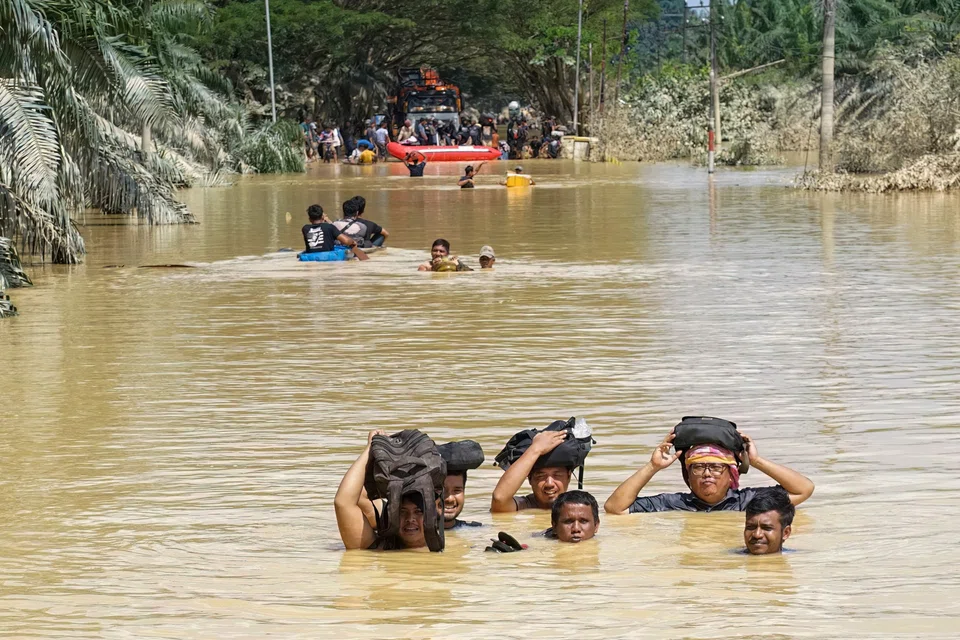
[JAKARTA/HO CHI MINH CITY] Catastrophic floods and storms battering South-east Asia and Sri Lanka in recent weeks have killed more than 1,250 people, displaced tens of thousands, and crippled key commodity and manufacturing hubs – a stark reminder of a region already grappling with US$86.5 billion in annual economic loss from natural disasters.
Economists warn that the overlapping disasters are beginning to dent growth momentum as 2026 approaches, forcing governments and investors to reckon with the rising economic costs of intensifying climate risks.
The financial toll is compounded by Asia’s chronic 82.8 per cent insurance gap, which leaves households and businesses to shoulder most climate-related losses, MAPFRE Economics noted.
Sean Walker, head of commercial insurance and chief technical officer for Asia-Pacific at Zurich Insurance, said many still underestimate their vulnerability, viewing floods as seasonal events that communities simply “learn to cope with”, causing protection to slip down the priority list until after a major loss.
The scale of this year’s loss is colossal. Indonesia alone has reported more than 753 deaths, and Vietnam’s typhoon season has racked up at least US$3 billion in losses.
Professor Lawrence Loh, director of the Centre for Governance and Sustainability at NUS Business School, said that while it may be too early to determine how recent disasters will shape long-term global investment flows into South-east Asia, one thing is clear: Climate risk will have to be factored into investments in the region, and specific agricultural commodities and manufacturing sectors remain particularly vulnerable.
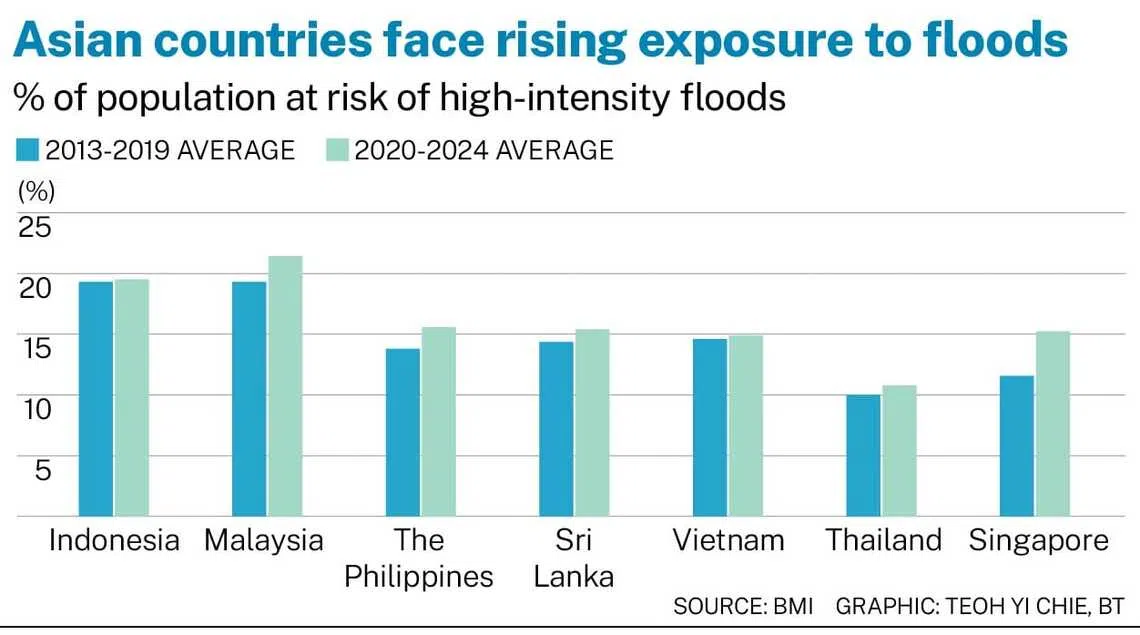
Some 20 per cent of Indonesians and Malaysians, and 15 per cent of the people in Singapore, Vietnam, the Philippines and Sri Lanka live in flood-prone areas, said BMI Research in a note on Monday (Dec 1), adding that this share will continue to rise as global warming accelerates and populations in vulnerable areas grow.
Commodity markets are already reacting. Analysts expect rubber and palm oil prices to rise in the coming week, amid fears of production disruptions in Malaysia, Indonesia and Thailand – the world’s dominant producers of both commodities.
Coffee output from Vietnam – the world’s second-largest exporter – has also been delayed by extreme weather in major producing regions. This impact is already reflected in the futures markets, with knock-on effects for consumers likely within one to three months, say experts.
Thailand’s macro outlook appears precarious. Nomura analysts warn that the floods compound the kingdom’s existing vulnerabilities. After a year of political turmoil and weak economic momentum, the added disruption from extreme weather raises the risk of a fourth-quarter technical recession, with gross domestic product growth expected at 1.8 per cent, down from 2.5 per cent last year.
The disaster further weighs on South-east Asia’s largest economy, Indonesia, which is already struggling with weak consumer demand as the government strives to lift growth above 5.4 per cent this year.
Jakarta-based think tank Center of Economic and Law Studies estimated that recent disasters in Sumatra, Indonesia’s largest island, caused around 68.7 trillion rupiah (S$5.3 billion) in losses, further complicating the country’s recovery efforts amid a strained budget.
They warn that economic disruptions could ripple across the provinces as North Sumatra, a key industrial hub, is hit by interrupted flow of consumer goods and industrial supplies.
State of floods
From late November to early December, cyclones and extreme monsoon rains swept through Indonesia, Thailand, Malaysia, Vietnam and Sri Lanka, overwhelming defences and disrupting supply chains for palm oil, rubber, electronics and coffee.
The exceptionally rare Cyclone Senyar then unleashed catastrophic landslides and flooding, with the worst damage in Indonesia, Sri Lanka and Thailand. Experts said the extreme weather was intensified by La Nina conditions and a negative Indian Ocean Dipole, both associated with heavier rainfall across the region.
“These natural phenomena, occurring simultaneously, amplified the severity of the monsoon,” said Mariam Zachariah, research associate at Imperial College London.
Indonesia: Commodity heartland
In Indonesia, torrential rains battered core production hubs for commodities, including palm oil and pulp paper in three provinces in Sumatra – Aceh, North Sumatra and West Sumatra.
The floods, described as the worst in the three decades, killed 753 people, left 650 people missing, and more than 10,000 homes damaged as at Dec 3, the National Disaster Management Agency reported. The scale of the disaster prompted the government to deploy the military to assist with relief efforts.
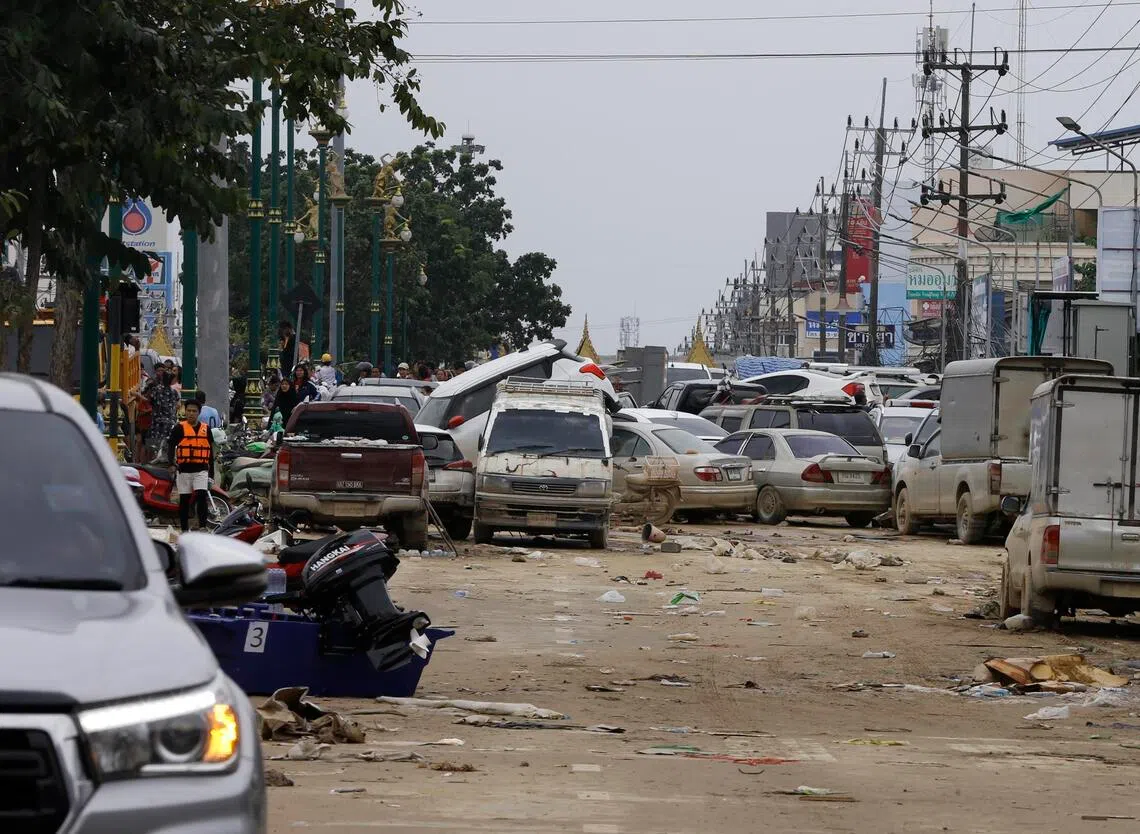
Thailand: Tourism hit by historic deluge
Thailand’s southern provinces, including tourist-heavy Songkhla – a destination popular among Malaysians, the kingdom’s second-largest source of arrivals – recorded its most extreme deluge in three centuries.
At least 162 deaths and 3.8 million people have been affected across 12 provinces, said the Department of Disaster Prevention and Mitigation. This has raised the risks for tourist-dependent sectors and rural households, which are already strained by sluggish growth.
The floods could hurt harvests in one of the biggest rice-producing regions, which could spike inflation if there are export bans or quotas, warned analysts.
Malaysia: Costly losses for traders
The November floods were Malaysia’s worst of the year. Heavy rainfall hit 10 states, including Kelantan, Perlis, Kedah and Perak, causing widespread flooding and mass evacuations.
By Nov 25, more than 21,000 people were displaced, rising to more than 34,000 nationwide. An Eco-Business report, citing World Bank specialist Marco Larizza, estimated that individual traders suffered losses of RM20,000 (S$6,294).
Vietnam: Typhoon threats
Vietnam has been hit by multiple typhoons this year, with Typhoon Kalmaegi in November triggering deadly floods in tourism hubs Hoi An, Da Nang and Nha Trang.
The storms disrupted manufacturing and supply chains, causing at least US$3 billion in economic losses so far this year. Recovery efforts continue in five central provinces, where recent floods and landslides have killed at least 98 people.
Heavy rainfall also delayed the harvest in Dak Lak, Vietnam’s largest coffee-growing province.
Climate storm cloud
With climate volatility escalating, South-east Asia’s hard-won economic resilience is now on thin ice.
Davide Faranda, research director at CNRS in France, said climate change is undeniably intensifying flooding across South-east Asia, fuelling a relentless cycle of storms and prolonged periods of heavy rainfall during increasingly erratic monsoon seasons.
“These shifts put densely populated coastal and urban areas at risk, jeopardise food security through crop failures, and strain already fragile water-management systems,” he said.
Prof Loh said that at a broader level, the interconnected supply chains necessitate even more diversification away from specific South-east Asian sources – this is especially felt in manufacturing in Indonesia, Thailand and Vietnam.
“If severe weather patterns persist, there may be chronic disruption in the supply chain for manufacturing, which will result in a structural redirection to other countries’ production bases,” he said.
Eye of the storm
BMI Research said that transportation and agriculture in many South-east Asian markets are likely to face even greater impacts from climate change, as the region becomes one of the world’s most disaster-prone areas, with risks amplified by rapid urbanisation, unsustainable land use and uneven climate adaptation.
It noted local factors such as large-scale deforestation in Indonesia and the slow operation of some flood barriers in Thailand, which exacerbated the impacts of the floods. The disasters are forcing governments to reconsider growth models that increase environmental vulnerability.
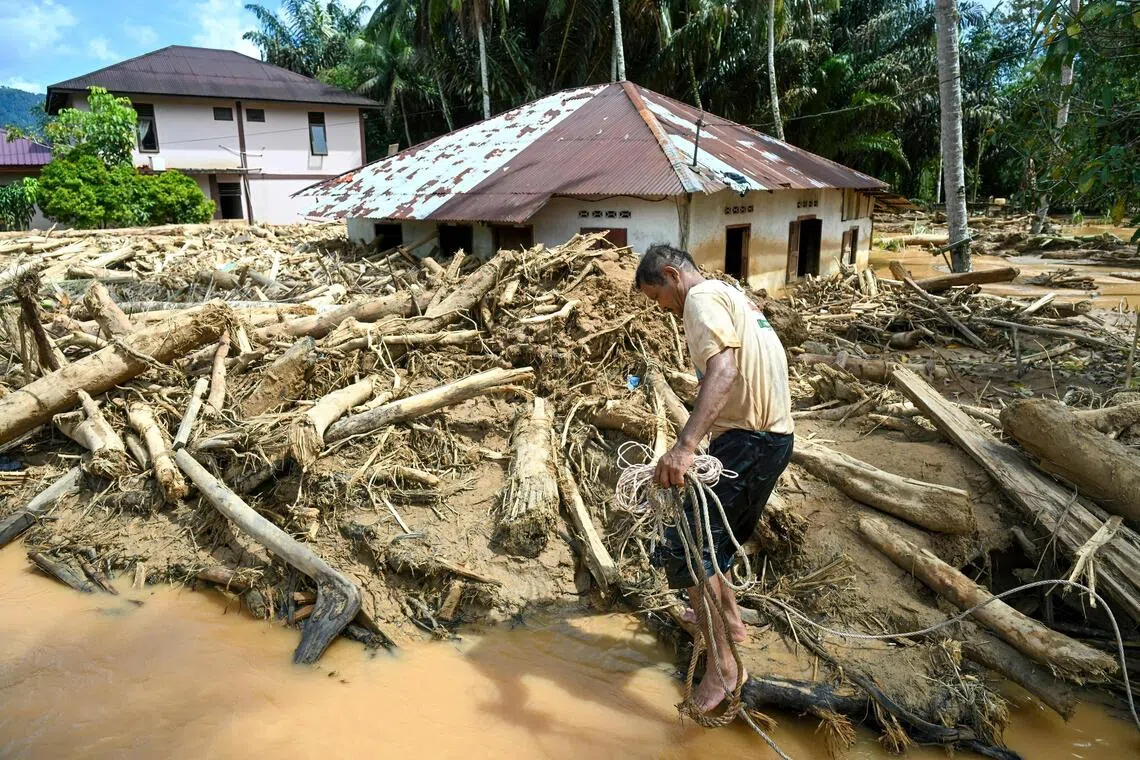
On Wednesday, the Indonesian government revoked the environmental permits of several companies in Sumatra and Aceh after finding indications of irresponsible logging and land clearing, activities officials said likely intensified the storm’s impact and the resulting severe flooding.
Analysts warned that the intensifying typhoons and worsening floods are a stark reminder of South-east Asia’s urgent need to fast-track climate adaptation, as the mounting costs of global warming increasingly burden local communities.
Prof Loh said a single priority measure will be the mobilisation of more financial resources for climate adaptation – the current emphasis, rightly so, has been on mitigation.
He added: “This redirection of financing is challenging, as mitigation is global and required as a country’s contribution to the Paris Agreement, whereas adaptation is local and suffers from a severe incentive problem in the application of funds.”
Additional reporting by Tan Ai Leng in Kuala Lumpur
TRENDING NOW

Once staunchly pro-China, Malaysian Chinese businesses are now distancing themselves from Beijing

Looking beyond looming CEO succession, should UOB potentially pursue a transformative merger?

Could stablecoins be the future of money?

Grab CEO’s wife Chloe Tong on life with Anthony Tan and finding her purpose

