Asean Business logo
SPONSORED BYUOB logo

Why the green, digital economies are a strategic focus for Singapore and Asean

At the recent Asean Summit in Laos, PM Wong brought up these priority areas in almost all his speeches and bilateral meetings

Goh Ruoxue
Published Tue, Oct 22, 2024 · 09:14 AM
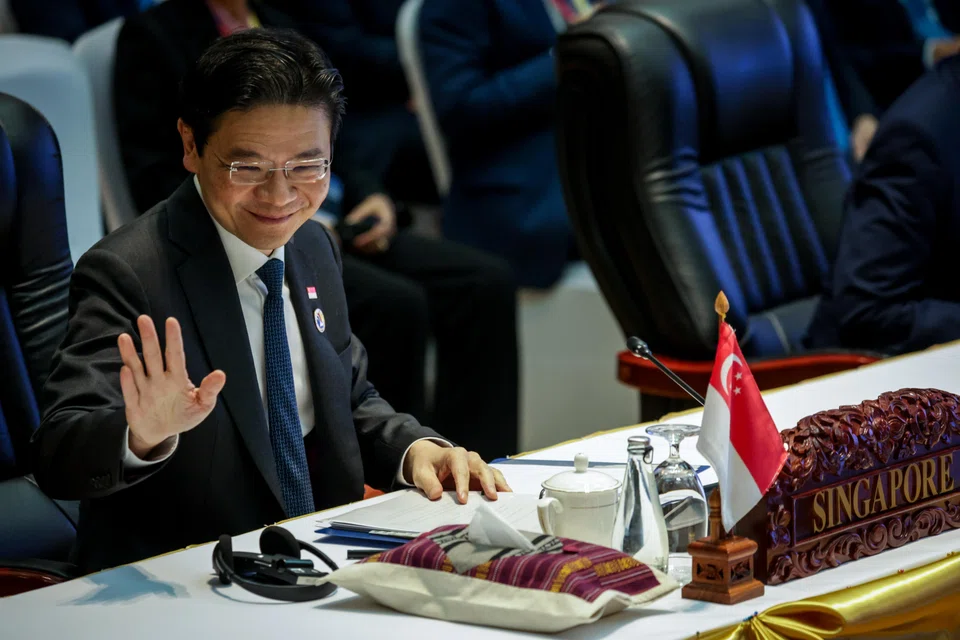
    • Prime Minister Lawrence Wong made his Asean Summit debut in his current capacity in Vientiane last week.
    • Prime Minister Lawrence Wong made his Asean Summit debut in his current capacity in Vientiane last week. PHOTO: LIANHE ZAOBAO

    BY all accounts, Singapore Prime Minister Lawrence Wong had an extremely busy and productive time during his recent four-day visit to Laos, which saw him attend his first multilateral summit in his current capacity followed by a bilateral visit.

    During his stay in the capital Vientiane, he attended over a dozen sessions at the Asean Summit and had bilateral meetings with several of the regional bloc’s leaders as well as other world leaders in attendance.

    PM Wong was not the only Asean leader making his debut at the Asean Summit. He was one of two new leaders at the gathering, having taken office in May this year – three months before Thai Prime Minister Paetongtarn Shinawatra – as Singapore’s fourth prime minister.


    While in Laos, PM Wong clearly signalled a strategic focus on the priority areas of the digital and green economies – topics that he brought up in 13 of the 14 speeches that he delivered during the three days of the summit from Oct 9 to 11.

    The Asean power grid was named 11 times and the regional alliance’s Digital Economy Framework Agreement was raised on six occasions. The latter is expected to be the world’s first such regional agreement when completed in 2025 as targeted.

    Whether in intra-Asean meetings or Asean’s sessions with its dialogue partners, PM Wong brought up the digital and green economies whenever he had the opportunity.

    The message was clear: Asean must redouble efforts and move quickly in these new priority areas and key growth sectors, as such connectivity will be central to the region’s continued economic growth and integration.

    PM Wong also called for deeper collaboration between the ten member states and its dialogue partners. He encouraged the partners to contribute to the region’s digital integration and green transition with their existing expertise, which in turn would provide new opportunities for their local businesses.

    Conscious positioning

    Among the many meetings that PM Wong attended was the 2nd Asia Zero Emissions Community Leaders Meeting. This was the final session on the last day of the summit on Oct 11, held just before the closing ceremony.

    The leaders of Brunei, Cambodia, Laos, the Philippines, Singapore and Vietnam were present, while the other member states sent representatives in their place.

    At this session, PM Wong emphasised the importance of investing in renewable energy projects. He noted that the region has great potential in the space yet the projects were still not bankable and as such, unable to attract financing.

    “We need to find ways to derisk the projects, improve their bankability and draw in commercial capital. That is why Singapore has worked with international stakeholders to create new blended and transitional financing initiatives, as well as standards for such financing,” he said.

    Observers noted that Singapore is well positioned to be a leader in these fields for the Asean bloc.

    At the 27th Asean-China Summit, negotiations spearheaded by Singapore’s Ministry of Trade and Industry to upgrade the Asean-China free-trade area were substantially concluded.

    Notably, the upgrade introduces new chapters on the digital and green economies.

    This is “the first Asean+ agreement to feature an environmental chapter, setting a precedent for future upgrades to other Asean-led trade agreements”, wrote researchers from the Asean Studies Centre at the Iseas – Yusof Ishak Institute.

    The digital economy chapter in the Asean-China Free Trade Area 3.0 spans digital trade standards, digital infrastructure connectivity, data governance, cybersecurity, artificial intelligence, fintech cooperation and anti-online scams.

    The green economy chapter, meanwhile, focuses on regional energy transition, green investment, sustainable finance and green technology.

    Consistent narrative bilaterally

    Outside of the summit’s official speeches, PM Wong continue the narrative during many of his bilateral meetings with his fellow Asean leaders.

    PM Wong – in a meeting with Vietnamese Prime Minister Pham Minh Chinh, who embraced the Singapore leader with a hug – said he looked forward to an upgrade of relations to a comprehensive strategic partnership, which will deepen their collaboration in “pivotal new areas” including renewable energy, carbon credits and food security.

    PM Wong (left) and Vietnam’s Prime Minister Pham Minh Chinh at the first annual leaders’ meeting between their two countries. PHOTO: LIANHE ZAOBAO

    Singapore earlier inked a cross-border electricity contract with Vietnam to import 1.2 gigawatts (GW) of low-carbon electricity largely powered by offshore wind energy.

    This follows similar collaborations with Indonesia for 2 GW of electricity and Cambodia for 1 GW of electricity.

    In a toast speech during his official visit to Laos after the Asean Summit, PM Wong said a major pillar of cooperation between Singapore and Laos was the enhancement of energy connectivity and resilience in the region.

    PM Wong (left) with Lao Prime Minister Sonexay Siphandone at an official banquet hosted by the latter on Oct 11, 2024. PHOTO: LIANHE ZAOBAO

    Since 2022, Singapore has also been importing up to 200 MW of renewable hydropower from Laos, under a power integration project that marks South-east Asia’s first tie-up on multilateral cross-border electricity trading.

    The two countries are also working towards a legally binding implementation agreement on the international transfer of correspondingly adjusted carbon credits, which Singapore has so far inked only with Papua New Guinea and Ghana.

    In a meeting with Thailand’s Paetongtarn, both countries agreed to deepen cooperation in various areas, including the digital economy, artificial intelligence and digital transportation, according to a news release by the Thai government.

    PM Wong (left) and Thailand’s Paetongtarn Shinawatra at the Asean Summit in Laos. PHOTO: REUTERS

    Sea-locked, resource-scarce Singapore

    It’s not surprising why Singapore has made significant efforts to steer the conversation towards the digital and green economies. 

    Singapore is a small, low-lying city-state that PM Wong described as sea-locked. With limited natural resources, renewable power is crucial to the nation’s diversification of energy sources and its broader strategy of combating climate change.

    The Republic’s moves in the digital space also align with its ambition to become a global tech hub. Traditionally, Singapore has relied heavily on technology to remain competitive and drive economic growth.

    On Oct 16, just days after the Asean Summit, Minister for Digital Development and Information Josephine Teo announced that the Asean Regional Computer Emergency Response Team was operationalised.

    The team will be located at the Asean-Singapore Cybersecurity Centre of Excellence in City Hall, with Singapore allocating S$10 million over the next decade to fund its operations.

    Malaysia – the upcoming chair of Asean – will lead the response team as its first overall coordinator, and the role will rotate every two years among the 10 Asean member states. Malaysia will officially assume the year-long chairmanship of Asean on Jan 1 next year.

    It has been six years since Singapore last chaired the regional bloc, and it will next do so in 2027. Singapore is likely to continue its push to enhance regional economic connectivity with efforts to accelerate Asean’s digital integration by streamlining cross-border trade processes while spurring the region’s energy transition.