Will Nusantara be Jokowi’s lasting legacy or a burden on Indonesia?
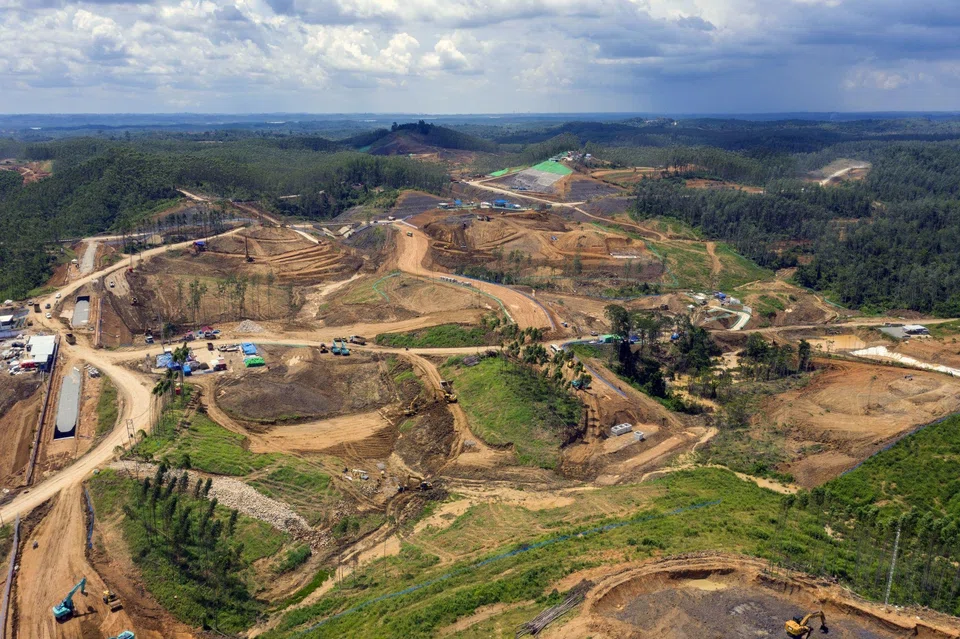
[JAKARTA] It was August 2019 when Indonesian President Joko Widodo first announced in parliament the bold plan to relocate the nation’s capital from Jakarta – a city that is congested, sinking and polluted – to East Kalimantan. The new capital, called Nusantara, would be a shining testament to Indonesia’s emergence as a new economic power in the region, he said then.
As things stand, Nusantara is envisioned to be a green and smart city, with its inhabitants enjoying a standard of living unheard of in Indonesia.
At an event last year, Widodo promised that 70 per cent of the capital city’s area would consist of forests and greenery. The authorities would also tap renewable energy to power offices, homes and public transportation. Only electric cars and bicycles would be allowed on the roads.
The idea behind the new capital, he said, was not just about physically moving government buildings and relocating offices, but also about fostering a new work culture, a new mindset, and to boost the new economy.
There is a view out there that relocating the capital is an adventurous and risky move by the president.
There have been other countries that have relocated their capital cities, albeit with varying degrees of success. Myanmar’s military rulers moved the capital 320 km north from Yangon in 2005, to a then-unconstructed site that was named the next year as Naypyitaw. In Malaysia, Kuala Lumpur (KL) remains the capital, but in the 1990s, the government moved all administrative functions to Putrajaya, a sprawling site south of KL.
Nusantara is roughly 2,000 km north-east of Jakarta and situated halfway between Samarinda and Balikpapan.
If this massive project does materialise as envisioned, Nusantara will help remake Indonesia’s economy from one reliant on fossil fuels and natural resources to one driven by innovation, technology and green energy.
Much, however, depends on how the new capital city will be funded. The total cost is estimated to be around US$34 billion, with the government committed to funding only 20 per cent.
The rest of it will come from the private sector, said Bambang Susanto, head of the Nusantara National Capital Authority, which is charged with overseeing the building of Nusantara.
He would only say that discussions with various investors were ongoing, with a bond issuance likely to be considered to fund construction.
While no private or sovereign investor has yet to commit to investing in Nusantara, the Asian Development Bank has pledged to help Indonesia plan the new capital as a carbon-neutral and inclusive city.
The government has also announced a slew of tax incentives to attract people and companies to relocate. For instance, banks and insurance companies that operate in Nusantara would pay no taxes if they move before 2035.
The tax breaks would also apply to educational and research institutions, infrastructure companies and manufacturing industries. The government would also consider waiving luxury and sales tax for goods imported into Nusantara.
Creating a modern and thriving city from scratch is complex, expensive and will take many years. Jakarta was built over 400 years and has a distinct character. More importantly, a city is more than just about buildings and trees. Cities are living structures with communities and neighbourhoods that develop over time and space.
Great cities have a defined culture and history, but they also bring people together. Culture does not just mean art museums and galleries; it is also about local art and artists, great restaurants that serve authentic local food, open parks and diversity.
Will Nusantara attract talent – both Indonesians and global citizens – to live, work and play in the city?
Apart from the sheer financial and physical challenge of building a city in Kalimantan – which is remote and sparsely populated – the greatest challenge facing Widodo and his government is convincing citizens and companies to buy into his vision. That is easier said than done, given that the concept of a new capital has been floating around for several decades already.
Indeed, Jakarta was declared Indonesia’s capital after the country’s first president Sukarno initially outlined a plan to develop Palangkaraya in Central Kalimantan as the country’s future capital.
That said, Jakarta does face some serious challenges arising from its disorderly growth. Central Jakarta is heavily gridlocked with traffic. Its air quality is among the poorest in the region. Parts of the city are sinking due to the unregulated usage of underground water. On the whole, Jakarta is overcrowded and has few open spaces.
Moving the capital to Nusantara may alleviate the traffic and people congestion somewhat, but it won’t solve all the other challenges. The fear is that if the government’s efforts and focus shift to Nusantara, Jakarta itself will be left unattended.
Widodo has just over 12 months left in office, so he is naturally in a hurry to get Nusantara off the ground, proclaiming that he hopes to celebrate the nation’s Independence Day next year in Nusantara.
He may well be able to achieve that goal, but it will be left to his successors to continue to fund the development of the new capital for decades to come. The burning question is if they will be as committed as he is, if the political winds shift and new priorities emerge.