Asia needs predictable US policy towards region: PM Lee

Sharon See
Singapore
A STABLE and predictable policy towards Asia and Europe with bipartisan consensus will be of great help to countries that are looking to depend on the United States, Singapore Prime Minister Lee Hsien Loong said on Tuesday night.
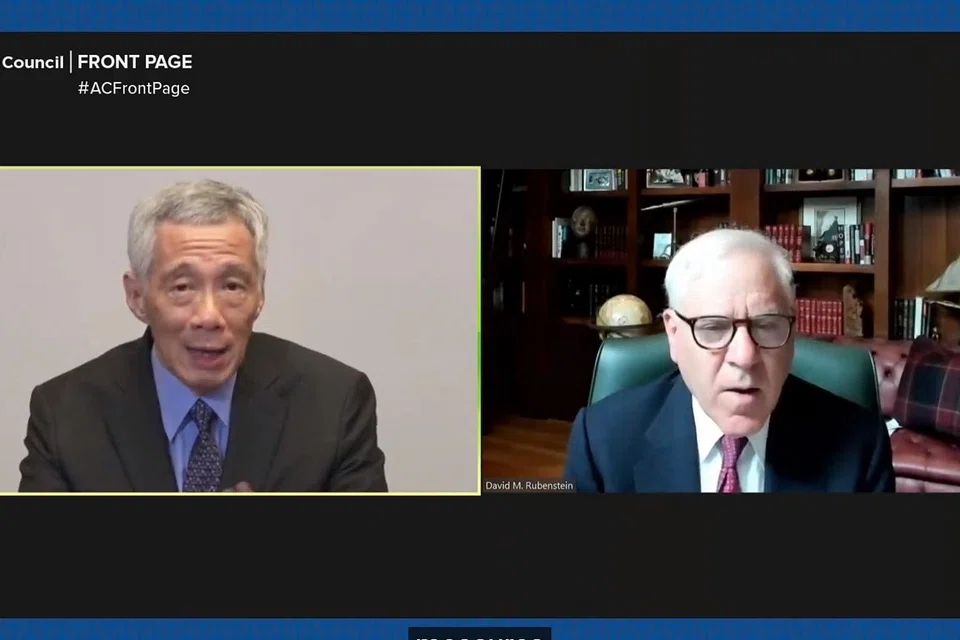
Mr Lee said this during a live conversation streamed online by the Atlantic Council, an American think tank, on Asia's response to US-China tensions and Covid-19.
He was asked by moderator David Rubenstein, co-founder and co-executive chairman of The Carlyle Group, what he would say if the next US president were to ask him for advice on how to enhance US relations in Asia.
"I would say, please try and develop a bipartisan consensus so that there's stability and predictability in US-Europe, US-Asia relations. Not just do the right thing for your administration, but make a consensus so that the policy will last beyond your administration and people can plan on it and can depend on it," Mr Lee replied.
He said many Asian countries had supported the Obama administration's rebalancing towards Asia and were told this pivot is "irreversible" even after his administration ends.
"But the Trump administration has a different take. They have raised issues of compensation and payments with the Japanese and South Koreans, they've also talked about putting more emphasis on Asia, which is welcome, but it's a quite different mood from what Obama used to do. And we don't know what Trump's successor is going to do, or the successor's successor," he said.
Mr Lee also said he hopes the US can find a way politically to return to the Trans-Pacific Partnership (TPP). While the US previously took the lead in negotiations, US President Donald Trump withdrew the US signature soon after his election in January 2017. Mr Lee said US participation would set a dynamic towards cooperation and raise standards for trade in the region, creating a win-win situation.
The other important thing he would ask is for the US to stabilise its relation with China in order to create a secure and predicable environment for the rest of Asia, he said.
He expressed concern about the tension between the US and China in recent years, noting that the issues have "metastasised" and spread into all fields of the relationship, resulting in deep distrust that is corrosive.
"It's making a very difficult relationship very dangerous because if it goes wrong, it's not just any bilateral relationship, it's the most important bilateral relationship in the world," he said.
He said US-China relations always gets entangled in US presidential election years, historically, but things do settle down later. However, Mr Lee said he is not sure this will happen this time, as the degree of animus and bipartisan consensus on treating China as a threat is "quite extraordinary".
"I fear that it may carry on over past the election, and if it does, I think that bodes ill for the world," he said.
Meanwhile, the political developments in Hong Kong have also triggered counter responses in the US, which Mr Lee said is unfortunate as there are already many complications between the US and China, and this only makes things worse.
Mr Rubenstein then asked if Singapore may benefit from these developments, if businesses look to move out of Hong Kong.
Mr Lee said both cities have had friendly competition, but it has never been very serious rivalry.
"Hong Kong has its advantages being on the doorstep of China, Singapore has a different set of advantages being in the middle of South-east Asia and with a broader footprint. So on balance, I would say I'd much prefer Hong Kong doing well than to have people looking for places to go out of Hong Kong."