Australia economic growth disappoints, easing rate-hike bets
Weak productivity means any pickup in demand risks spilling straight into prices
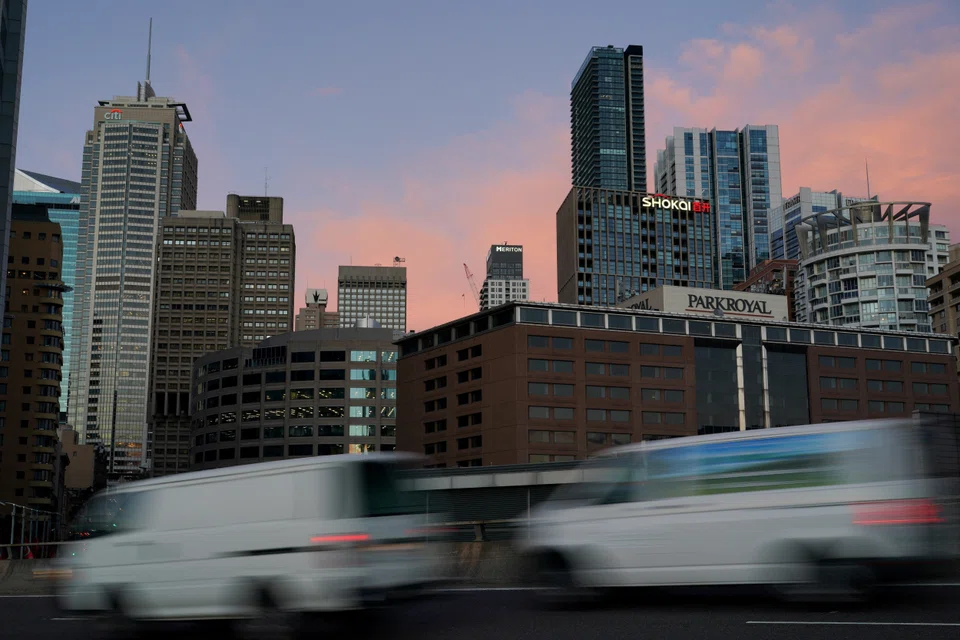
[SYDNEY] Australia’s economy grew at a surprisingly softer pace last quarter, clouding the picture on its underlying strength and suggesting markets may have been premature in pricing interest-rate hikes.
Gross domestic product advanced 0.4 per cent in the three months to September, slower than the predicted 0.7 per cent, government data showed on Wednesday (Dec 3). The 2.1 per cent annual expansion came in just below a forecast 2.2 per cent gain, though it’s tracking close to the Reserve Bank of Australia’s (RBA) estimates.
Government bond yields slipped after the data, erasing an earlier gain as traders trimmed bets on the Reserve Bank turning more hawkish next year. Stocks rose.
“The RBA will be on hold at 3.6 per cent for the time being,” said Felix Ryan, a strategist at ANZ Group Holdings. “We think any market expectations, no matter how minor, of RBA rate hikes are a little unjustified at this stage.”
Australia’s bond market suffered its worst monthly sell-off in more than a year in November, spurred by bets that the RBA will hike next year amid inflation pressures and a still-healthy jobs market. The divergence in policy with the US Federal Reserve had seen the yield premium Australian bonds hold over their Treasury counterparts rise to the most in more than three years.
The GDP data showed the household savings ratio climbed to 6.4 from 6 per cent three months earlier, underpinned by higher incomes. Households also shifted away from discretionary spending, down 0.2 per cent, while boosting essential outlays which jumped 1 per cent.
Even so, Su-Lin Ong, chief economist at Royal Bank of Canada, reckons that details in the report pointed to underlying strength in the economy.
“The private side of the economy is continuing to pick up which is encouraging,” she said. “At a time when the labour market’s pretty healthy, the economy has limited capacity and inflation is already pushing at above target, that continued strength in unit labour costs suggest that the bank really has no scope to cut rates, that it needs to stay on the sidelines.”
And if inflation continues to surprise to the upside, then there’s a risk that the next move in rates is up, Ong added.
SEE ALSO



That was also the assessment of RBA governor Michele Bullock who warned earlier on Wednesday that the rate-setting board would act on renewed price pressures. That had prompted traders to pull forward expectations for a hike to August, from November. However, those bets quickly unwound following the disappointing GDP report.
The RBA holds its final policy decision of the year next week, when rates are widely expected to stay unchanged at 3.6 per cent after three cuts this year. The central bank expects the economy to grow around its “potential” rate of 2 per cent in 2026, supported by lower borrowing costs, steady household incomes and still-strong population growth.
The RBA remains uncertain about the restrictiveness of monetary policy and whether the economy is running beyond its speed limit. A key question for policymakers is also how much further they can lower borrowing costs, if at all, in an environment of a still-tight labour market and poor productivity growth.
While the GDP report showed a solid pick-up in private demand, the much-awaited rotation away from the public sector has yet to occur, said Alex Joiner, chief economist at IFM Investors.
“We risk having an economy that is pushing up against its potential rates of growth, an uncomfortable development given it comes at a time when inflation has accelerated,” Joiner said. “Improvements in productivity growth remain modest and a re-acceleration of population growth still suggests that our economy gets bigger more quickly than it gets better.”
Weak productivity means any pickup in demand risks spilling straight into prices. The RBA has already cut its estimate of the economy’s potential growth rate to just 2 per cent, effectively lowering Australia’s speed limit. With less room to run, the country cannot grow as quickly without reigniting inflation, keeping policymakers wary.
Economic output per person was flat in the third quarter. GDP per capita slid for seven consecutive quarters to 2023 and much of 2024, in a sign of declining living standards.
Wednesday’s data also showed:
- Household spending advanced 0.5 per cent, adding 0.3 percentage point to GDP growth.
- Government spending rose 0.8 per cent, adding 0.2 percentage point.
- Changes in inventories subtracted 0.5 percentage point and net trade detracted 0.1 percentage point from GDP growth. BLOOMBERG
Decoding Asia newsletter: your guide to navigating Asia in a new global order. Sign up here to get Decoding Asia newsletter. Delivered to your inbox. Free.
Share with us your feedback on BT's products and services