

Australian PM says US-China conflict ‘not preordained’
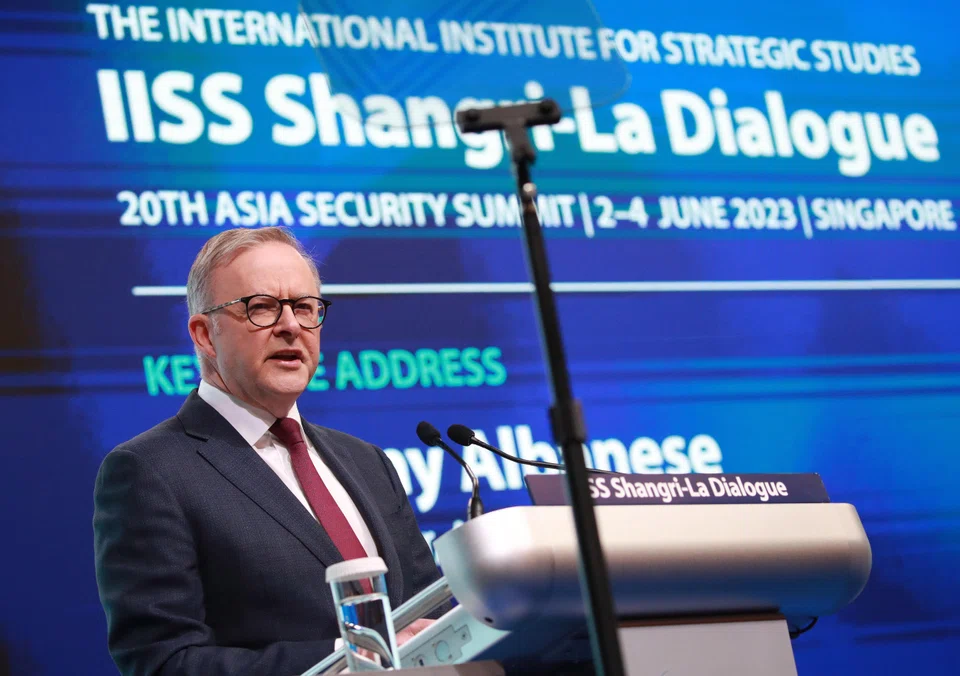
AUSTRALIAN Prime Minister Anthony Albanese called for the US and China to work together to maintain peace in the Pacific, saying the region is not simply an “arena for the ambitions of others”.
In the keynote address at the Shangri-La Dialogue security summit in Singapore on Friday (Jun 2), Albanese said the future of the Asia-Pacific region was yet to be decided, and it was harmful to assume that a regional war was “inevitable”.
“The fate of our region is not preordained. It never was and it never is,” Albanese told the International Institute for Strategic Studies gathering. “I can assure you, that when Australia looks north, we don’t see a void for others to impose their will.”
The annual Singapore summit has been overshadowed by a widening rift between China and the US. Washington has said any direct meeting between US Secretary of Defense Lloyd Austin and his Chinese counterpart Li Shangfu has already been ruled out by Beijing. They were seated at the same table during Albanese’s speech and briefly exchanged words while shaking hands.
Austin will address the conference on Saturday morning, followed by Li on Sunday.
The gathering follows months of diplomatic tensions between Washington and Beijing, beginning in February with a war of words over a Chinese-made balloon that floated over the US mainland, to flyovers in the South China Sea and growing military ties between America and the Philippines.
Speaking on Friday, Albanese said it was important for guardrails to be put in place to avoid any spiraling of major power competition in the region. “The consequences of such a breakdown – whether in the Taiwan Strait or elsewhere – would not be confined to the big powers or the site of their conflict, they would be devastating for the world,” he said.
Albanese echoed comments made by Indonesian President Joko Widodo, who said regional powers needed to work as “partners, not competitors.”
The Australian leader’s attempts to act as a neutral voice for the nations of the Asia-Pacific region are likely to be greeted with scepticism from regional leaders, given Canberra’s close military and diplomatic ties to the US. Those links were reinforced in March when Albanese stood alongside US President Joe Biden to announce plans to purchase nuclear-powered US Virginia-class submarines in the 2030s, as part of the Aukus agreement.
The Aukus partnership between Australia, the UK and the US has faced criticism in the region, with China in particular raising concerns over the threat of nuclear proliferation. In his speech on Friday, Albanese emphasised his long-running support for nuclear disarmament.
“It’s one of the issues that drew me to a life in politics, and I wanted to take this opportunity to acknowledge this region’s longstanding commitment to nuclear disarmament,” he said. BLOOMBERG
Decoding Asia newsletter: your guide to navigating Asia in a new global order. Sign up here to get Decoding Asia newsletter. Delivered to your inbox. Free.
Share with us your feedback on BT's products and services
TRENDING NOW

Olivia Lum, ex-CFO not giving evidence in their Hyflux trial

Bank on AI-resilient Singapore property via deep-value listed property groups

Positive pivot or premature? Analysts split on Keppel Reit’s S$610.9 million buy

Once staunchly pro-China, Malaysian Chinese businesses are now distancing themselves from Beijing

