

Australia’s household spending surprisingly declines in December
Economists and financial markets expect another hike this year
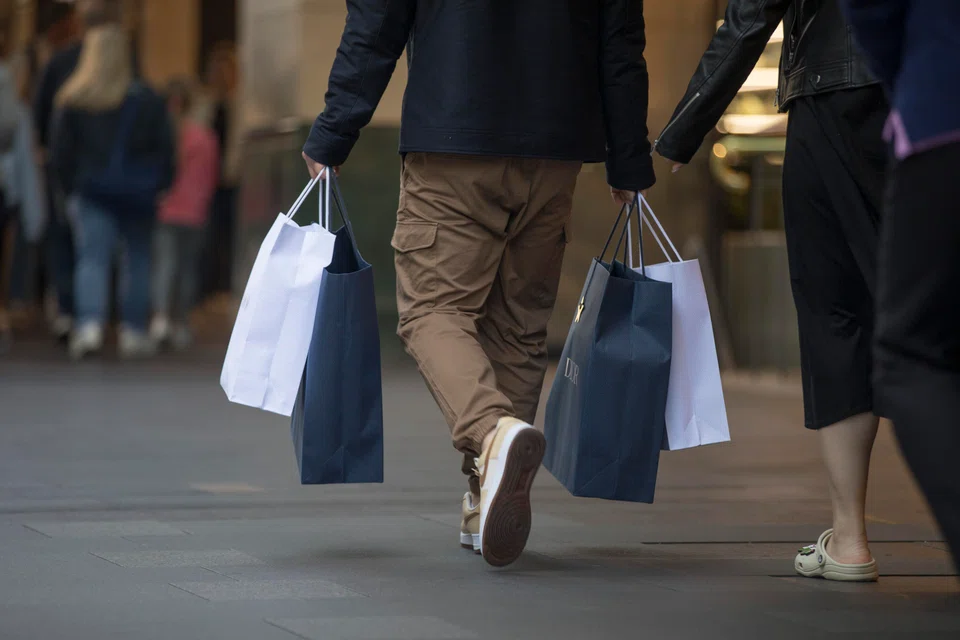
[SYDNEY] Australia’s household spending growth unexpectedly declined in December following strong gains in the preceding two months, with the outlook for the new year clouded after the Reserve Bank of Australia (RBA) raised interest rates to help restrain demand.
Consumption fell 0.4 per cent from the prior month, missing economists’ predictions for a 0.1 per cent gain and after a 1 per cent increase in November, according to data from the Australian Bureau of Statistics (ABS) on Monday (Feb 9). This resulted in an on-year rise of 5 per cent.
“The fall in December indicates that households brought forward purchases during sales events in October and November,” said Tom Lay, head of business statistics at the ABS. “These falls were across a range of categories, including discretionary items such as electronics, clothing and furniture, as well as essential items like healthcare.”
RBA officials had been surprised by the strength of the pickup in household consumption late last year as incomes were boosted by tax cuts and government support payments. Yet a renewed burst of inflation prompted the central bank to raise borrowing costs last week, which is likely to weigh on household balance sheets and cool shoppers’ ardor.
Spending can be an important consideration for monetary policy as private consumption accounts for more than half of gross domestic product.
The RBA became the first monetary authority in the world to hike rates this year as inflation has jumped above the top of its 2 to 3 per cent target. Economists and financial markets expect another hike this year that would take the cash rate to 4.1 per cent and mostly reverse the short and shallow easing cycle of 75 basis points last year.


While most economists expect the next rate rise will come at the May meeting after the release of first-quarter inflation data, a back-to-back move at the next meeting in March cannot be ruled out.
Governor Michele Bullock said last week that at least one major source of Australia’s inflation is beyond the RBA’s control: how supply-constrained the economy has become. That leaves a low speed limit for economic growth before inflation flares anew.
Monday’s data also showed:
- The biggest fall was in clothing and footwear, down 2.4 per cent, followed by furnishings and household equipment at 1.7 per cent while health dropped 1.3 per cent.
- Higher spending on new vehicles helped offset the decline in December.
- Household spending on discretionary goods and services fell 0.3 per cent month on month.
- Non discretionary goods and services dropped 0.5 per cent month on month. BLOOMBERG
Decoding Asia newsletter: your guide to navigating Asia in a new global order. Sign up here to get Decoding Asia newsletter. Delivered to your inbox. Free.
Share with us your feedback on BT's products and services
TRENDING NOW

Fed hike throws Singapore banks a margin lifeline; UOB most likely to feel impact

He built the Vingroup empire. Now South-east Asia’s richest man is handing some key roles to his sons

Real-estate veteran Desmond Sim quits from CEO roles at Realion, ETC

Chagee, Mixue and Luckin won the market. Sustaining their edge is the harder part

