Bank of Canada holds rates at 5%, keeps threat of more hikes
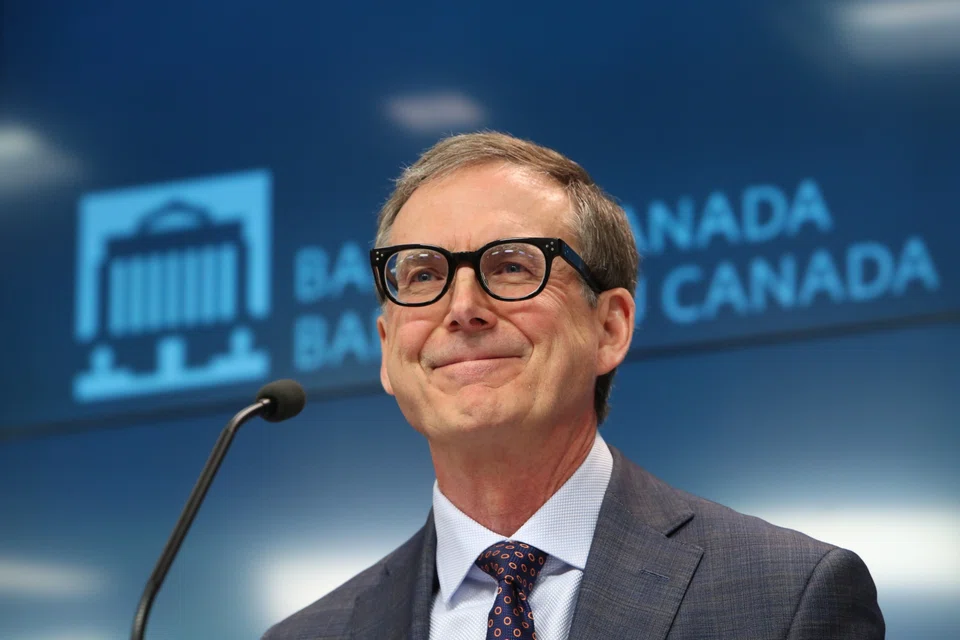
THE Bank of Canada kept interest rates unchanged for a second straight meeting, but left the door open to more tightening even as officials forecast weaker economic growth.
Policymakers led by governor Tiff Macklem held the benchmark overnight lending rate at 5 per cent on Wednesday (Oct 25) the highest level in 22 years. The pause was expected by markets and economists, and marks the fourth time officials sat on the sidelines during this rate cycle, in which borrowing costs have jumped 475 basis points.
“There is growing evidence that past interest rate increases are dampening economic activity and relieving price pressures,” the bank said in a statement. “A range of indicators suggest that supply and demand in the economy are now approaching balance.”
Short-term bonds rallied, pushing the Canada two-year yield to 4.73 per cent at 10.17 am in Ottawa, down about 4 basis points from its level prior to the rate decision. The loonie extended its decline and was trading at C$1.38 per US dollar.
Despite their forecasts for slower economic growth, policymakers also expect higher inflation in the near term and aren’t yet seeing progress on core inflation, major reasons they’re continuing to threaten additional hikes. Officials now expect inflation to average 3 per cent in 2024, up from a 2.5 per cent projection in July.
The central bank’s governing council is “concerned that progress towards price stability is slow and inflationary risks have increased,” reiterating they’re prepared to boost rates further if needed.
Still, the deteriorating outlook for economic growth reinforces the case the bank is likely done raising rates, and that policymakers may soon be forced to turn their discussions to lowering borrowing costs in order to preserve a so-called soft landing.
In the accompanying monetary policy report, officials slashed third-quarter gross domestic product growth by nearly half to 0.8 per cent, and forecast fourth-quarter output at 0.8 per cent, quarter over quarter at annual rates. They also revised down growth for this year to 1.2 per cent and next year to 0.9 per cent.
The economy is projected to move into modest excess supply in the fourth quarter of 2023. That’s one key reason why the bank removed language warning about persistent excess demand from the rate statement.
SEE ALSO





Over the past year, GDP growth has averaged 1 per cent, while GDP per capita growth has been negative, falling by 1.6 per cent. The output gap is effectively closed – estimated to be between -0.75 per cent and 0.25 per cent in the third quarter, suggesting that demand pressures have been rapidly easing. The bank had previously expected the output gap to close in early 2024.
The more balanced economy has not yet resulted in slower inflation, however. The consumer price index is expected to remain “persistently high” in the near term, averaging about 3.5 per cent through mid-2024. The bank once gain pushed back the timeline for inflation to return to its 2 per cent target. Now it expects that in the second half of 2025, from a previous forecast of mid-2025.
“With progress towards the 2 per cent target slow and increased global risks of higher inflation, the risk that disinflation could stall or that inflation even could rise again has increased,” the bank said in the report.
War risks
Upside risks to inflation include elevated inflation expectations of households and businesses, growing extreme weather events, and heightened geopolitical uncertainties including the Israel-Hamas war.
Price gains in energy and shelter – upward pressures on inflation – are “anticipated to be partially offset by the easing of excess demand, weaker pressure from input costs and further disinflation in globally traded goods,” the bank said.
“Ongoing excess supply in the economy moderates price inflation, helps ease inflation expectations and encourages businesses to gradually return to more normal pricing behaviour.”
Policymakers said they want to see downward momentum in core inflation, and continue to be “focused on the balance between demand and supply in the economy, inflation expectations, wage growth and corporate pricing behaviour.”
Macklem will shed more light on the decision during a news conference at 11 am in Ottawa.
Canada’s households are more indebted, on average, than their US counterparts and their shorter-duration mortgages roll over faster. That makes the Canadian economy more sensitive to higher rates and is one reason the Bank of Canada first declared a pause in January, well before the US Federal Reserve.
The central bank’s next decision is due Dec 6, after two releases of jobs data, October inflation numbers and third-quarter gross domestic product figures. BLOOMBERG
Decoding Asia newsletter: your guide to navigating Asia in a new global order. Sign up here to get Decoding Asia newsletter. Delivered to your inbox. Free.
Share with us your feedback on BT's products and services