Bank of England faces the end of easing cycle
The 25 bp cut on Dec 18 will bring the BOE’s rate to 3.75%, and is suggested as Britain’s ‘neutral rate’
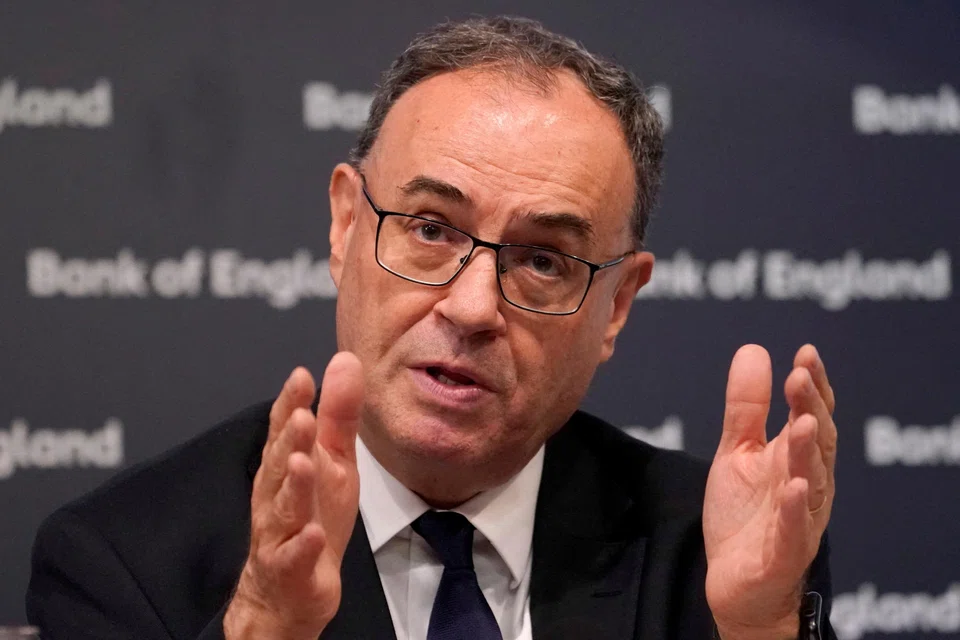
[LONDON] A widely anticipated interest-rate cut by the Bank of England (BOE) this week will force policymakers to confront whether their easing cycle is nearing its end, almost one-and-a-half years after it began.
The 25 basis-point cut that most economists and investors expect on Thursday (Dec 18) will bring the BOE’s benchmark rate to 3.75 per cent.
This is within a cut or two of what some measures, including one recently cited by governor Andrew Bailey, suggest is Britain’s “neutral rate”, the level that neither stokes nor smothers inflation.
While most members of the BOE’s monetary policy committee (MPC) have been reluctant to signal where they think the neutral rate lies, it is already shaping their decisions. The nine-seat panel has been evenly split between hawks and doves in recent months, with Bailey emerging as the key swing vote.
Divisions in the MPC have centred on whether to give more weight to Britain’s stubbornly high inflation, running at 3.6 per cent as at October, or its weakening job market.
The competing forces have made rate reductions progressively more difficult since the bank started its current easing cycle in August 2024. The approaching neutral rate will only make them harder.
“From now on, every interest-rate cuts almost has a higher bar,” said Paul Dales, chief UK economist at Capital Economics. “There’s been big disagreements, but I just wonder whether that automatic nature of cuts just fades away.”
Traders are betting that central banks from Australia to the US will be forced to pause or end easing cycles in the coming months, as they approach their own neutral rates.
Policymakers are facing higher long-term interest rates as factors such as looser fiscal policy and heavy investments in artificial intelligence, climate change and defence become upward pressures on the price of money.


Demographic pressures and lower productivity growth have been forces in the opposite direction in recent decades, particularly in the UK and Europe.
Some analysts, including those at Morgan Stanley and Capital Economics, believe a darkening outlook will prompt policymakers to cut further.
Economists surveyed by Bloomberg expect the BOE’s bank rate to fall to 3.25 per cent in the second half of next year.
Investors are more pessimistic, betting that borrowing costs will settle at around 3.4 per cent, meaning rate-setters would have space to cut by a quarter point just once more before they risk stoking inflation, if they follow through with a reduction next week.
“Having dropped ‘careful’ from its guidance in November, we expect the MPC’s wording to be little changed in December, with the committee sticking to the line that further easing will be ‘gradual’. That will likely reflect uncertainty about the level of the equilibrium rate – the end point for the cycle,” said Dan Hanson and Ana Andrade, Bloomberg economists.
They added: “We think the MPC will shift its guidance in April, when we expect another cut to 3.5 per cent. At that point, the majority of policymakers will probably judge the central bank’s policy stance is broadly neutral.”
One BOE policymaker who has given a clear answer on the neutral rate is Alan Taylor, who puts it at 2.75 to 3 per cent. But he has been among the most dovish members of the MPC, arguing that trade wars and a slowing economy will increase disinflationary pressures in the economy.
Officially, the BOE endorses only a range of 2 to 4 per cent for the neutral rate, which even Clare Lombardelli, the bank’s deputy governor for monetary policy, conceded last week was “quite broad”.
She is among policymakers who have argued that the level is difficult to estimate with any accuracy, although they believe it’s higher now than before the pandemic.
“They’re trying to make this whole concept quite fuzzy, so that it gives them maximum flexibility to push rates either side of that neutral level,” said Andrew Goodwin, chief UK economist at Oxford Economics.
He added: “The other thing that makes life much harder is that you have two very well entrenched camps of four members, and Bailey floating around in the middle.”
Bailey’s view has taken outsized importance given the rest of the MPC is split equally between four hawks, including Lombardelli and chief economist Huw Pill, and four doves, including deputy governors Dave Ramsden and Sarah Breeden.
Bailey has counted himself among those who “don’t actually, frankly, feel that there is enough confidence” to pinpoint the neutral rate.
Still, the governor raised eyebrows in November when he aligned himself with the path envisaged by the policy rule developed by American economist John Taylor. This points to rates falling to 3.3 per cent and settling a touch higher at 3.5 per cent.
Where markets expect rates to end up, currently at just below 3.5 per cent, is important for determining the mortgage rates offered by banks on fixed-term loans.
A lower path for borrowing rates would alleviate some of the pressure on the Labour government, which has vowed to tackle high living costs.
Chancellor of the Exchequer Rachel Reeves announced multiple measures to help bring down inflation during last month’s Budget, partly a bid to tempt the BOE into loosening its monetary policy.
Bailey has placed a particular emphasis on two rounds of inflation and jobs data between the November and December meetings.
While the first round showed price pressures easing, the second will arrive in the days before Thursday’s decision. The BOE expects Wednesday’s figures to show inflation cooled by 0.2 percentage point to 3.4 per cent in November.
“If there is an upside surprise, that could derail things at the last minute,” Goodwin said. BLOOMBERG
Decoding Asia newsletter: your guide to navigating Asia in a new global order. Sign up here to get Decoding Asia newsletter. Delivered to your inbox. Free.
Share with us your feedback on BT's products and services