

Bank of Japan continues to signal further easing
Stronger yen threatens to derail Japan's economic recovery
Tokyo
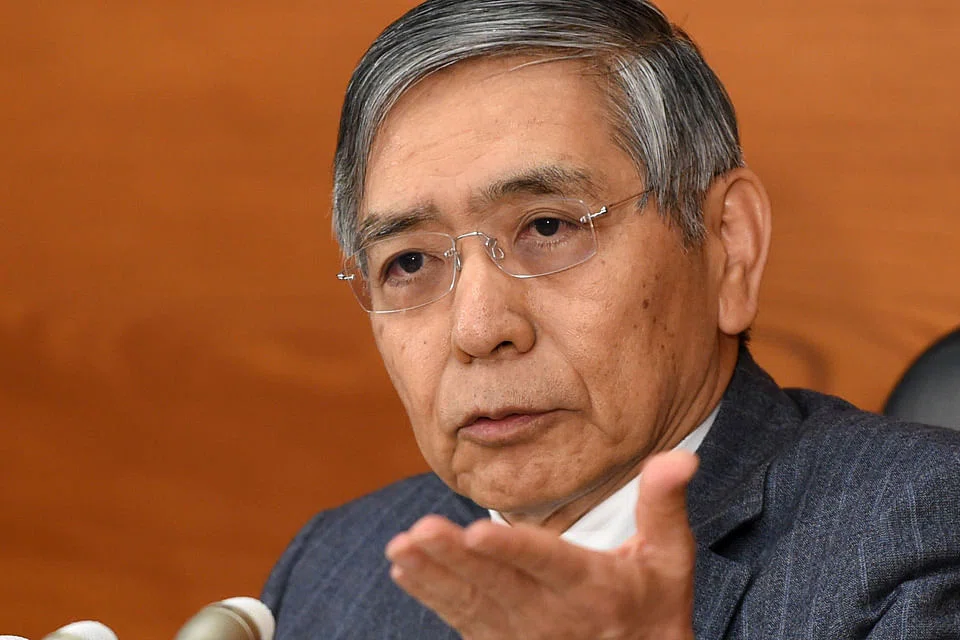
WHAT markets see as coded signals from the Bank of Japan (BOJ) that it intends to launch fresh monetary easing soon - possibly as early as this month - continued to flash on Wednesday as Japanese central bank governor Haruhiko Kuroda again stressed that Japan has not yet escaped from deflation.
His comments in an interview on public television broadcaster NHK were aired as the yen shot to a three- month high against the dollar and to several month-highs against other leading currencies in a development which, analysts say, threatens to derail Japan's economic recovery.
"We are not in a situation where we can say deflation has been beaten," Mr Kuroda said, again stressing the dangers of a return to deflation - even though, until very recently, the BOJ has claimed that progress towards achieving its inflation target is on track when the impact of falling oil prices is excluded.
The BOJ cannot be seen as targeting the exchange rate of the yen by further monetary easing, for fear of being accused by other advanced and emerging economies of creating friction or "currency wars".
So, instead, it has taken to playing up the supposed danger of a return to deflation, some say.
Despite ultra-low interest rates in Japan, the yen is being seen as a "haven currency" along with the US dollar as global economic and political uncertainties and tensions mount. These concerns intensified on Wednesday with news that North Korea had detonated another nuclear device.
China's renminbi is meanwhile being allowed by Chinese authorities to depreciate quite rapidly, while many other emerging economy currencies are also sliding against the dollar and the yen as capital flows out of these economies in search of safety or higher yields elsewhere.
The yen is normally sought after in times of risk aversion such as the present and has climbed to its strongest level since last April against the euro and its highest since last October versus the dollar. It has also risen to its highest against sterling since October 2014.
"It is a risk-aversion trade - a persistent play in the yen," Mazen Issa, senior currency strategist at TD Securities in New York, was reported as saying by Reuters from New York.
The yen jumped 0.6 per cent to 118.35 to the dollar in Tokyo on Wednesday, its highest level since last Oct 15, while it rose to 127.435 per euro, its strongest level since last April.
A stronger yen threatens to derail Japan's economic recovery, which has been based largely upon rising export earnings and profits for the Japanese corporate sector and a surge in service sector earnings, from tourism especially, on the back of a weak yen.
Tokyo's Nikkei 225 share average fell one per cent on Wednesday to 18,191.32 to its lowest close since last Oct 19, reflecting damage caused to investor sentiment by the sudden surge in the yen.
Yen buying accelerated after China's central bank, the People's Bank of China (PBOC), set the renminbi or yuan at a much weaker level than Tuesday's close - a move that sparked fresh speculation that Beijing wants a weaker yuan as its economy loses momentum.
TRENDING NOW

Nvidia reinstates Jensen Huang as CEO; Trump says move poses no national security risk

Beyond the greenback, Vietnam’s big borrowers turn to Asian-currency bonds

Indonesia’s coal tycoon Low Tuck Kwong replaced as Bayan Resources president-director

Six workers file employment claims against Crystal Jade Food Manufacturing

