Bank of Japan’s new trend gauge shows inflation exceeding target
The central bank’s index reveals that CPI rose 2.2% in February, against the 1.6% benchmark by the internal affairs ministry
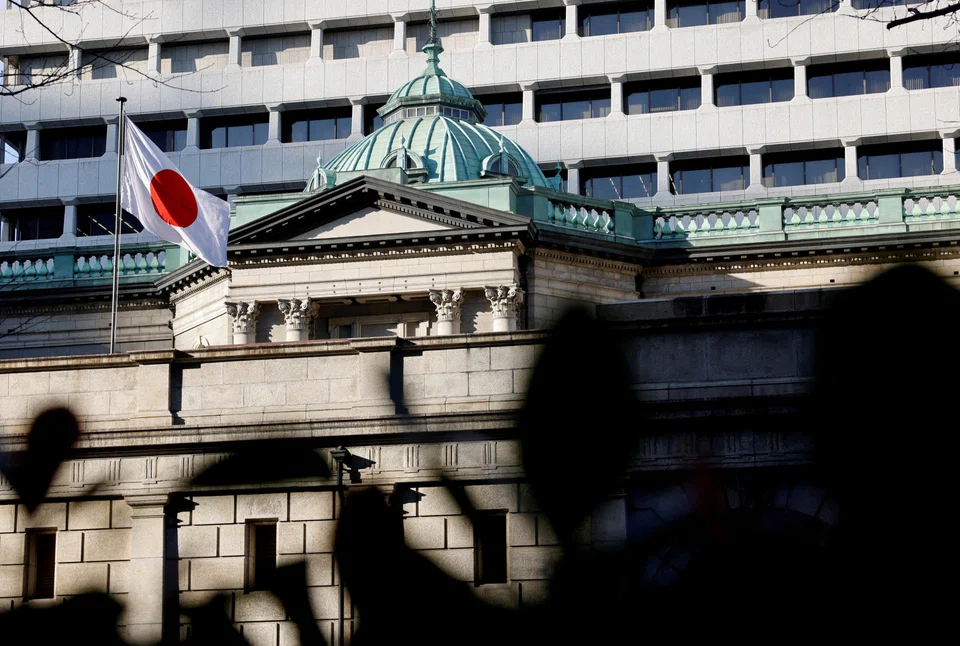
[TOKYO] The Bank of Japan (BOJ) said on Thursday (Mar 26) that the core consumer price index (CPI) rose 2.2 per cent in February, excluding special factors.
The bank released the new gauge for the first time, in what analysts say is an effort to show that underlying inflation is on track for further rate hikes.
The new index, which removes “institutional factors”, showed a sharper year-on-year rise, against the benchmark core CPI figure of 1.6 per cent the internal affairs ministry announced on Tuesday.
Institutional factors include education and energy-related subsidies.
The move follows BOJ governor Kazuo Ueda’s pledge on Mar 19 to disclose new data to enhance communication on underlying inflation, a concept criticised by analysts as too vague despite it being crucial to the banks’ rate-hike decisions.
Former top BOJ economist Seisaku Kameda noted: “While the new indicator likely won’t have a direct impact on the BOJ’s rate-hike timing, it’s a major revamp in the way it communicates underlying inflation.
“The BOJ’s goal was probably to reset and simplify what had become a complex concept that wasn’t very convincing.”
In a statement published on its website, the BOJ said that the new indicator excludes from the core CPI the impact of transitory, policy-related factors, such as the expansion of school tuition subsidies and measures to curb utility bills.
Such government measures were mainly introduced to cushion the blow to households from rising living costs, and therefore work to push down consumer inflation.



The BOJ said that it would publish the data every month, two days after the nationwide CPI is released.
The bank added that core-core CPI, which also excludes energy prices, rose 2.7 per cent excluding special factors, against the government’s calculation of 2.5 per cent.
The gauge is expected to help the BOJ argue that underlying inflation remains on track to stably hit 2 per cent, even if headline inflation briefly slides below the level, analysts say.
The BOJ has defined underlying inflation as price moves driven by domestic demand, rather than cost-push factors such as higher raw material costs.
As inflationary pressures broadened, however, it became increasingly hard to differentiate between price rises driven by higher costs and those driven by solid demand, analysts say.
While the central bank already releases estimates of consumer inflation excluding the impact of fresh food and fuel costs, such indices have also been swayed by various government steps to ease the burden on households from rising living costs.
In a separate statement, the BOJ also released on Thursday updated data that showed Japan’s potential growth rate at 0.65 per cent, a figure Kameda said may lead to a slight upgrade in the BOJ’s neutral rate estimate.
Ueda had said that the BOJ will release updated estimates by June on Japan’s neutral interest rate, which is the level that neither cools nor overheats growth.
The neutral rate is closely watched by markets for clues on the extent the BOJ could raise its short-term policy rate from the current 0.75 per cent. REUTERS
Decoding Asia newsletter: your guide to navigating Asia in a new global order. Sign up here to get Decoding Asia newsletter. Delivered to your inbox. Free.
Share with us your feedback on BT's products and services