

Bank of Korea to hold rate as risks to economy grow
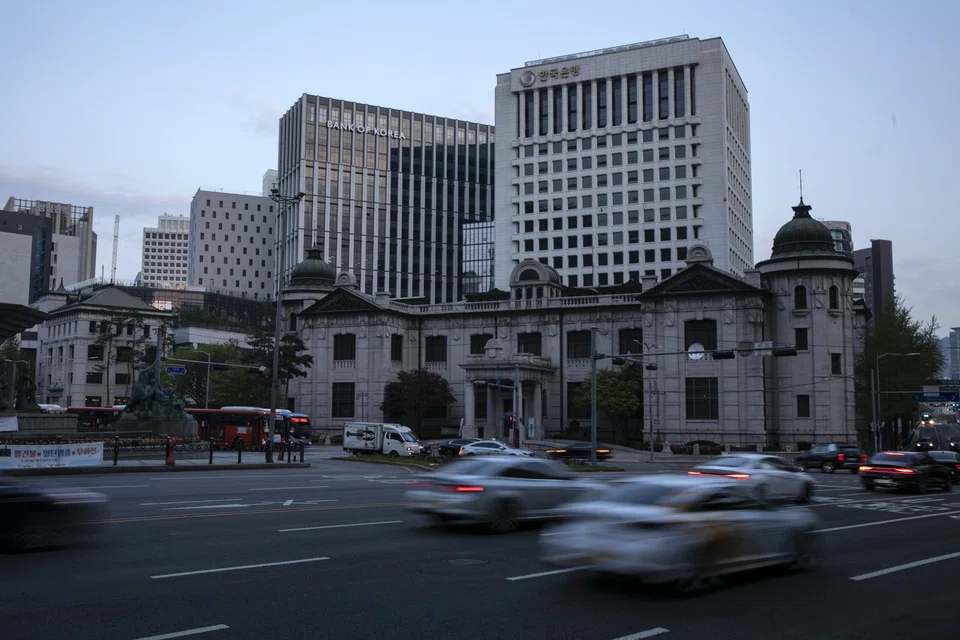
THE Bank of Korea (BOK) is poised to hold its benchmark interest rate steady on Thursday (Aug 24) as it seeks to keep a lid on consumer inflation and household debt while also taking into account increasing risks to the prospects for economic growth.
All 18 analysts surveyed by Bloomberg forecast that South Korea’s central bank will keep its rate at 3.5 per cent for a fifth consecutive meeting. The BOK last raised the rate in January after having begun its tightening cycle in 2021.
A decision to retain a hawkish hold would signal policymakers are continuing their battle against inflation by keeping their policy restrictive. It would also mean they are assessing rising threats to the economy that range from distress in the debt market to a months-long slump in exports.
“The BOK is unlikely to go ahead with another hike, but they will probably maintain their hawkish tone,” said Ahn Yea-ha, an analyst at Kiwoom Securities. The BOK is also likely to keep previous forecasts for economic growth and inflation intact, she said.
Korea’s inflation eased to the slowest in more than two years in July, giving the BOK breathing room to address rising economic risks. In particular, concern is growing in Korea’s credit market after bad loans tied to property projects forced a branch of a credit union to close last month. The central bank has since beefed up its emergency measures to support troubled lenders as needed, but concerns related to the sector persist.
Questions also remain over the timing of a long-awaited rebound in the semiconductor sector, a key for Korean trade. Exports fell at a double-digit pace again for the first 20 days of August. Hopes for a recovery in external demand have been clouded by conditions in China, where authorities are grappling with a host of economic challenges. China is Korea’s biggest trading partner.
One promising spot for Korea’s economy is Beijing’s recent decision to allow its nationals to resume group travel to nearby countries.
Meanwhile, the BOK worries inflationary pressure may pick up once again. While headline inflation eased in July, gains in the core price gauge remained sticky. The central bank, which has a target of 2 per cent inflation, expects consumer prices to accelerate again to the 3 per cent level around the end of the year.
All the members of governor Rhee Chang-yong’s central bank board said at the previous meeting they were ready to raise the rate by another 25 basis points if needed. Rhee didn’t express his view.


Household debt is another concern. As home prices rebounded on government support for the property sector, borrowing picked up again last quarter, according to BOK data. Finance Minister Choo Kyung-ho told lawmakers on Tuesday he would seek to rein in the growth in household debt.
The BOK decision comes just before global monetary officials gather in Jackson Hole in the US for an annual meeting. Rhee said on Tuesday at parliament that the board would be focusing on what Federal Reserve chairman Jerome Powell says when he delivers a speech on Friday. There is an increasing split within the ranks of the Federal Open Market Committee about what should be done in September.
The rate differential between the BOK and the Fed is the biggest on record, putting pressure on the won and complicating the efforts by policymakers to rein in inflation as Korea relies heavily on imports for food and energy.
“The BOK will have to hike rates regardless of the country’s economic fundamental should the won extend losses faster,” said Moon Hongcheol, a fixed-income and FX strategist at DB Financial Investment. “The won is likely at the centre of this week’s policy decision.”
The won traded on Tuesday near a nine-month low and is the worst performer in Asia this month. BLOOMBERG
Decoding Asia newsletter: your guide to navigating Asia in a new global order. Sign up here to get Decoding Asia newsletter. Delivered to your inbox. Free.
Share with us your feedback on BT's products and services
TRENDING NOW
Can a first-time homebuyer couple earning S$18,000 a month afford a new EC unit?

He built the Vingroup empire. Now South-east Asia’s richest man is handing some key roles to his sons

Asia needs new energy security architecture

Chagee, Mixue and Luckin won the market. Sustaining their edge is the harder part

