

Bank of Korea likely to hold rate as inflation tame, growth steady
Inflation projections are broadly expected to remain near the bank’s 2% target
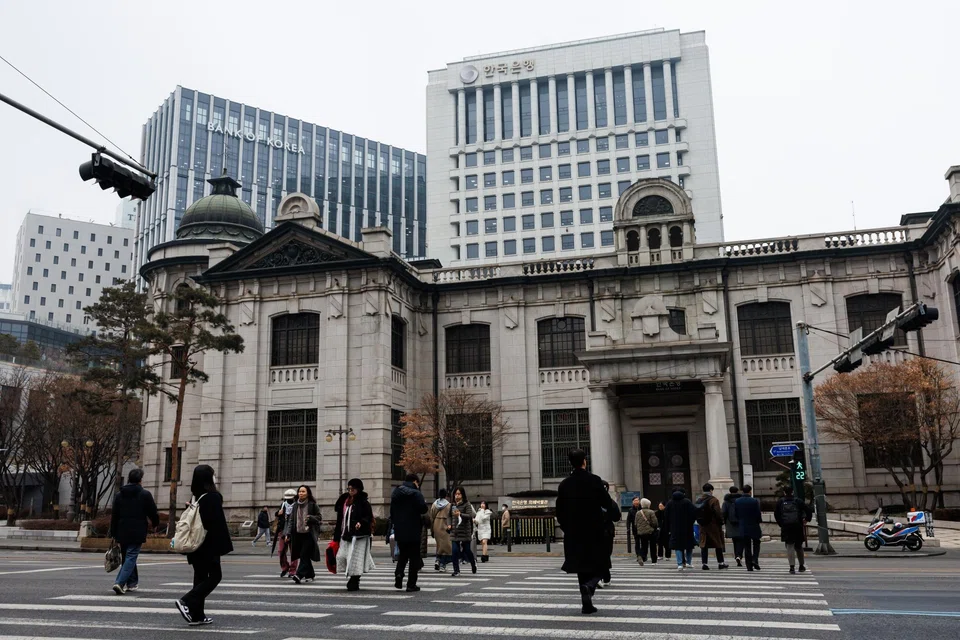
[SEOUL] South Korea’s central bank is widely expected to keep its benchmark interest rate unchanged this week as tame inflation and steady chip exports give authorities room to monitor financial stability risks tied to a property market rally.
In a Bloomberg survey, all 22 economists forecast the Bank of Korea (BOK) will hold the seven-day repurchase rate at 2.5 per cent on Thursday (Feb 26). At its January meeting, policymakers voted unanimously to stand pat and removed language that had pointed to the possibility of further rate cuts, signalling a shift to a neutral stance.
Policymakers will also release updated forecasts for growth and inflation, with strong semiconductor shipments underpinning expectations among economists that the central bank will raise its 2026 GDP growth projection to 2 per cent from 1.8 per cent. Inflation projections are broadly expected to remain near the bank’s 2 per cent target.
Minutes from the Jan 15 meeting showed that one board member still saw scope for additional easing once risks tied to the weakening won and elevated housing prices subside, citing subdued domestic demand and a persistent negative output gap. Still, the rest of the board emphasised financial stability risks, warning that easing could exacerbate financial imbalances and currency volatility.
Recent economic data suggest little need to act. Consumer prices rose 2 per cent in January from a year earlier, slowing from 2.3 per cent in December. Core inflation also held at 2 per cent, in line with the central bank’s target. Although officials remain wary of exchange-rate swings and food-price risks, inflation is not currently viewed as a binding constraint on policy.
Growth trends are also uneven. Early data showed exports extended their expansion in February, driven by hot demand for semiconductor on the back of continued investment in artificial intelligence and data centres.
The BOK’s policy statement is likely to strike “a balanced tone while flagging upside risks to growth and inflation, in our view”, BNP Paribas economist Jeeho Yoon wrote in a note. “We do not see any great urgency for the BOK to adjust its policy rate.”
Beyond chips, however, there’s little driving growth. Domestic demand remains soft, and external risks persist.
Uncertainty over US trade policy has resurfaced after the Supreme Court struck down US President Donald Trump’s reciprocal tariffs last week. While South Korea has said that the trade agreement reached with the US remains intact, Washington is readying a spate of additional national security investigations under Section 232 that would enable Trump to impose new tariffs.




Even before the court ruling, Trump had threatened to reinstate tariffs of 25 per cent on Korean goods, citing delays in investment commitments that were part of last year’s trade agreement. While officials in Seoul have sought to downplay the risk as they continue negotiations, renewed trade friction adds caution to the policy outlook.
Housing is another constraint. Apartment prices in Seoul have risen for 55 straight weeks, according to the Korea Real Estate Board, though the pace of gains has recently moderated. A BOK survey showed that consumer sentiment on home prices cooled in February to a three-and-a-half year low.
The government plans to accelerate construction of about 60,000 homes in the greater Seoul area starting as early as 2027 as part of a broader pledge to construct about 1.4 million units nationwide to 2030. But it may take time before supply measures affect demand.
The central bank has repeatedly warned that looser financial conditions could reignite borrowing and exacerbate household-debt. In January, board members said lending growth was being contained under tighter regulations, but strong housing-price expectations in the capital region could keep upward pressure on leverage.
The external backdrop also supports caution. The US Federal Reserve kept rates unchanged in January after delivering three cuts, citing a stabilising labour market. Minutes, however, revealed divisions among US policymakers, with some arguing rates may need to remain higher for longer if inflation proves sticky. The BOK is likely to remain sensitive to the Fed’s rate path given its implications for yield differentials and the won.
For now, steady inflation, buoyant semiconductor exports and persistent financial-stability risks appear to have anchored the BOK in a wait-and-see mode – a stance unlikely to shift absent a sharper slowdown or a renewed pickup in price pressures. BLOOMBERG
Decoding Asia newsletter: your guide to navigating Asia in a new global order. Sign up here to get Decoding Asia newsletter. Delivered to your inbox. Free.
Share with us your feedback on BT's products and services
TRENDING NOW

Once staunchly pro-China, Malaysian Chinese businesses are now distancing themselves from Beijing

Looking beyond looming CEO succession, should UOB potentially pursue a transformative merger?

Could stablecoins be the future of money?

Grab CEO’s wife Chloe Tong on life with Anthony Tan and finding her purpose

