



To become major hubs, South-east Asia’s new airports need strong national carriers
Singapore still a leading air hub, but managing costs crucial to retaining its edge, says sales agent Aviareps


[SINGAPORE] South-east Asia’s major upcoming airport projects will provide a boost to aviation traffic, but they will not challenge established regional air hubs like Singapore without world-class carriers to support them.
Marcelo Kaiser, chief operating officer of aviation for Aviareps, told The Business Times: “There is no successful air hub without a strong national carrier behind it.”
He said that while Singapore is still a leading air hub, it is not immune to cost concerns and managing this will be crucial for it to maintain its competitiveness.
Kaiser sees airlines headed for further turbulence as fuel costs continue to be elevated; with margins shrinking, they have trimmed the network and increased prices on strong routes to cope.
Therefore, ancillaries become more important.
Based in Germany, Aviareps is a general sales agent (GSA) that manages ticket sales, operations and marketing for airlines lacking a local presence. It also services the hospitality and tourism sectors.
Globally, 40 per cent of airlines use GSA companies for passenger services and 85 per cent for cargo.
Asia’s decade
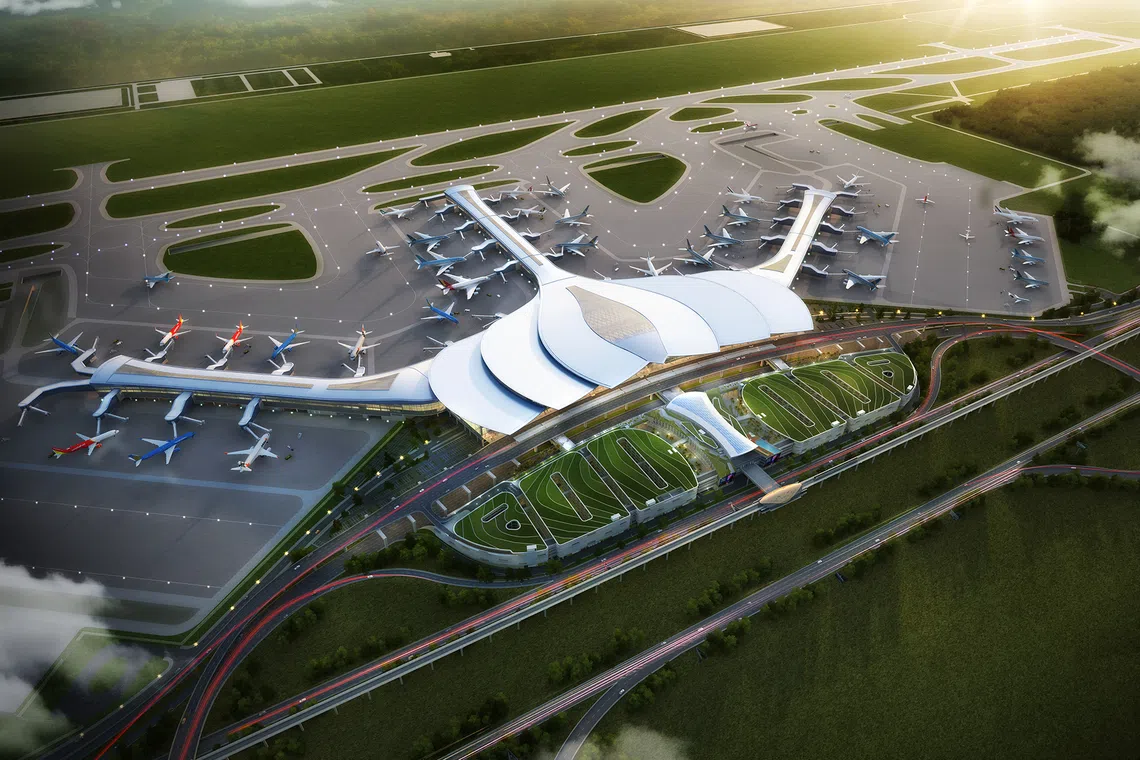
With Asia-Pacific as the largest and fastest-growing aviation market for the coming decades, huge airport projects are in the pipeline to help serve demand, including in South Korea, Australia, China and India.
In South-east Asia, this includes Vietnam, Indonesia and the Philippines.
Vietnam’s new Long Thanh International Airport is one example. It is slated to open by the end of 2026 with a capacity of 25 million passengers per year.
Costing around US$19 billion, Long Thanh International Airport’s final phase after 2035 will make it one of the largest airports in the world with a capacity of 100 million passengers per year.
Other major projects include an expansion for Jakarta’s Soekarno-Hatta International Airport that is planned to bring its capacity to more than 90 million passengers a year in the long run, and a new Manila airport opening in 2028, targeting 35 million passengers.
But Kaiser says that new airports are not necessarily slated to become hubs on size alone, as a competitive national carrier is needed to support connectivity. “Twenty years ago, the global hub of aviation was Europe. Now it is the Middle East. Emirates, Qatar Airways, Turkish Airlines – all these airlines really became world-class… and they built their businesses to become global hubs.”
The region’s new airports will drive traffic in those locales, but established regional hubs such as Hong Kong and Singapore are still dominant.
“It is great to have new airports, which they will price aggressively to attract airlines, but I would not necessarily see a big challenge (for hubs like) Singapore,” he noted.
He added that airports go hand in hand with increased economic development and aviation growth, and they may become strong inbound or outbound gateways, depending on their location.
But these would become end destinations – serving point-to-point traffic – rather than hubs, which thrive on transfers and stopovers.
Singapore’s edge
“The good thing (for Singapore) is the fact that you have Singapore Airlines as a state-of-the-art carrier operating successfully for many, many years and well positioned. I would see today Singapore, as well as Hong Kong as two main hubs or super well-consolidated hubs in Asia.”
Yet, Changi’s rising costs require careful management as it is already one of the most expensive air hubs in the region.
In 2024, Singapore announced increased fees and costs for passengers and airlines until 2030, to fund Terminal 5.
“Jetstar Asia in Singapore closed last year and the reason was cost. Singapore is one of the most expensive hubs in terms of costs,” he noted.
Singapore is a high-cost country and Jetstar a low-cost carrier, this means that high demand and high load factors are required for the airline to be profitable in the market
Jetstar Asia’s struggle to rebalance profitability on routes is not unique, as the region’s low-cost carriers, and indeed major airlines, are in the midst of trimming unprofitable routes, with the likes of AirAsia, Lion Air and Cebu Air all paring back destinations since the Iran conflict began.
With tickets often booked months in advance and the crisis dragging on, high fuel prices have outlasted the typical hedging duration of up to half a year. Airlines now have no choice but to absorb costs, increase current prices, or cancel unprofitable routes, said Kaiser.
Vietnam, India ascendant
But while established hubs still have an advantage, Kaiser does see room for new hubs to spring up especially in key growth markets like Vietnam.
“Competition always forces you to move to the next level – and (Long Thanh) Vietnam could be one such airport. Vietnam to me is one of the destinations or the regions in South-east Asia with massive potential for inbound and outbound traffic and also to become a hub,” he explained.
The country plans to build 30 new airports by 2030, which will feed a demand for air travel and a fast-growing, increasingly mature economy. In terms of capacity, Vietnam has overtaken Thailand as South-east Asia’s second largest aviation market in the past two months.
But developing Long Thanh into a hub will hinge on strong, long-term commitments to make a world-class “five-star” hub and for flag carrier Vietnam Airlines to continue its fleet and network expansion.
India is another market that is full of potential and already driving Apac’s growth. “India is not a promise, it’s already a reality, and it will continue to grow at a very fast pace – much more than already consolidated nations,” Kaiser pointed out.
According to the International Air Travel Association, India is already the third largest single aviation market in the world, with 174 million passengers traveled from and within India by air in 2024. The number of flights increased to 1.8 million in 2024 from 800,000 in 2015.
“It’s the largest country, the most populated country in the world. If you look at the airlines and aircraft orders, India is far from reaching its domestic capacity,” noted Kaiser.
It already has a mega-airport in the works as well: Mumbai’s new airport opened last year, with a total of three phases it is planned to handle 90 million passengers a year by 2032.
India’s airports are mainly point-to-point, but Kaiser envisions that a change in strategy to attract connecting flights and relaxing visa rules could help create a better environment for an air hub in the country.
“I think in the future, maybe in 10 to 15 years, we could see them change their strategy to be a bit more flexible and attract travellers to connect through its airports,” he added.
TRENDING NOW

Government to bring forward raising of retirement age, give employers more financial support to create flexi-load jobs

If Europe goes to war, the fallout will be felt in East Asia

Indonesia stocks suffer worst plunge in nearly 30 years as MSCI proposes standalone status

Vietnam’s northern provinces, not Hanoi or Ho Chi Minh City, are powering near 10% GDP growth

