Beijing tightens rules for entering city after Omicron case
Travellers must get a Covid-19 test within 72 hours of arrival in the capital under new regulation
 Add BT as a preferred source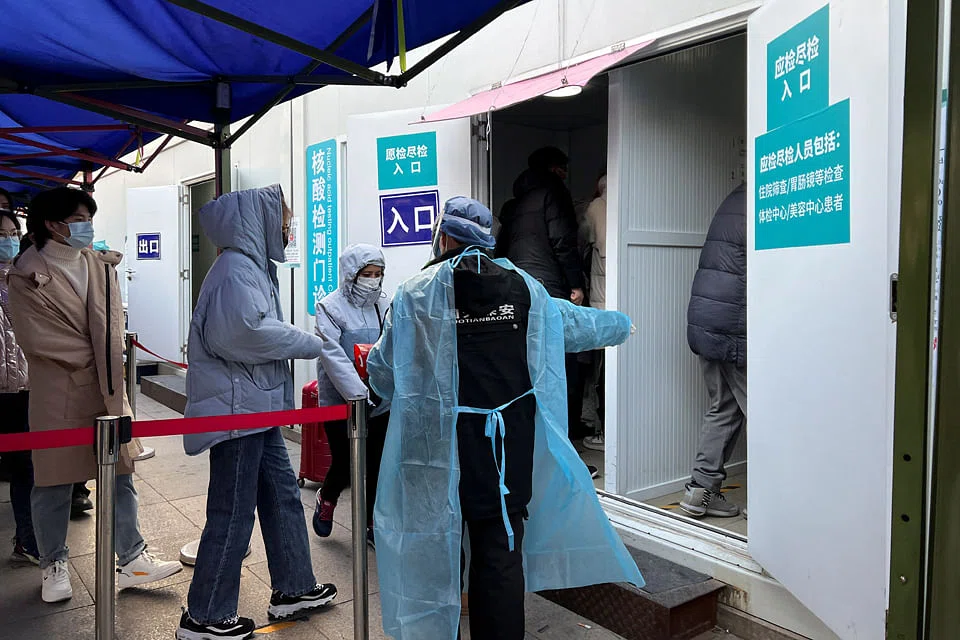
DeeperDive is a beta AI feature. Refer to full articles for the facts.
Beijing
BEIJING will require travellers to get a Covid-19 test within 72 hours of arrival in the Chinese capital, state media announced on Sunday, a day after the city reported its first Omicron case and as it readies to stage the Winter Olympics next month.
On Saturday, the city reported the first local infection of the highly transmissible Omicron variant, involving a person who had visited multiple malls and restaurants in the previous 14 days. The person had not left the city since the start of this year.
The new rule, effective from Jan 22 to end-March, is aimed to help with early detection of Omicron, which is surging globally, and the control of epidemic risks, Beijing Daily, a government newspaper, said on its official social media account.
Already, the capital city requires inbound travellers to take a Covid-19 test within 48 hours of departure for the city and have a green code on the city's health tracking app.
The city and neighbouring Hebei province will host the Olympics, which start on Feb 4, inside a "closed loop" separating athletes and other Games personnel from the general public.
Navigate Asia in
a new global order
Get the insights delivered to your inbox.
So far, local cases of the Omicron variant have been detected in at least 5 provinces and municipalities, prompting cities to impose curbs to stop its spread and threatening to further undercut slowing economic growth.
China has not said how many Omicron cases it has detected in total. "It is too soon to conclude that Omicron will swamp China's efforts to suppress Covid," said Mark Williams, chief Asia economist at Capital Economics, in a note issued on Friday. "But it is clear that the emergence of more transmissible variants is requiring more frequent interventions . . . And the economic toll from this vigilance is mounting."
About 13,000 people have been tested for Covid-19 in the Haidian district where the Beijing case was discovered, but none of the results came back positive, Beijing Daily cited official data as saying on Sunday.
However, some religious sites in the city were already being closed to visitors as a precautionary measure. Lama Temple, a Tibetan Buddhist monastery in central Beijing, said on Sunday that it was closing down for an unspecified period due to Covid-19 epidemic and control measures.
Some Beijing residents, concerned about being trapped in the city for the upcoming week-long Chinese New Year holiday, were rushing to travel back home early because of the Omicron case.
Mainland China reported 119 new confirmed Covid-19 cases for Jan 15, including imported infections, down from 165 a day earlier, according to National Health Commission (NHC) data on Sunday.
The new locally transmitted cases were in Tianjin, Henan, Beijing, Guangdong and Shaanxi, NHC said.
There were no new deaths, leaving the death toll at 4,636.
As at Jan 15, mainland China had 104,864 confirmed cases.
Separately, China's state planner on Sunday urged local governments to minimise the impact from Covid-19 restrictions over the upcoming Chinese New Year holiday to help a rebound in consumption, as rising cases of the Omicron variant threaten economic growth.
"Local governments should avoid simplified, one-size-fits-all . . . Covid-19 epidemic and control measures (over the holiday) and minimise the impact on the people's life," the National Development and Reform Commission (NDRC) said in a statement. It said low-risk places in China should meet the reasonable demand for short trips from urban and rural residents, and step up the supply of everyday products over the holiday period.
China's economy likely grew at its slowest pace in 11/2 years in the fourth quarter, weighed down by weaker demand due to a property downturn, curbs on debt and strict Covid-19 measures.
The NDRC on Sunday also said it supports the healthy development of the property market and the legitimate demand from home buyers, while asking local governments to step up oversight of unfair competition and other monopolistic behaviours. "The measures are aimed to further release the potential of consumer spending and push for a stable start to the economic growth in the first quarter," the NDRC said. REUTERS
Decoding Asia newsletter: your guide to navigating Asia in a new global order. Sign up here to get Decoding Asia newsletter. Delivered to your inbox. Free.
Share with us your feedback on BT's products and services