

Between 'fake news' and 'alternative facts', where would the truth stand?
Team Trump has set in motion a chilling irreverence towards fact that could do great damage to its credibility
New York
WHEN Donald Trump swore the presidential oath on Friday, he assumed responsibility not only for the levers of government but also for one of the United States' most valuable assets, battered though it may be: its credibility.
The country's sentimental reverence for truth and its jealously guarded press freedoms, while never perfect, have been as important to its global standing as the strength of its military and the reliability of its currency. It's the bedrock of that "American exceptionalism" we've heard so much about for so long.
Disinformation was for dictatorships, banana republics and failed states.
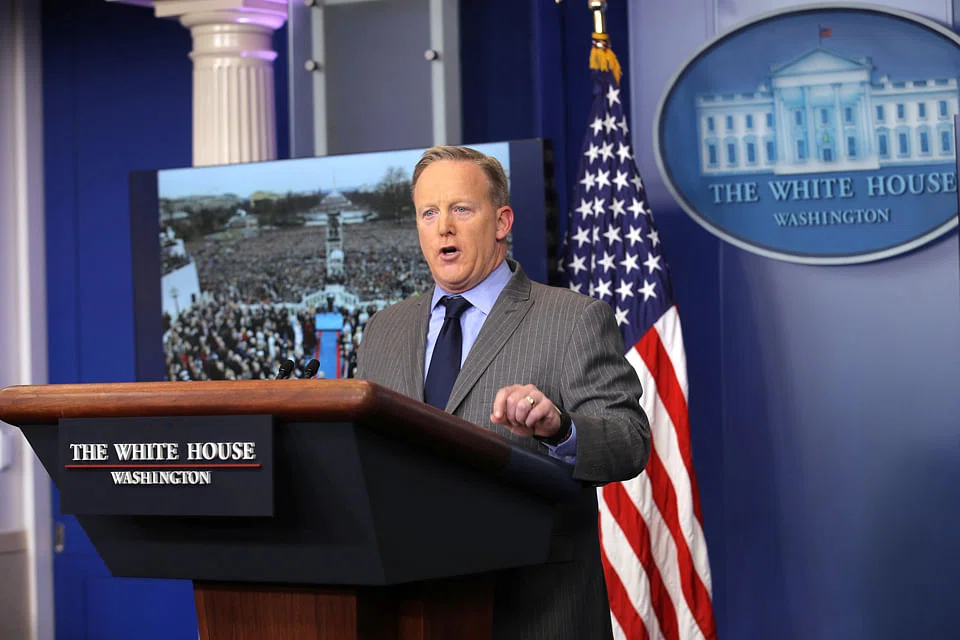
Yet there it was Saturday, emanating from the lectern of the White House briefing room - the official microphone of the United States - as Mr Trump's press secretary, Sean Spicer, used his first appearance there to put forth easily debunked statistics that questioned the news media's reporting on the size of the president's inaugural audience (of all things).
Mr Spicer was picking up on the message from his boss, who made false claims about news coverage earlier that day as he declared a "running war" with the news media during a visit to the CIA, whose most solemn duty is to feed vital and true information to presidents as they run actual wars.
It was chilling when Mr Trump's assertion that reporters were "among the most dishonest people on earth" became an applause line for the crowd gathered to hear him speak in front of the memorial to fallen agents at CIA headquarters.
Still more chilling was when White House senior adviser Kellyanne Conway appeared on Meet the Press on Sunday to assert that Mr Spicer's falsehoods were simply "alternative facts". Ms Conway made no bones about what she thought of the news media's ability to debunk those "alternative facts" in a way Americans - especially Trump-loving Americans - would believe.
"You want to talk provable facts?" she said to the moderator, Chuck Todd. "Look - you've got a 14 per cent approval rating in the media, that you've earned. You want to push back on us?" (She appeared to be referring to a Gallup poll figure related to Republicans' views.)
And really, there it was: an apparent animating principle of Mr Trump's news media strategy since he first began campaigning. That strategy has consistently presumed that low public opinion of mainstream journalism (which Mr Trump has been only too happy to help stoke) creates an opening to sell the Trump version of reality, no matter its adherence to the facts.
Long-term costs
As Mr Trump and his supporters regularly note, whatever he did during the campaign, it was successful: he won. His most ardent supporters loved the news media bashing. And the complaints and aggressive fact-checking by the news media played right into his hands. He regularly portrayed it as just so much whining and opposition from yet another overprivileged constituency of the Washington establishment.
But will tactics that worked in the campaign work in the White House? History is littered with examples of new administrations that quickly found that the techniques that served them well in campaigns did not work well in government.
And if they do work, what are the long-term costs to government credibility from tactical "wins" that are achieved through the aggressive use of falsehoods? Whatever they are, Mr Trump should realise that it could hurt his agenda more than anything else.
There's a reason George W Bush's adviser Karen Hughes told the newly promoted Bush press secretary, Scott McClellan, in 2003, "Your most important job, in my view, will be to make sure the president maintains his credibility with the American people." "It's one of his greatest strengths," Mr McClellan quoted Ms Hughes as saying in his autobiography, What Happened. Mr McClellan's book chronicles how Mr Bush staked that credibility on the false rationale for the Iraq invasion - that Saddam Hussein had weapons of mass destruction - and ultimately lost the confidence of Americans, hobbling him for the rest of his presidency.
But the damage wasn't isolated to Mr Bush's political standing. To this day, the American intelligence community must contend with lingering questions about its own credibility - to wit, taunts from Moscow (not to mention from Mr Trump) that assessments pointing to Russian meddling in the presidential election are questionable. After all, wasn't it wrong about Iraq?
There's a big difference in importance between the size of Mr Trump's inaugural audience and the intelligence that led to war, no question. And, as the former Bush White House press secretary Ari Fleischer noted in a conversation with me Sunday, it's way too early to say whether Mr Spicer's weekend performance will be the norm.
The Trump team's emotions were raw over the weekend, Mr Fleischer noted, after a mistaken pool report was sent to the rest of the White House press corps, claiming that Mr Trump had removed a bust of the Reverend Dr Martin Luther King Jr from the Oval Office. Zeke Miller, the Time magazine journalist who had written the report, quickly corrected it and apologized when the White House alerted him to the error.
"It rightly leaves the people inside feeling that 'reporters were opposed to us all along for being racist and the first thing they did was imply we were'," Mr Fleischer said.
Still, the weekend's events did not arrive in a vacuum. There was the report last week in The Washington Post that the Smithsonian's National Museum of American History, known for high standards of accuracy, was selling a commemorative book about Mr Trump riddled with questionable notions, such as that Hillary Clinton deserved more blame than Mr Trump did for the birther campaign questioning Mr Obama's citizenship. (After that report, the museum said it was removing the book pending an investigation into whether it met standards for accuracy.)
Sanctity of data
The administration's decision to eradicate nearly any reference to "climate change" on the White House website could be expected given Mr Trump's promises to overturn his predecessors' climate policies. But it set off concerns among climate scientists that it would extend to valuable government data - fears that also apply to the sanctity of other administration-controlled data. (Mr Fleisher, for one, noted that career bureaucrats would blow the whistle on any moves to manipulate government data.)
Then there is the central information centre of any White House: the pressroom.
On Thursday, Jim Hoft, founder of The Gateway Pundit, said the White House was giving his site an official press credential. The Gateway Pundit promoted hoaxes such as one alleging that protesters in Austin, Texas, were bused in by liberal donor George Soros. (The originator of that story told The New York Times that his assertions were not supported by fact.) The White House has not confirmed that it will credential The Gateway Pundit, but Mr Hoft's announcement stoked anxiety among traditional reporters that the new administration will pack the pressroom with sympathetic organisations willing to promote falsehoods - or, perhaps, "alternative facts".
It's one thing if that creates a false feedback loop about the size of an inauguration crowd - and quite another if it does so about a more important national security matter, as the CNN chief national security correspondent, Jim Sciutto, said over the weekend.
Mr McClellan, the Bush press secretary, warned in an interview with me Sunday that Mr Spicer might come to regret it if reporters started to doubt the veracity of what he told them. "There will be tough times ahead - there are for every White House - and that's when that credibility and trust is most important," Mr McClellan said.
But more important, he added, when you're at the White House lectern, "you're speaking for the free world to some extent, and what ideals are you holding up for that free world?" There's nothing exceptional about the ones that aren't true. NYTIMES
TRENDING NOW

Indonesia’s coal tycoon Low Tuck Kwong replaced as Bayan Resources president-director

Nvidia reinstates Jensen Huang as CEO; Trump says move poses no national security risk

Six workers file employment claims against Crystal Jade Food Manufacturing

AI agents and stablecoins a ‘perfect match’ for payments, says MetaComp’s Tin Pei Ling

