

Biden and Putin, two children of the Cold War, face off in new confrontation
 Add BT as a preferred source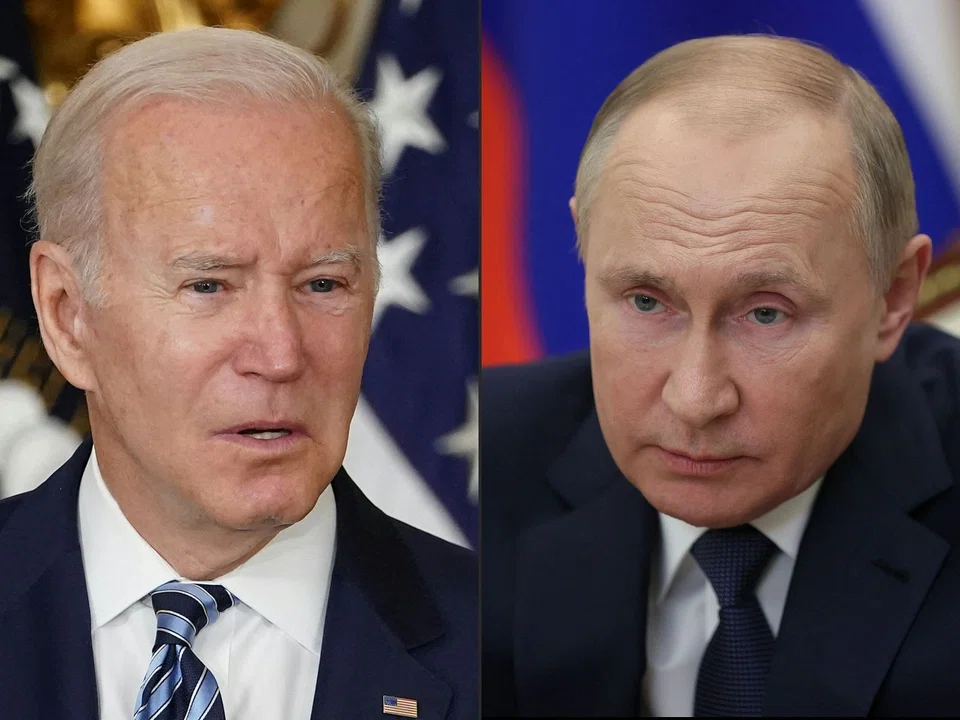
DeeperDive is a beta AI feature. Refer to full articles for the facts.
[WASHINGTON] AS US President Joe Biden tells the story, he was blunt with Vladimir Putin during a meeting in Moscow more than a decade ago.
"I'm looking into your eyes, and I don't think you have a soul," Biden recalled telling the KGB veteran. Putin smiled. "We understand one another," he said.
Now, as the United States seeks to rally the world to counter Russia's invasion of Ukraine, Biden and Putin, the Russian president, are testing their understandings of each other as never before, trying to anticipate and outmanoeuvre each other with the fate of millions of people in the balance.
Not since John F Kennedy and Nikita Khrushchev squared off over Berlin and Cuba have an American president and Russian leader gone eyeball to eyeball in quite such a dramatic fashion.
Although the 2 nuclear states are not poised for war directly with each other, as they were 6 decades ago, the showdown between Biden and Putin nonetheless holds enormous consequences for the world order that may be felt for years to come.
Biden has denounced Putin as "the aggressor" for invading Ukraine and vowed to make him "a pariah on the international stage". To that end, Biden decided last Friday (Feb 25) to impose sanctions on Putin himself, targeting him personally in a way that never happened even during the Cold War.
Navigate Asia in
a new global order
Get the insights delivered to your inbox.
Putin, for his part, is testing Biden's mettle at a time when the Russians have concluded that the US is divided and distracted at home, leaving little room for consensus.
"They are coming from two different planets, and it's difficult to see where that intersects," said Frank Lowenstein, who was on the staff of the Senate Foreign Relations Committee when Biden was its chair. Biden believes in the rules-based system that Putin is trying to tear down.
"He almost seems to personify the old order of things," Lowenstein said of Biden, "whereas Putin in some ways personifies the new lack of order."
Over the past few weeks, Biden has spent hours with advisers and intelligence officials trying to figure out what's in Putin's head and how to influence his calculations - without success so far.
Putin has long harbored bitterness about Ukraine and denied that it was genuinely an independent state, but briefers told Biden that Putin seemed to grow more extreme in his thinking during his isolation over the past two years amid the coronavirus pandemic.
More than most world leaders, Putin has been a virtual recluse, keeping distant even from his own circle, as dramatised by video images in recent days of him sitting far across a room from other Russian officials or visiting foreign leaders. After more than two decades in power and nearing his 70th birthday, Putin has seemed more focused lately on his legacy, Biden's team has told the president.
American officials are debating whether Putin has become unbalanced.
"I wish I could share more, but for now I can say it's pretty obvious to many that something is off with #Putin," Senator Marco Rubio, the top GOP member on the Senate Intelligence Committee, who has access to some of the same intelligence as Biden, wrote on Twitter on Friday night.
As Russian troops gathered near the Ukrainian border, Biden sought to engage Putin by getting on the phone with him and sending every envoy he could to meet with any Russian official who would talk, but his call went nowhere and so did the other discussions.
The challenge is this: If Putin, in the later stages of his reign, is trying to rewrite history by reversing what he sees as the injustice of the 1991 breakup of the Soviet Union and rebuilding the old empire, then traditional tools of deterrence and diplomacy may not be enough to get him to abandon such a messianic mission.
So Biden in recent weeks has emphasised solidarity with Europe to restore the unity of the trans-Atlantic alliance that frayed under former president Donald Trump, who regularly criticised America's friends more than he did Putin.
That diplomatic spadework led both sides of the Atlantic to decide on Friday to target Putin himself by going after his money held abroad.
Biden is the fifth American president to deal with Putin but the first to enter office with a history of involvement in setting policy towards Russia from his time as a senator and vice-president. Unlike the previous 4 presidents, who each to different degrees hoped to forge better ties with Moscow, Biden never harboured illusions about making friends with Putin's Russia, advisers said.
But he did aspire to establish a "stable, predictable relationship" with a tend-the-garden strategy of paying just enough attention to Putin to make him feel respected without wasting time on grand diplomacy that would never work, an approach that would allow Biden to focus on China.
In the face of a previous Russian troop buildup near Ukraine last spring, Biden agreed to a summit meeting with Putin in Geneva over the objection of some advisers who worried it was rewarding the Kremlin leader, who, as it turned out, was more intent on an unstable and unpredictable relationship.
If Biden underestimated his counterpart, Putin may have done the same.
Perhaps influenced by the chaotic US troop withdrawal from Afghanistan last summer, Putin knew that the US had no appetite to commit forces to Ukraine and may have calculated that Biden would not otherwise strongly resist Russian aggression, according to American and Russian analysts.
But although some critics believe he should be even tougher, Biden was unrelenting in calling out Putin's plans to invade Ukraine in recent weeks and has rallied European allies into a more or less common front.
"Like Kennedy and Khrushchev, they're such polar opposites in many ways, but they also share an understanding of the Cold War," said Nina Khrushcheva, the great-granddaughter of the Soviet leader, who now teaches at the New School in New York. "And I think they do understand each other."
Still, she added that they both may have miscalculated in thinking that their familiarity would lead to concessions when neither was actually in a position to deliver what the other really wanted. Biden wanted Putin to basically stay in his box, and Putin wanted to expand the size of his box.
Biden and Putin are both children of the Cold War, raised, educated and married in an era when the spectre of a planet-ending conflict between the US and the Soviet Union hovered over everything.
Yet they emerged from that twilight struggle with radically different views of how it ended: one celebrating it as a victory for freedom and democracy, the other mourning it as a disaster for his nation and people.
They both come from modest upbringings and are products of their disparate systems, but they rose to power along distinct paths.
Biden, 79, is a backslapping politician who relies on the force of his upbeat personality to drive diplomacy, while Putin, 69, is a dour former intelligence agent who nurses resentments and conspiracy theories.
Putin never talks about his family, while Biden can hardly stop talking about his. Putin spent no time in elective politics before being plucked out of obscurity to succeed Boris Yeltsin, while Biden spent a lifetime running for office.
They each have a penchant for macho exhibitionism - Putin posing for pictures shirtless or with tigers, and Biden showing off his muscle cars and boasting that he would like to beat up Trump.
"Biden's a retail politician, and Putin is from the covert security services who runs with a Mafia-like inner circle," said Heather Conley, president of the German Marshall Fund of the US, a group that promotes trans-Atlantic relations.
"Putin's vision is of a grievance-filled history that he is seeking to overturn, and Biden's history is of an American victory at the end of the Cold War and the positive power of alliances and freedom and democracy."
For a time, American presidents thought they could make common cause with Putin.
After he took over as prime minister in 1999 and president in 2000, Putin seemed determined to bring Russia into the West, aligning himself with president George W Bush after 9/11 and welcoming US troops into former Soviet territory.
In 2002, he said that the Baltic republics had every right to join Nato if they wanted to.
But after the Rose Revolution in the former Soviet republic of Georgia in 2003 and the Orange Revolution in Ukraine in 2004 brought to power pro-Western governments, Putin suspected the uprisings were US-sponsored dress rehearsals for a plot to take him out.
While objecting to the Iraq War, he still cared enough about international approval to host the Group of 8 leaders at a palace outside St Petersburg in 2006.
By the next year, he broke with the West in a blistering speech at the Munich Security Conference blasting the US-led order.
Putin's war with Georgia in 2008 and annexation of Crimea and sponsorship of separatist uprisings in Ukraine in 2014 signalled a revanchist strategy of undoing the Soviet collapse, which he termed the "greatest geopolitical catastrophe" of the 20th century.
After he concluded that street protests against him in 2011 were somehow the work of Hillary Clinton, he authorised a clandestine operation to help defeat her in 2016 and elect Trump.
Biden has a long history with Russian officials as well. In 1979, as a senator, he met with Soviet leader Leonid Brezhnev, and when he became president Barack Obama's vice-president, Biden was the one who suggested the two sides "press the reset button". But after tensions rose, he was assigned to lead support for Ukraine, putting him at odds with Putin.
When he visited Moscow in 2011, Biden held what he described as a contentious meeting with Putin, who at the time held the position of prime minister again but was still the country's paramount leader.
"Putin was ice-cold calm throughout, but argumentative from start to finish," Biden recalled in a memoir. He wrote that he told Putin about his efforts to keep Georgia's leader Mikheil Saakashvili from antagonising Moscow.
"I speak to Saakashvili regularly on the phone and I urge him not to take provocative actions, just as I urge you to restore Georgia's sovereignty," Biden said.
"Oh," replied Putin, the old spy, "we know exactly what you say to Saakashvili on the phone".
Whether Biden actually told Putin that he had no soul at this meeting or embellished the story as some suspect, the point was that the vice-president was trying to distinguish himself from Bush's famous comment that he "was able to get a sense of his soul" upon first meeting Putin.
John Beyrle, who was the US ambassador at the time and sat in on Biden's meeting with the Russian leader, recalled that Putin delighted in throwing the Americans off guard with a surprise proposal to loosen visa rules between the two countries, but otherwise it was "just a plain vanilla meeting".
"I don't even remember the chemistry or the body language being terrible," he said. But Putin was not oozing in warmth, he noted: "Talk about expressionless. Very controlled guy."
It was a contrast with Biden. "Obviously, they are very different people," Beyrle said
A decade later, the 2 men who thought they understood each other find themselves on opposite sides of a collision that is shaking the world. NYTIMES
Decoding Asia newsletter: your guide to navigating Asia in a new global order. Sign up here to get Decoding Asia newsletter. Delivered to your inbox. Free.
Share with us your feedback on BT's products and services
TRENDING NOW

StarHub hands Ensign InfoSecurity control back to Temasek in S$115 million deal, books S$200 million gain
Singaporeans can now buy record amount of yen per Singdollar
Air India asks Tata, Singapore Airlines for funds after US$2.4 billion loss

Keppel DC Reit posts 13.2% higher Q1 DPU of S$0.02833 on strong portfolio performance

