

Biden's shots-for-millions rule hinges on supreme court showdown
Business groups, Republican-led states trying to stop the rules, saying they would cost billions of dollars and violate state sovereignty
 Add BT as a preferred source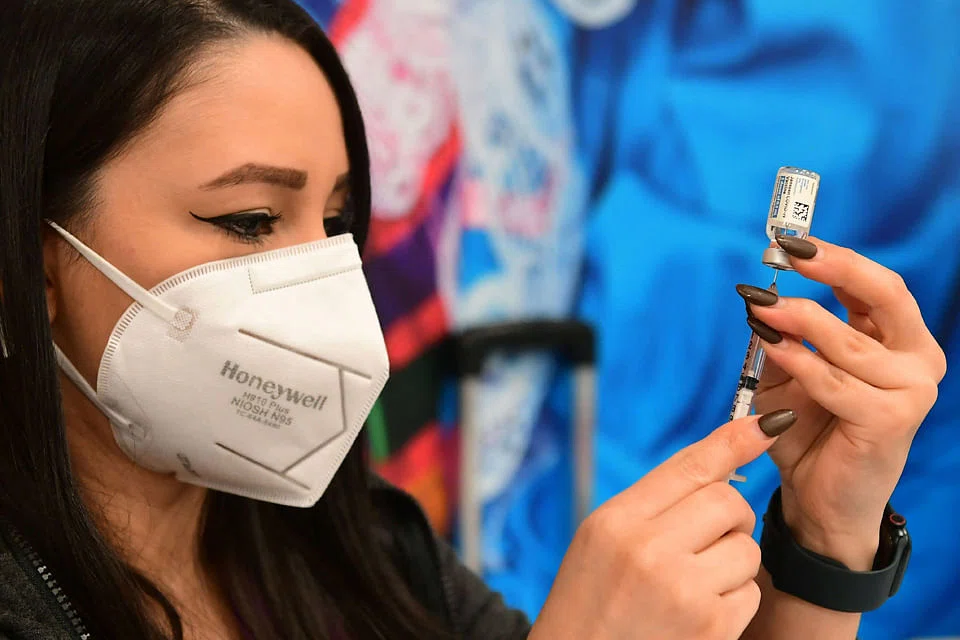
DeeperDive is a beta AI feature. Refer to full articles for the facts.
THE fate of President Joe Biden's push to vaccinate millions of workers amid the latest Covid-19 surge rests with a US Supreme Court likely to be wary of his assertion of broad federal power to confront the pandemic.
The justices hear arguments on Friday (Jan 7) on 2 administration rules, one demanding 80 million workers get vaccinated or regularly tested, and a second requiring shots for workers in facilities that receive government healthcare funds. Business groups and Republican-led states are trying to stop the rules from taking effect, saying they would cost billions and violate state sovereignty.
The initiatives represent the heart of Biden's plan to increase the country's vaccination rate as the Omicron variant propels a spike in cases. The US Centers for Disease Control and Prevention (CDC) says only 62 per cent of the country is fully vaccinated and just 35 per cent of people have received a booster shot.
But administration lawyers will have to persuade a conservative-majority court that has already blocked 1 Biden effort to contain the deadly virus. The justices in August lifted the CDC'S moratorium on evictions, saying that landlords were suffering "irreparable harm" and that Congress hadn't given the agency the type of "sweeping authority" it was asserting.
"Our system does not permit agencies to act unlawfully even in pursuit of desirable ends," the court wrote in an unsigned decision that drew dissents from the 3 liberal justices.
The double showdown will mark the first time in decades the court has heard arguments on emergency requests for a stay without ordering the full briefing that occurs when cases are heard on the merits. The court could rule in a matter of days.
Navigate Asia in
a new global order
Get the insights delivered to your inbox.
A Supreme Court spokesman said that all 9 justices have received booster shots, indicating they don't have personal objections to the vaccines. And the court has been receptive to targeted vaccine mandates issued by state and local officials, repeatedly rejecting religious objections.
The latest cases involve very different legal issues: The power of federal agencies whose governing statutes don't explicitly authorise vaccine requirements. Curbing federal agency power has been a core issue for several members of the court's conservative wing.
While state and local authorities have well-established power to protect public health, federal agencies "have more narrow and discrete sources of authority that extend no more broadly than their legislative authorisation".
The bigger of the cases involves an Occupational Safety and Health Administration (Osha) rule that requires employers with 100 or more workers to make them get vaccinated or be tested regularly, potentially at their own expense. Osha has said it could start issuing citations as soon as Jan 10.
Osha issued the rule as a so-called emergency temporary standard, or ETS. Under federal law, the agency can put an ETS in place immediately for 6 months but must meet a more demanding legal test by showing it is "necessary" to protect employees from "grave danger". Twenty-six business groups led by the National Federation of Independent Business (NFIB) contend that Osha didn't meet that test and that Congress didn't provide the clear authorisation the court's precedents require for such a sweeping mandate.
"Unless this court immediately stays the ETS's effective date, on Jan 10, America's businesses will immediately begin incurring billions in nonrecoverable compliance costs, and they will lose employees amid a pre-existing labour shortage," the trade associations argued in court papers. They said that Osha "drastically underestimated" compliance costs when it pegged them at US$3 billion.
Ohio is leading a separate group of 27 states challenging the Osha rule. They argued that the rule "will interfere with the states' sovereign prerogative to develop vaccine policies best suited to their populations".
US Solicitor General Elizabeth Prelogar countered that the rule "falls squarely within Osha's statutory authority". She pointed to the agency's pre-Omicron estimate that the standard will save more than 6,500 worker lives over 6 months.
The second rule, issued by the Centers for Medicare & Medicaid Services (CMS), requires vaccinations for employees at facilities that participate in the Medicare and Medicaid health-care programmes. Facilities must provide medical and religious exemptions.
Federal law lets CMS, part of the Department of Health & Human Services, impose rules that "the secretary finds necessary in the interest of the health and safety" of patients. Two groups of states, led by Missouri and Louisiana, are challenging the mandate.
With both rules, a central issue is whether the main effect will be to keep people healthy and on the job, or instead prompt employees to quit rather than comply.
The NFIB-led group says surveys indicate a large percentage of workers would resign, exacerbating what is already a historically tight labour market. But Andy Slavitt, who served as acting director of CMS when Barack Obama was president and advised Biden on Covid for a few months, says data shows that when mandates are put in place, the vast majority of workers eventually agree to get vaccinated. BLOOMBERG
Decoding Asia newsletter: your guide to navigating Asia in a new global order. Sign up here to get Decoding Asia newsletter. Delivered to your inbox. Free.
Share with us your feedback on BT's products and services
TRENDING NOW
‘Boring’ is the new black: The stars are aligning for a Singapore stock market revival
Near sell-out launches in March boost developer sales to 1,300 units after four slow months

China pips the US if Asean is forced to choose, but analysts warn against reading it like a sports result

Genting Singapore’s Lim Kok Thay receives S$7.5 million pay package for FY2025

