

BOE set to stress test longer energy shock while holding rates
Its monetary policy committee is expected to leave borrowing costs on hold at 3.75% on Thursday
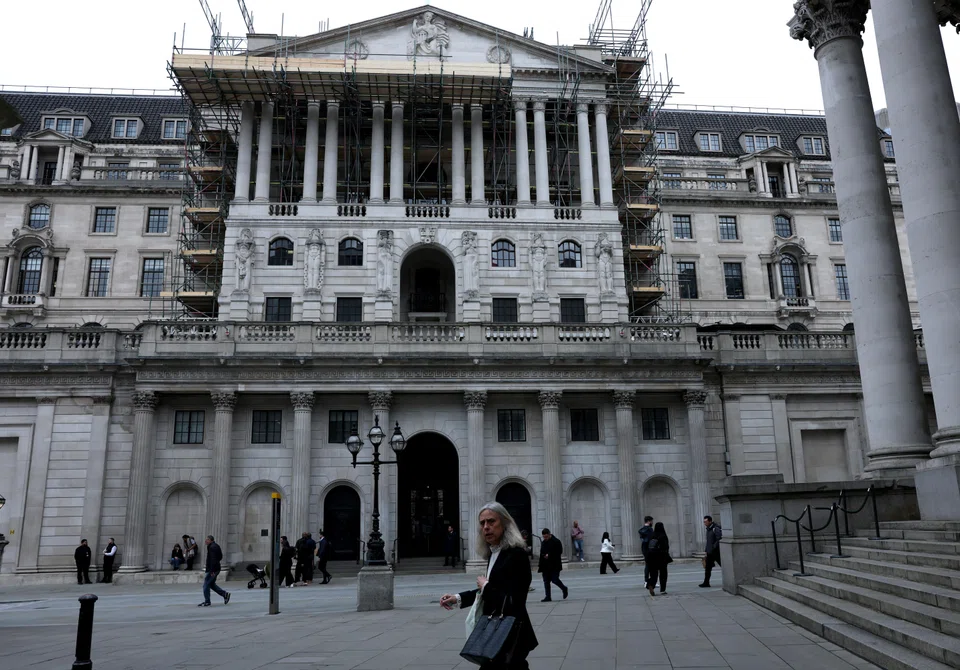
[LONDON] The Bank of England (BOE) is expected to stress test multiple scenarios, which reveal how it might react to a prolonged energy price shock this week. This comes as it holds off immediate action on interest rates.
The monetary policy committee (MPC) is widely predicted to leave borrowing costs on hold at 3.75 per cent on Thursday (Apr 30), as it awaits further clarity on the Middle East conflict.
However, its members may use an innovation in their communications to show how they will respond to extended market turmoil, as the Iran war comes close to entering its third month.
Officials believe that futures signalling a sharp easing of energy-price pressures may be too optimistic, given the damage done to infrastructure in the Middle East.
While that pricing will underpin the BOE’s central forecasts, the bank is likely to acknowledge the possibility of a more negative outcome with damaging implications for growth and inflation.
“They may have scenarios for energy prices, but will probably also have scenarios for the different extent of second-round effects for a given path of energy prices,” said Michael Saunders, a former BOE rate-setter and senior adviser at Oxford Economics.
He added that the scenarios will “play a central role in their decision making” because of the “wide range of possible outcomes”.
A prolonged energy shock would likely deliver a further blow to growth and jobs, but also increase the risk of an inflationary feedback loop as workers demand bigger pay rises to compensate, and squeezed firms respond by trying to raise prices.
BOE hawks could put more emphasis on the latter than the former, with recent data suggesting that activity bounced back in April.


So far, however, the evidence of such effects is limited, as neither employees nor companies have real leverage at a time when firms are cutting jobs and demand is fragile.
Money markets are pricing in two quarter-point rate increases this year, but many economists think the BOE is more likely to keep policy unchanged.
Dan Hanson and Matt Bunny, Bloomberg economists, said: “The BOE looks set to hold rates steady in April, as it continues to assess the impact of the energy shock on the economy.
“It is likely to maintain its guidance that it ‘stands ready to act’, with a minority of policymakers calling for pre-emptive hikes.”
They added: “While those votes might grab the headlines, we think the majority will be concerned about ratcheting up rates when demand is weak. That would be consistent with our view that rates will ultimately remain steady this year.”
Some analysts believe that the damage from weeks of conflict in the Persian Gulf will keep energy prices elevated, even if the US and Iran manage to reach a peace deal and the Strait of Hormuz is reopened to commercial shipping.
The BOE has sought to de-emphasise its central inflation forecast after being criticised for underestimating the size and persistence of inflation following the energy shock triggered by Russia’s invasion of Ukraine.
Recent monetary policy reports have included alternative paths for inflation and rates, which were part of reforms proposed by former US Federal Reserve chair Ben Bernanke.
Policy rules that were derived from economic literature were used to show how rates could respond, with some of the nine MPC members indicating which of the scenarios they viewed as the most probable.
The BOE will be seeking to avoid a repeat of the sharp market reaction to its March meeting, when investors rushed to bet on more rate hikes after the bank said it was ready to act on inflation. The two-year yield swung some 32 basis points on the day of the decision.
Many market participants blamed the volatility on another innovation that features the bank publishing the views of each rate-setter alongside its main statement.
Governor Andrew Bailey tried to calm investors who had priced in as many as four hikes, insisting that he was in no rush to change policy.
“It was quite an overreaction from markets last time,” said Thomas Pugh, chief economist at RSM UK. “I wouldn’t be surprised if, to avoid that reaction, you get something a bit temporary and clearer.”
While the bank may lean on scenarios to address the huge uncertainty over energy prices, there is likely to be a clearer common thread running through the individual contributions, said Laurence Mutkin, head of Europe, the Middle East and Africa rates strategy at Bank of Montreal.
“They probably think they should express a more unified front again,” he added. “You’ll see much more shared text in the individual statements.” BLOOMBERG
Decoding Asia newsletter: your guide to navigating Asia in a new global order. Sign up here to get Decoding Asia newsletter. Delivered to your inbox. Free.
Share with us your feedback on BT's products and services
TRENDING NOW

Once staunchly pro-China, Malaysian Chinese businesses are now distancing themselves from Beijing

Cliff Tan has 7 million followers and a 4-month waitlist. Why won’t he expand his business?

Could stablecoins be the future of money?

Grab CEO’s wife Chloe Tong on life with Anthony Tan and finding her purpose

