

BOJ signals concern over surge in Japanese banks' overseas lending
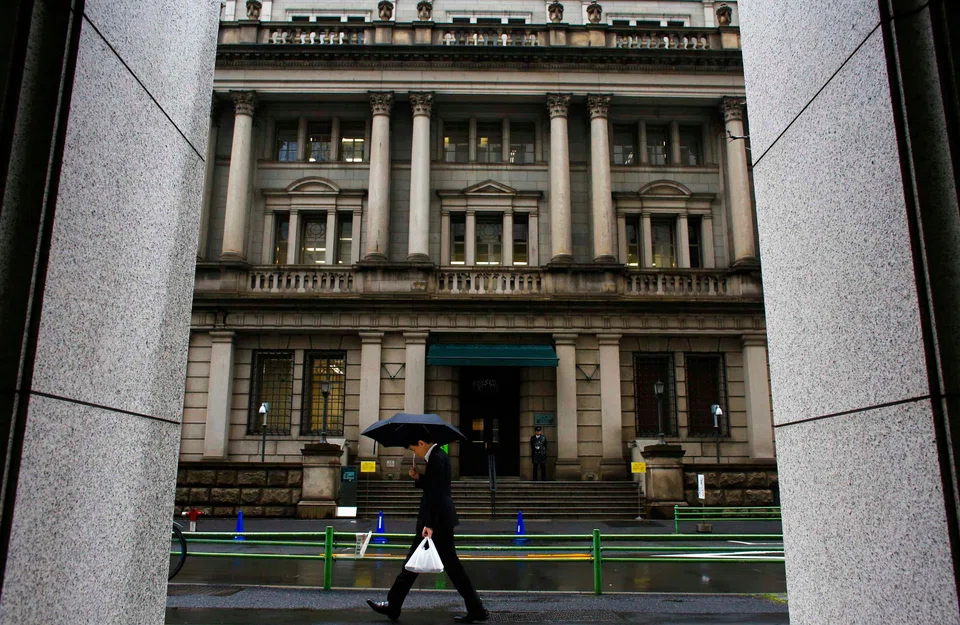
Tokyo
JAPANESE banks have been advancing aggressively in Asia and beyond in the wake of the 2008 global financial crisis, swelling their loan books and making acquisitions, while European and US banks have retreated. This strategy is worrying the Bank of Japan (BOJ), which sees possible funding risks ahead for banks.
"This is a major concern from our perspective," a senior BOJ official said. "We think the banks' (overseas) funding structure needs attention and we may have to enhance our monitoring," he added.
BOJ officials said that while the massive non-performing loan problem that Japanese banks faced in years following the collapse of Japan's "bubble economy" is now a "thing of the past", new potential problems are looming, including the surge in overseas lending and a shift towards "riskier" assets in general.
The Japanese central bank's warning about overseas risks at banks in general came in the same week that one of Japan's three so-called megabanks, Bank of Tokyo Mitsubishi UFJ (BTMU), announced that it had invested US$100 million to become the first foreign lender in decades to open a branch in Myanmar.
Two years ago, BTMU announced ground-breaking plans to buy a majority stake in Thailand's Bank of Ayudhya from General Electric and others, giving Japan's biggest bank a strong foothold in the South-east Asian lending market, which is expanding three times faster than the Japanese market.
As other major and minor banks follow suit, concerns are reviving of funding "squeezes" that Japanese banks have been subjected to in the past when foreign banks demanded a "Japan premium" on the interbank dollar loans they made to Japanese banks to enable them to fund their foreign loans.
While US banks are able to lend overseas in dollars, and European banks to make euro loans overseas, demand for yen-denominated loans is smaller and Japanese banks suffer from a "currency mismatch" in funding as well as a "maturity mismatch" between short-term deposits and long-term loans.
Potential problems are greatest among Japanese regional banks that have piled into overseas lending over the past two years, making so-called "impact loans" denominated in foreign currencies from Japan, whereas major banks have made loans from their foreign branches and are somewhat more insulated.
All Japanese banks are vulnerable to interest-rate rises on their dollar borrowing as monetary policy normalises in the United States and the cost of borrowing rises, the BOJ said in its latest annual Financial System Report, adding that attention should "be paid to the risk that volatility in global financial markets will rise".
"We share these concerns," Naoko Nemoto, managing director and research fellow at rating agency Standard & Poor's in Tokyo, told The Business Times. Japanese bank lending overseas "has been increasing at a rapid pace", funded mainly by "wholesale" market deposits rather than an organic deposit base, she added.
BOJ data shows that overseas lending by Japanese megabanks and other major banks virtually doubled to around US$600 billion between 2010 and 2015 (rising even more sharply in yen terms) while lending by regional banks that are relatively new to overseas markets more than quadrupled to over US$20 billion.
Overseas lending has surged by eight times over the past 10 years, a BOJ official noted. Data for the three megabanks - BTMU, Mizuho Financial Group and Sumitomo Mitsui Financial Group - shows that loans have grown fastest to Asia and North America, followed by Europe and Latin America.
Overseas loans now account for around 80 trillion yen (S$896 billion) or some 20 per cent of Japanese banks' total outstanding loans of around 400 trillion yen, according to approximate estimates by sources at the BOJ.
The rise reflects the stagnation in Japan's economy in recent years and the need for Japanese banks and other deposit-taking institutions to look overseas for lending growth. But the size of their overseas lending has not been matched by growth in their foreign-currency deposit base, said S&P's Ms Nemoto.
The BOJ's Financial System Report lists the need to monitor the expansion of international operations and overseas exposure at the top of the list of "macroprudential challenges" in order to "ensure the stability" of the Japanese financial sector in the future.
"Particularly in the foreign exchange and currency swap market, lenders of US dollars have tended to be concentrated among a small number of large institutions," the report noted. "It is therefore necessary to be aware of the risks associated with the concentration of dollar lending among large institutions."
Financial institutions must "continuously assess liquidity conditions" in foreign currency funding markets as well as their own funding ability in markets, and diversify their funding measures and counterparties, and conduct stress tests in order to set practical responses, the report said.
The BOJ report also noted that Japanese banks' exposure to property markets is rising as financial asset prices in general are boosted by the central bank's aggressive monetary expansion. Likewise, the exposure of banks and other Japanese financial institutions to "riskier" asset such as equities is rising.
Japanese have meanwhile reduced their bond holdings while boosting loans and securities investment, the report said.
Since the BOJ launched its monetary stimulus programme two years ago, domestic financial institutions saw their balance sheet expand by 124 trillion yen, of which 89 trillion yen was in cash and deposits, it noted.
As the BOJ itself has bought Japanese Government Bonds (JGBs) aggressively, in order to inject cash into the market, financial institutions cut their JGB holdings by 34 trillion yen while spending nearly twice that amount, increasing domestic and overseas lending as well as investing in other securities.
Despite reducing JGB holdings, financial institutions would incur a total 7.5 trillion yen in losses if long-term interest rates rose by one percentage point, the report said. "While that is about 10 per cent lower than the peak of 8.3 trillion yen as of end-March 2013, it is still a significantly high level from a long-term perspective."






