

Brexit shock will cause severe unemployment, recession: UK Treasury
London
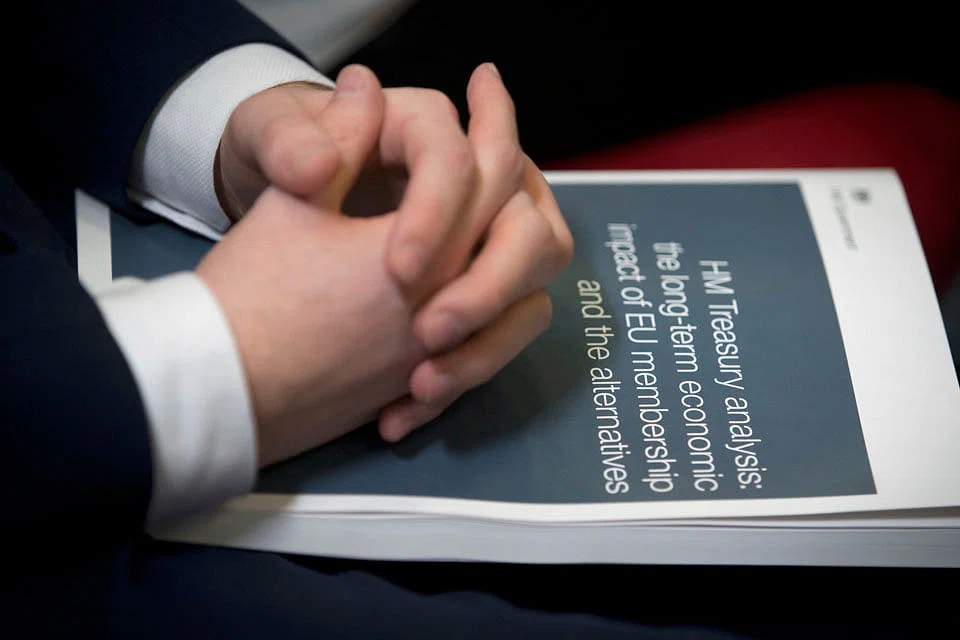
WITHIN weeks of an exit from the European Union (EU), the British economy would slide into an inflationary recession with unemployment rising by at least 500,000, the UK Treasury has predicted.
Previously the Treasury projected poor economic performance in the long term, but the latest analysis forecasts "economic shock scenarios" in the event of Brexit. Unveiling the latest analysis, George Osborne, UK Chancellor of the Exchequer, said that the latest Treasury study focused on the immediate economic impact if voters chose to exit the union in the June 23 referendum.
"The analysis in this document comes to a clear central conclusion: a vote to leave would represent an immediate and profound shock to our economy," Mr Osborne said. "That shock would push our economy into a recession and lead to an increase in unemployment of around 500,000, gross domestic product (GDP) would be 3.6 per cent smaller, average real wages would be lower, inflation higher, sterling weaker, house prices would be hit and public borrowing would rise."
This scenario, which accepts an eventual UK bilateral trade agreement with the EU, still predicts that the pound would fall by 12 per cent, inflation would increase by over two percentage points and the value of homes would slide by 10 per cent in the two years following the referendum.
Mr Osborne added that there was a more "severe scenario" following an amplification of uncertainty and "tumultuous" volatility in financial markets. There was a "credible risk" that "GDP would be 6 per cent smaller, there would be a deeper recession, and the number of people made jobless would rise by around 800,000 compared with a vote to remain".
Under this dire scenario, the stock market slide would be steep, sterling would slump by 18 per cent to around 1.18 against the US dollar, inflation would jump by 2.7 per cent, house prices would tumble by 18 per cent and government borrowing and bond yields would surge.
In response to yet another gloomy forecast in the event of Brexit, following pessimistic predictions of the International Monetary Fund (IMF), Organisation for Economic Co-operation and Development (OECD) and Bank of England (BOE), the stock market hardly moved and sterling dipped marginally against the US dollar. The reasons, according to market participants, is that the consensus, surveys and polls currently indicate that the British electorate will narrowly vote to remain in the EU. Also several respected Brexit supporting economists contend that a Brexit impact would be minimal and potentially positive in the medium and long term.
Jon Moulton, founder of Better Capital, a private equity firm, Minister of State at the Department of Energy and Climate Change Andrea Leadsom and Capital Economics executive chairman Roger Bootle joined more than 30 economists, politicians and business leaders in signing a statement saying the Treasury had consistently got its forecasts wrong.
"The real risk to the economy is to stay tied to the failing single currency (euro) with an obligation to pay its bills," they wrote. "If we vote 'Leave', we will substantially cut the current-account deficit and thus will be able to stabilise the economy. The same old scare stories simply don't wash."
Iain Duncan Smith, who resigned from the Cabinet in March, accused the government of focusing only on the negatives. "They have today chosen only to produce the downside," Mr Duncan Smith said. "That makes this report categorically unfair and biased."
Nevertheless, since "Remain" is the overall belief in the markets, Brexit could well prove to be a shock and the probable short term consequence could well be a stock market and sterling slide that would jolt the economy in the short term. Voters could easily turn to Brexit because of fears of excessive migration and worries about Turkey, Albania and several impoverished nations joining the EU. UK Prime Minister David Cameron's former strategist, Steve Hilton, for example, came out with severe criticisms of the EU and has publicly supported the "Leave" campaign. The gap in opinion polls is narrow.
"The Treasury analysis in this document uses a widely-accepted modelling approach that looks at the impact of this uncertainty and instability on financial markets, households and businesses, as our economy transitions to a worse trading arrangement with the EU," said Mr Osborne. He added that Charles Bean, a former deputy governor of the Bank of England, who had reviewed the latest analysis, contended that it "provides reasonable estimates of the likely size of the short-term impact of a vote to leave on the UK economy".
The Treasury's latest analysis sets out how the immediate economic impact of a vote to leave would be driven by three factors. Firstly, during the "transition effect", businesses would start to reduce investment spending and cut jobs in the short term, consistent with lower external demand and investment. This transition effect would also lead to lower incomes, reducing household spending. Secondly, there would be an "uncertainty effect" as the nation grapples with new trade and other deals, commercial contracts and new domestic and international policies. Businesses and households would respond by putting off spending decisions until the nature of new arrangements with the EU became clearer, the Treasury forecasts. Finally, as a result of uncertainty, the "financial conditions effect" would cause asset price falls that would add to a pessimistic environment and the UK would be viewed as a bigger risk to overseas investors.
"Through a combination of these three factors, a vote to leave the EU would have a damaging effect on both the demand and supply side of the economy," the report concludes.
READ MORE:
TRENDING NOW
Despite the de-dollarisation debate, demand for dollar liquidity in Asia is growing

URA to review guidelines on floor space to give developers more design flexibility: Chee Hong Tat

He built the Vingroup empire. Now South-east Asia’s richest man is handing some key roles to his sons

Can a first-time homebuyer couple earning S$18,000 a month afford a new EC unit?

