

Business leaders force British PM to defend EU referendum plan
London
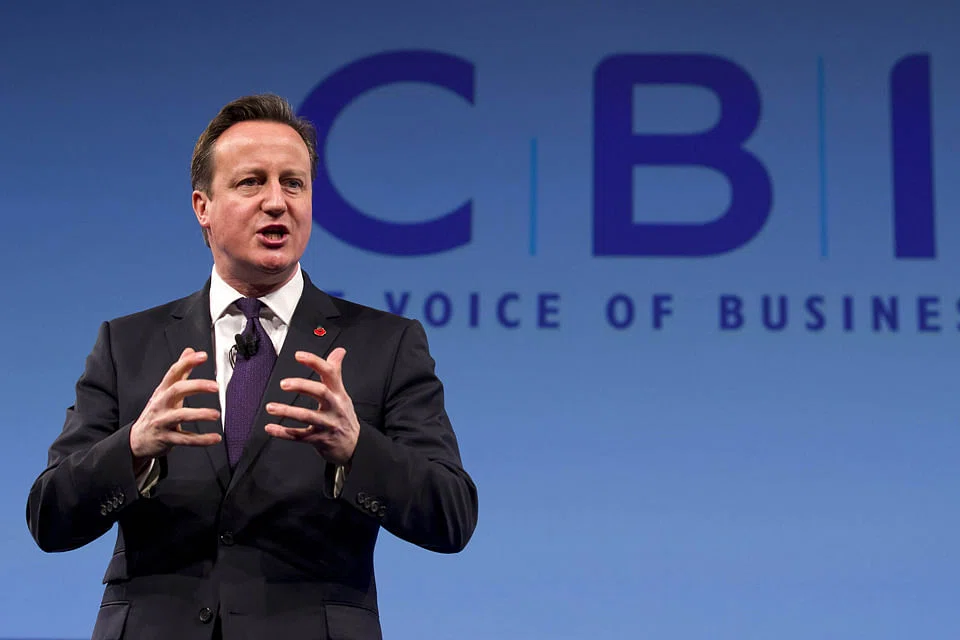
UK Prime Minister David Cameron was forced to defend his plan to hold a referendum on European Union (EU) membership as he appealed for the support of business leaders in next year's general election.
Mr Cameron was the first of three UK party leaders to make his pitch to the Confederation of British Industry's (CBI) annual conference in London. CBI president Michael Rake, introducing the prime minister, told him that eight out of 10 members would vote to stay in the EU, and they strongly support immigration.
"The UK's membership of a reformed EU is overwhelmingly in our national interest," Mr Rake said. "By withdrawing from Europe we do not somehow become more open to trade elsewhere; instead we turn inwards, going against the grain of an increasingly connected world."
The prime minister's referendum policy means he is, unusual for a leader of the Conservative Party, on the opposite side of the debate from most large business groups. Ed Miliband, the leader of the opposition Labour Party, who is due to address the CBI will emphasise his own position that a referendum would be destabilising.
"There are some people in our country who advocate exit from the EU," Mr Miliband will say, according to extracts released by his office. "There are others who flirt with it. In my view both are equally dangerous. Every nod and wink to those who want to leave sends a message to potential investors in our country that we are not open for business."
Mr Cameron, who focused the bulk of his remarks to the CBI on his plans for infrastructure investment, defended his position, which he said was the best plan for keeping Britain in the EU.
"Britain's future in Europe matters to our country," he said. "And it isn't working for us properly at the moment and that is why we need to make changes. I'm the politician who has the plan for that reform, who wants to see the single market safeguarded."
He attacked Mr Miliband's position as not paying attention to voters' concerns.
"Simply standing here and saying I will stay in Europe, I will stick with what we have come what may, that is not a strategy, that is not a plan, and that won't work," Mr Cameron said.
Mr Rake, non-executive chairman of BT Group plc, said the telecommunications company has only been able to deliver superfast broadband thanks to migrant labour. "Without the availability of this labour, instead of 82 per cent coverage, much of Britain would still be waiting for superfast broadband," he said.
Still, Mr Rake told delegates, voters didn't see the issue in the same way as employers. "Business has a role to play in ensuring the debate is based on the facts whilst recognising the genuine concerns of the public," he said.
After the Scottish independence vote in September, when businesses swung in behind keeping the UK together, both sides in the debate on EU membership know that the position of the CBI and other business groups will be important.
Those pushing for a British exit from the EU are already attacking the CBI. The UK Independence Party's economic spokesman, Patrick O'Flynn, said the organisation has a poor record on Britain's relationship with Europe.
"This is the big business lobby group that insisted the only viable economic future for Britain was as a member of the euro," he said. "Its judgments should always be questioned."
Daniel Hannan, a Conservative member of the European Parliament, said on his Twitter feed: "The CBI, the EU and the Labour leadership are part of the same corporatist racket."
Business for Britain, a rival lobby group, on Sunday attacked the CBI for taking money from the European Commission to conduct polling. BLOOMBERG
TRENDING NOW

Nvidia reinstates Jensen Huang as CEO; Trump says move poses no national security risk

Indonesia’s coal tycoon Low Tuck Kwong replaced as Bayan Resources president-director

Nvidia surges 33% after reinstating Jensen Huang, reviving AI trade; stocks soar in US and Europe

Consider lowering homeownership barriers for some non-resident foreigners

