Canada PM Carney clinches majority government in special elections to push energy and trade ambitions
It is the first time any Canadian political party has had a majority government since 2019
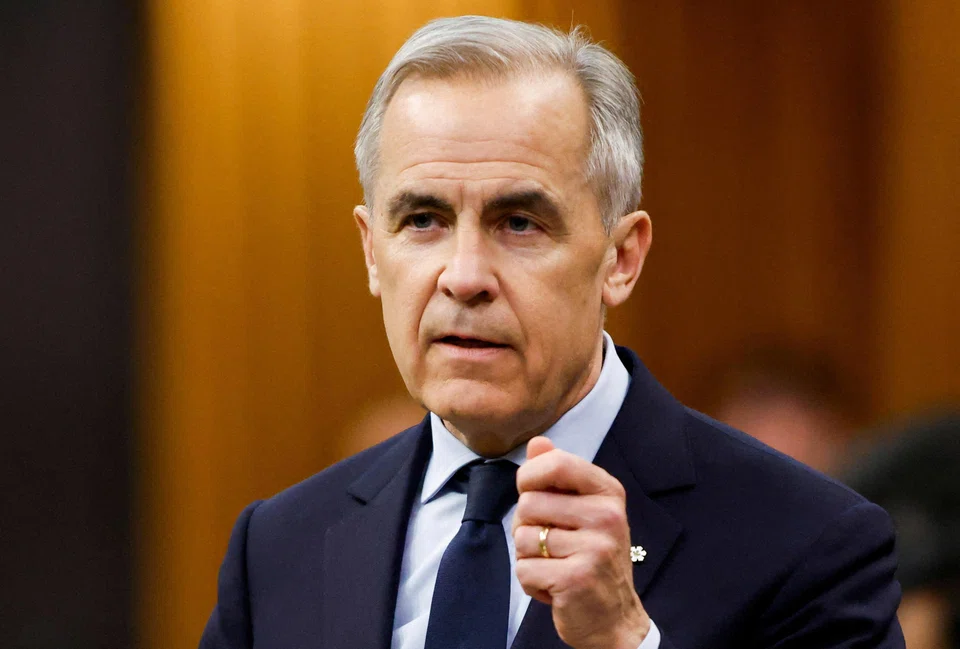
[OTTAWA] Canadian Prime Minister Mark Carney secured a majority government on Monday (Apr 14) after his Liberal Party won three key special elections, giving his administration the ability to push ahead faster with an economic agenda centred on expanding energy exports and reducing reliance on the US.
Early projections from the Canadian Broadcasting show the Liberals winning Toronto’s University-Rosedale district – the seat formerly held by Finance Minister Chrystia Freeland – in addition to victories in Scarborough Southwest and in Terrebonne, near Montreal.
By clinching the Toronto and Montreal-area districts, the Liberals now hold more than half the seats in the House of Commons. That makes it easier for Carney to pass major legislation and clears the way for his economic priorities: increased defence spending and construction of large infrastructure projects, including ports and energy export facilities.
It is the first time any Canadian political party has had a majority government since 2019.
The past year has brought a historic turnaround for the Liberals, whose prospects were in steep decline under former Prime Minister Justin Trudeau before his resignation in January 2025. Trudeau’s departure – combined with US President Donald Trump’s return to the White House – reshaped Canada’s political landscape.
Carney, a former central bank governor, persuaded Canadians he was the right person to lead the country through tumultuous economic times and steered the Liberals to a near-majority win last April, falling just short of the threshold. With the new seats, another federal election is unlikely anytime soon.
Since taking office, Carney has pushed to diversify Canada’s trade relationships and build new export infrastructure. However, he has yet to gain any ground with the US in reducing tariffs on steel, aluminium and autos.
“Tonight, voters have placed their trust in our new government’s plan,” Carney said in a statement. “We accept that support with humility, determination and a clear understanding of what this moment demands.”
His most contentious moves have come on climate and energy policy, where he has rolled back several of Trudeau’s environmental measures while promoting growth in oil and gas production. His Quebec lieutenant, a former environment minister, resigned from his Cabinet in protest.
SEE ALSO





Two of the special elections were triggered by the departures of former Trudeau Cabinet ministers Bill Blair and Freeland, whose Toronto districts are traditional Liberal strongholds. The Montreal-area seat was opened up when the Supreme Court invalidated last year’s one-vote Liberal victory due to a mail-in ballot error.
The Liberals’ candidate in Scarborough Southwest, Doly Begum, resigned as deputy leader of the left-wing Ontario New Democratic Party to run federally under Carney – a sign of his cross-party appeal.
As of 12.25 am Toronto time, Begum had captured 70 per cent of the vote, according to the independant non-partisan Elections Canada agency. In University-Rosedale, Liberal Danielle Martin won with 64 per cent of the vote, the CBC projected. And in Terrebonne, Liberal Tatiana Auguste won with 48 per cent, compared with 47 per cent for the Bloc Québécois’ Nathalie Sinclair-Desgagné with 100 per cent of the votes counted, according to the CBC.
Carney’s path to a majority was also paved by five defections. Four Conservative lawmakers and one New Democrat crossed the floor of the House to join the government caucus. Such moves are permitted in Canada’s parliamentary system but remain rare; the last prime minister to attract as many opposition members was Jean Chrétien, who governed from 1993 to 2003, according to CBC News.
Conservative Leader Pierre Poilievre said the Liberals achieved their majority through “backroom deals with politicians who betrayed the people who voted for them.”
“While the prime minister spent the year on this cynical power grab, he has doubled the deficit, and given Canada the worst grocery prices and housing costs in the G7,” Poilievre said on social media.
“Liberals expect Canadians to give up, get complacent and go away, so Carney can have total power without any accountability. That will not happen.”
But the defections underscore Carney’s current popularity. A Nanos Research poll from early April shows the Liberals leading the Conservatives by 15 points, while Carney holds a more than 30-point advantage over Poilievre as preferred prime minister.
For Poilievre, the Liberal majority is a significant setback. Once favoured to become Canada’s next prime minister, he is now facing increased scrutiny over his leadership style after the loss of four elected members. Still, there is no immediate sign of an internal push to oust him, and he easily secured a vote of confidence from party members at a January convention. BLOOMBERG
Decoding Asia newsletter: your guide to navigating Asia in a new global order. Sign up here to get Decoding Asia newsletter. Delivered to your inbox. Free.
Share with us your feedback on BT's products and services