Canada’s Carney hails improving China ties during landmark visit
Warming ties have paved the way for strategic partnership in areas such as energy, people-to-people ties and security, adds PM
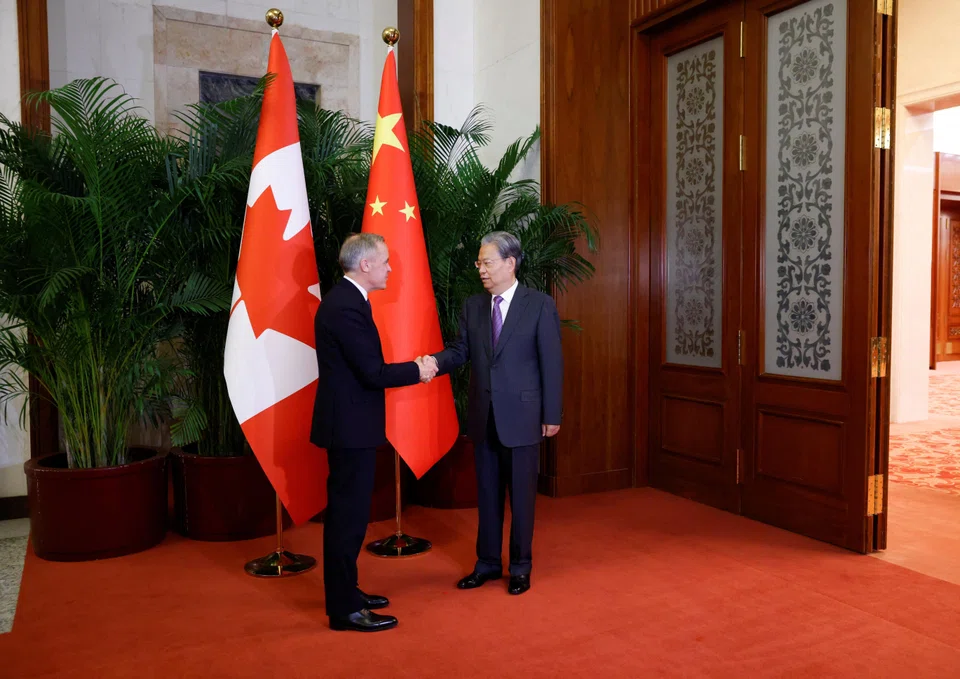
[BEIJING] Canadian Prime Minister Mark Carney hailed on Thursday (Jan 15) the speed of progress in ties with China, declaring that the stage was set for both nations to become strategic partners across many fields.
Carney’s optimistic remarks, in a meeting with China’s top legislator Zhao Leji in Beijing, followed months of intense re-engagement by both countries aimed at recalibrating ties that had soured under previous prime minister Justin Trudeau.
The four-day visit to China was the first by a Canadian prime minister since 2017, following up on Carney’s positive meeting with Chinese leader Xi Jinping in South Korea in October. The two are set to meet again on Friday.
Carney said that he was “heartened by the leadership of President Xi Jinping”, adding that warming relations had paved the way for strategic partnership in areas such as energy, people-to-people links and security, according to a spokesperson for his office.
Re-engagement with China has also been fuelled by a push to diversify export markets after US President Donald Trump imposed tariffs on Canada last year and suggested the longtime US ally could become his country’s 51st state.
Earlier on Thursday, China’s top diplomat, Wang Yi, called Carney’s visit a “pivotal” event. “This marks the Canadian prime minister’s first visit to China in eight years, representing a pivotal and landmark moment for our bilateral relations”, Wang told his counterpart Anita Anand, travelling in Carney’s delegation.
Anand praised the behind-the-scenes work in organising Carney’s approaching meetings with China’s leaders to ensure their success, the Canadian prime minister’s office said in a statement.
Periods of tension in the past decade have roiled ties, most recently after Trudeau’s government imposed tariffs on Chinese electric vehicles in 2024, following similar US curbs.
China retaliated last March with tariffs on more than US$2.6 billion of Canadian farm and food products, such as canola oil and meal, leading to a slump of 10.4 per cent in Chinese imports of Canadian goods in 2025, shown in customs data on Wednesday.
Efforts to strike up new dialogue gathered pace since Carney took the helm last year, with top officials of both sides setting up meetings and telephone calls that resulted in the leaders’ October meeting in South Korea.
Chinese state media had blamed the Trudeau government’s policies to contain China in lock step with the US as the chief cause of tension.
“It was pretty tough watching that previous administration,” said Jacob Cooke, chief executive of Beijing-based WPIC Marketing + Technologies, a Canadian company what worked with garment firms Arcteryx and Lululemon on their China launch.
“We know Carney has got a lot of business experience, and he’s been to China many times,” Cooke told Reuters. “So from the business community’s perspective, we’re very optimistic, we’re confident.”
Since arriving in China’s capital on Wednesday, Carney has met senior executives of its business groups, such as EV battery giant Contemporary Amperex Technology and China National Petroleum Corp.
He has also met officials of smart wind turbine maker Envision Energy, Industrial and Commercial Bank of China, investment firm Primavera Capital Group and e-commerce titan Alibaba. REUTERS
Decoding Asia newsletter: your guide to navigating Asia in a new global order. Sign up here to get Decoding Asia newsletter. Delivered to your inbox. Free.
Share with us your feedback on BT's products and services