

China boosts defence spending by 7% in drive to modernise by 2035
It is stepping up deployments across East Asia and purging top brass to tackle graft
[TAIPEI] China, in 2026, will boost defence spending by 7 per cent, the lowest rate in five years, it said on Thursday (Mar 5).
It is still outpacing wider economic-growth targets and the rest of Asia at a time of growing regional tension, including over Taiwan.
Security analysts and regional military attaches are watching China’s Budget closely as it scrambles to modernise the military by 2035, while stepping up deployments in East Asia and purging the top brass to tackle graft.
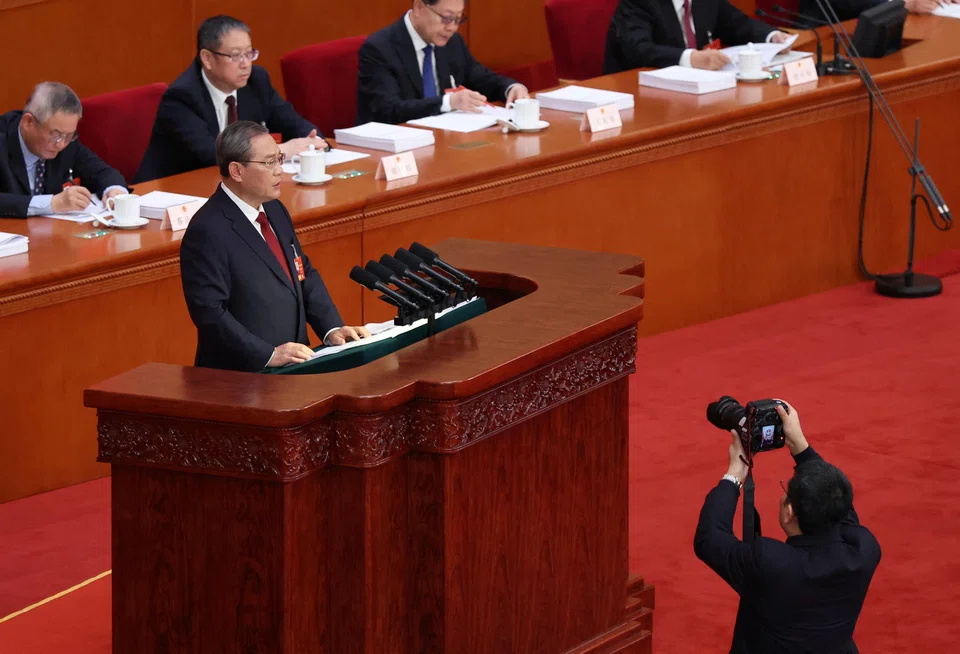
China will improve its combat readiness and accelerate the development of “advanced combat capabilities”, Prime Minister Li Qiang said at the opening of the parliament’s annual meeting, at which he unveiled a broader gross domestic product growth forecast of 4.5 to 5 per cent.
“All these steps will boost our strategic capacity to safeguard China’s sovereignty, security and development interests,” he said in his work report, adding that Chinese President Xi Jinping held ultimate command responsibility.
Raising defence spending by 7 per cent, which follows three years of annual rises of 7.2 per cent and is the lowest since 6.8 per cent in 2021, is part of a spending campaign in which China’s military has developed new advanced missiles, ships, submarines and surveillance methods.
The increase in 2026 showed Beijing was keeping to a long-held principle of balancing economic growth with national defence goals, said James Char, an assistant professor with the China Programme at the S Rajaratnam School of International Studies in Singapore.
“Essentially, the budget of the People’s Liberation Army (PLA) has been growing at a fairly consistent rate as a percentage of GDP... roughly the rate of GDP growth plus inflation,” he added.
It comes amid the highest-profile purge of upper military ranks in decades, with the two most senior generals ensnared in disciplinary investigations.



Zhang Youxia, a veteran military ally of Xi, was placed under investigation in January, while He Weidong was expelled in October 2025.
The purge leaves just two members of the usual seven on the supreme Central Military Commission – Xi himself as its chair, and a newly promoted vice-chairman, Zhang Shengmin.
The corruption crackdown showed “Beijing will keep a tighter watch on military spending”, said Wen-Ti Sung, a security analyst based in Taiwan, although it was clear that all levels of government were getting more frugal.
The government remains committed to the ruling PLA’s “absolute leadership over the armed forces”, Premier Li added.
“Guided by the principle of ensuring political loyalty in the military, we will continue to improve the military’s political conduct and make major strides towards the centenary goals of the PLA.”
Some regional analysts believe the 100th founding anniversary in 2027 will bring further increases in military drills and deployments around Taiwan, the democratically-governed island that Beijing views as its territory.
‘Reunification’ with Taiwan
China would “resolutely fight against separatist forces aimed at ‘Taiwan independence’ and oppose external interference”, Li vowed, virtually reprising comments in 2025.
This would “promote the peaceful development of cross-Strait relations and advance the cause of national reunification”, he added.
Taiwan’s government, which says only the island’s people can decide their future, had no immediate reaction to his remarks.
He toned down a warning about the international environment which was made in 2025, calling it “complex and challenging” rather than “increasingly complex and severe” in comments that had cited “changes unseen in a century”.
In Tokyo, Japan’s Chief Cabinet Secretary Minoru Kihara said China was not sufficiently transparent about its continued high level of defence spending and stronger capabilities.
Despite China’s efforts to change the status quo in the East and South China Seas by “force or coercion”, Japan would keep up efforts to build constructive, stable ties with it, he said at a press briefing.
While the graft crackdown left gaps in the PLA’s command structure and dented short-term readiness, it was expected to keep improving capabilities and broaden modernisation, the London-based International Institute of Strategic Studies said.
Growth in Chinese military spending was consistently outpacing the rest of Asia amid a global surge in defence budgets, it said in a report in February.
China’s share of Asia’s total military expenditure grew to almost 44 per cent in 2025 from an average of 37 per cent between 2010 and 2020, it added.
The country gives no breakdown of its defence spending, though its budget of 1.9 trillion yuan (S$353.9 billion) is just about a quarter of a US$1 trillion defence Bill US President Donald Trump signed into law in December. REUTERS
Decoding Asia newsletter: your guide to navigating Asia in a new global order. Sign up here to get Decoding Asia newsletter. Delivered to your inbox. Free.
Share with us your feedback on BT's products and services
TRENDING NOW
Singapore identifies 7 firms responsible for haze fires, notices issued urging action: Grace Fu
DBS remains analysts’ pick ahead of Q3 earnings after Singapore banks’ share slump

High Court rules against Julius Baer’s Singapore trust arm in US$50 million family trust dispute

Could stablecoins be the future of money?

