

China consumption start to year seen as worst ever outside Covid-19
So far, the Chinese government has not suggested it’s about to change course amid the fast-changing international geopolitical environment
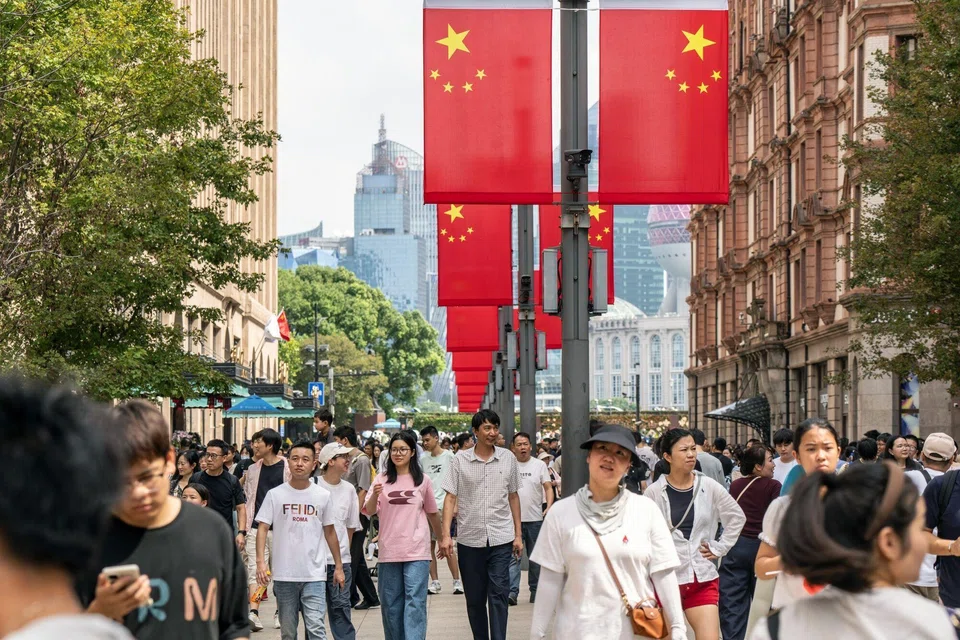
CHINA’S consumer spending may have booked the worst start to any year outside the pandemic, highlighting the challenge to a government that has targeted a bigger role for domestic demand.
Retail sales for the first two months of the year likely rose 2.1 per cent compared with the same period of 2025, according to the median forecast of economists surveyed by Bloomberg ahead of the official release on Monday (Mar 16). That would be the lowest ever reading in a data series that started in 2000, outside of January to February 2020, when the economy was reeling from the Covid-19 shock.
Industrial production likely expanded 5 per cent in the past two months, a notable slowdown from the 5.9 per cent pace recorded at the start of 2025, though still a relative bright spot, reflecting robust foreign demand.
The third key indicator due on Monday is fixed asset investment, where economists see the unprecedented slump of 2025 extending into this year. Outlays are forecast to be down 4.2 per cent from a year before, with property investment contracting some 19.3 per cent.
If the forecasts are realised, the first detailed 2026 snapshot of the world’s second-largest economy would depict a further weakening in domestic demand, in the face of official pledges to make its revival a priority. The figures represent a bigger challenge in light of risks to the surprisingly strong export side of the economy, stemming from the Iran war.
“Beijing needs export growth to offset the crashing property market, but the resulting staggering trade imbalance is unlikely to be sustained,” Nomura Holdings economists led by Ting Lu wrote in a Thursday note. “It’s a dilemma that Beijing will have to resolve.”
So far, the Chinese government has not suggested it’s about to change course amid the fast-changing international geopolitical environment. The leadership unveiled its annual economic goals just last week, plans likely made months ahead of the current upheavals in the Middle East.
China’s authorities modestly scaled back fiscal stimulus plans for this year as they lowered their annual growth target to 4.5 to 5 per cent, the least ambitious goal since 1991, though from an enormously larger base of gross domestic product.
Tolerance of a slower expansion pace has increased as Beijing seeks to limit wasteful investment that would worsen an already-large debt overhang, and to experiment with ways to spur consumption.
SEE ALSO


Policymakers did not present any new major plans to lift consumption. The increase in the minimum benefits of one of the main public pension programmes was kept unchanged from last year. That ran against the expectation of some economists who had anticipated a significant hike to reduce precautionary household savings and encourage spending.
And though it vowed to double down on a campaign to boost consumption, the government reduced the subsidies for a flagship consumer trade-in programme to 250 billion yuan (S$47 billion) from 300 billion yuan last year.
Ahead of Monday’s figures, the China Association of Automobile Manufacturers reported that car sales slumped 15 per cent in February. The Wednesday figures reflected the impact of the downgraded trade-in subsidies as well as the scaling back of tax breaks for purchases of some new energy vehicles.
Without “new, meaningful policy support”, growth in China’s retail sales could decelerate further to as weak as 1.7 per cent this year, analysts, including Catherine Lim with Bloomberg Intelligence, have cautioned. That would be a post-Covid-19 low. The consensus forecast is for a 4 per cent annual rise.
“China’s robust export performance in the first two months of the year reduces the pressure for policymakers to boost domestic demand in the short term,” Pantheon Macroeconomics economists, including Duncan Wrigley, wrote in a Friday note. BLOOMBERG
Decoding Asia newsletter: your guide to navigating Asia in a new global order. Sign up here to get Decoding Asia newsletter. Delivered to your inbox. Free.
Share with us your feedback on BT's products and services






