

China economy worse off in some ways than 2020, Premier Li says
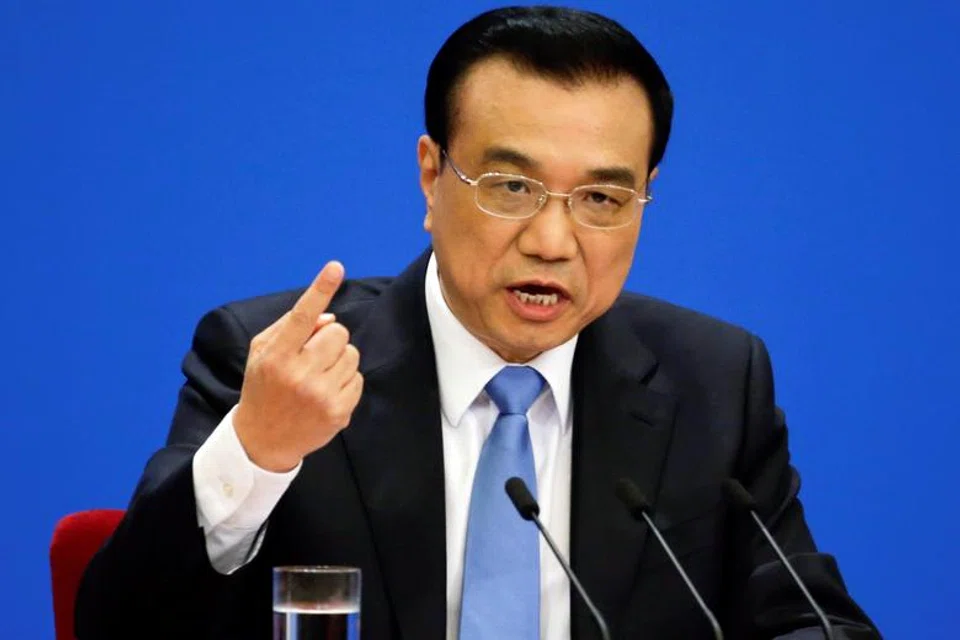
CHINA'S economy is in some respects faring worse than in 2020 when the pandemic first emerged, Premier Li Keqiang said, urging efforts to reduce a soaring unemployment rate.
"Economic indicators in China have fallen significantly, and difficulties in some aspects and to a certain extent are greater than when the epidemic hit us severely in 2020," Li said Wednesday (May 25) at an emergency meeting with thousands of representatives from local governments, state-owned companies and financial firms on stabilising the economy. China's full-year growth in 2020 was 2.2 per cent.
The bearish comments weighed on stocks, with the CSI 300 Index dropping almost 1 per cent in early trading to lead losses in Asia. China's 10-year government bond yields extended its decline for a fourth day to 2.75 per cent.
Li's warnings add to expectations that Beijing may admit to missing its GDP target by a large margin this year as it keeps its focus on controlling Covid-19 infections through stringent controls. Economists surveyed by Bloomberg forecast gross domestic product (GDP) will grow 4.5 per cent this year, well below the government's target of about 5.5 per cent.
The premier called on officials to ensure unemployment falls and the economy "operates in a reasonable range" in the second quarter of this year, state media cited him as saying. The nation's surveyed jobless rate climbed to 6.1 per cent in April, the highest since February 2020. Official data for April showed industrial output contracting for the first time since 2020.
"The economy is at its most grim moment since the second quarter of 2020," said Bruce Pang, head of macro and strategy research at China Renaissance Securities Hong Kong. "The meeting was not intended to announce more policy measures, but instead to strengthen the consensus, flesh out the details and urge the implementation of policies to ensure all existing policies are taking effect."
State media echoed Li's plea on Thursday to boost growth. China has to take more strenuous effort to achieve this year's economic growth target, and all work on stabilising employment and helping small businesses needs to accelerate, the Economic Daily said in a commentary Thursday. The newspaper is affiliated with the State Council, China's cabinet.
Li's emphasis on growth in the second quarter may be an "implicit acknowledgement" that the growth target set in early March will be "challenging", Goldman Sachs Group economists wrote in a note. "Chinese policymakers are in greater urgency to support the economy after the very weak activity growth in April, anaemic recovery month-to-date in May, and continued increases in unemployment rates."
Data accuracy
The meeting is the latest in a series of calls by Li to support growth, which has come under enormous pressure since March from Covid outbreaks and President Xi Jinping's commitment to Covid Zero, requiring strict restrictions on activity where outbreaks occur. Li said that economic data for the second quarter would be released "accurately" - amid some suspicion that official data could be massaged to appear less bad.
The premier indicated that China will try to reduce the economic impact of its strict coronavirus control policies, without specifying how that would be achieved. "At the same time as controlling the epidemic, we must complete the task of economic development," he said.
High-frequency data showed the economy remained in a deep slump in May as lockdowns continued to weigh on activity, according to Bloomberg's aggregate index of 8 indicators.
Beijing has never admitted to missing its annual growth target by a large margin since it began setting such goals more than 3 decades ago, with only one narrow miss previously reported in 1998.
Li outlined 33 support measures on Monday to help businesses, including more than 140 billion yuan (S$28.7 billion) of additional tax reductions including one for vehicle purchases. Local governments were told to spend most of the proceeds from 3.65 trillion yuan of bonds used mainly for infrastructure by the end of August. Li said more detailed instructions on how to implement those policies would be issued this month.
The central bank and banking regulator also held a meeting with major financial institutions on Monday to urge them to boost loans. State media reported following the meeting that some banks had been handed specific quotas requiring them to accelerate loan growth.
"It's obvious that Li was very worried, as he ordered all possible ways to stabilise growth, jobs and businesses as soon as possible," said Raymond Yeung, chief economist for Greater China at Australia & New Zealand Banking Group. "But the State Council can only do their best under the unchanging framework of Covid Zero, and it ultimately depends on the transmission of the virus." BLOOMBERG
Decoding Asia newsletter: your guide to navigating Asia in a new global order. Sign up here to get Decoding Asia newsletter. Delivered to your inbox. Free.
Share with us your feedback on BT's products and services
TRENDING NOW
Easy to rent out, hard to sell: Are buyers losing interest in Singapore’s one-bedroom condos?

GovTech retrenches another 38 staff in second round of layoffs
Stocks to watch: Seatrium, CapitaLand Investment, Keppel DC Reit, Suntec Reit, CLCT, TSH Resources
World’s largest offshore wind platform by Seatrium consortium on track to be completed by 2028

