

China isn’t the answer for Canada’s trade troubles, Taiwan envoy says
US President Donald Trump’s high tariffs have pushed Canada to urgently try to diversify its US-dominated export markets
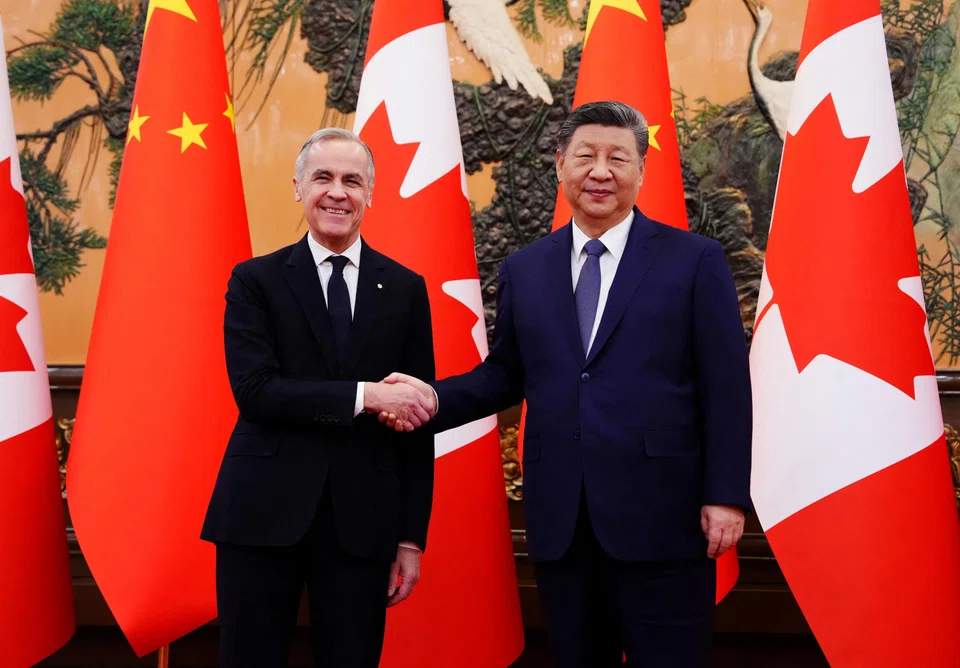
[VANCOUVER] China does not hold the solution for Canada’s economic issues and is not a trustworthy partner, Taiwan’s top representative to Ottawa said following Prime Minister Mark Carney’s tariff deal with Xi Jinping.
The Canadian and Chinese leaders reached an agreement last week to lower trade barriers and rebuild ties, a milestone reset after years of poor relations.
The deal will see Canada open its market to a small number of Chinese electric vehicles at a low tariff rate, while China will reduce its import taxes on canola, an important western Canadian crop. US President Donald Trump’s high tariffs have pushed Canada to urgently try to diversify its US-dominated export markets.
“If this trip to China is genuinely looking for an economic remedy for Canada, I don’t think you can find an answer in China,” Harry Ho-jen Tseng, Taiwan’s representative in Canada, said. “If this trip to China is trying to create political leverage of some sort, domestically or internationally, I don’t know – it’s another matter.”
A free trade deal is “unachievable between Canada and China, simply because China is not a market economy”, with many restrictions on aspects of its own market, the former deputy foreign minister for Taiwan said.
“The contraction or the expansion of their market is actually a result of political calculation,” he said. “Those who come to buy from Canada will be from the state-owned enterprises. It is not the consumers,” meaning “the state can stop buying at any time.”
Officials with the Chinese embassy in Ottawa did not reply to a request for comment.
Ho-jen Tseng is Taiwan’s equivalent to an ambassador. The island does not have formal diplomatic recognition in Ottawa due to Canada’s policy, shared by other Western nations, of neither challenging nor endorsing China’s claim to the self-ruled democracy.
Taiwan was Canada’s 15th-largest merchandise trading partner in 2024 with C$6 billion (S$5.6 billion) in goods exchanged, according to the Canadian government. The services trade between the two was C$1.9 billion.
The Canadian government’s Indo-Pacific Strategy, published in late 2022 when Justin Trudeau was still prime minister, called China “an increasingly disruptive global power” that disregards international rules and norms. That document is a “very good road map”, Ho-jen Tseng said.
But comments from Carney’s Cabinet have suggested that the strategy is not set in stone, and the global political and economic landscape has changed radically since it was written. When asked on Wednesday if Canada stood by that description of China, Foreign Minister Anita Anand said: “This is a new government with a new prime minister, a new foreign policy and a new geopolitical environment.”
Ho-jen Tseng also said that it was “totally unnecessary” that Canadian lawmakers from Carney’s Liberal Party cut short a trip to Taiwan last week to avoid overlapping with Carney’s visit to Beijing.
Parliamentary visits to Taiwan have been a normal practice for years and are the best way for Canadian lawmakers to understand the island nation’s challenges, the diplomat said.
Canada should also sign a trade cooperation framework agreement it has drafted with Taiwan “as early as possible”, he said. BLOOMBERG
Decoding Asia newsletter: your guide to navigating Asia in a new global order. Sign up here to get Decoding Asia newsletter. Delivered to your inbox. Free.
Share with us your feedback on BT's products and services
TRENDING NOW

The only common thing in S-E Asia is that we all eat rice: Cisco’s Asean president
‘How many will survive?’: Bubble fears arise as China’s humanoid robotics face reality check
Green fuels, autonomous ships: How Singapore is future-proofing its shipping industry

Could stablecoins be the future of money?

