

China to issue new quotas for investing overseas, official says
The move is intended to better meet the cross-border investment needs of domestic institutions
[BEIJING] China plans to increase the amount of money that approved investors can channel into overseas assets as Beijing loosens its control over capital outflows.
Authorities are preparing a new round of quotas under the qualified domestic institutional investor programme, which allows select institutions in the mainland to invest abroad. The quota caps investors’ ability to purchase assets like US Treasuries and overseas equities and was last increased in the summer.
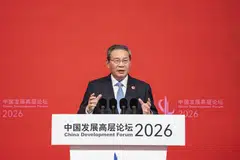
The move is intended to “better meet the cross-border investment needs of domestic institutions,” Zhu Hexin, head of China’s top currency regulator, told the China Development Forum in Beijing on Monday (Mar 23).
Zhu said China has been pushing towards progress on capital account convertibility – or the free flow of capital across borders – saying that more than 90 per cent of capital-account items are now at least partially open. “In the next five years, China will continue to promote opening up of capital accounts and coordinate the course with financial reforms and renminbi internationalisation,” he added.
Despite volatility in global financial markets, Zhu said that cross-border capital flows were “basically balanced.” That stability has given Beijing breathing room to loosen capital controls and revive a longer-term push to expand the renminbi’s global role.
Speaking earlier at the same forum, former People’s Bank of China deputy governor Zhu Min said there was a mismatch between China’s status as the world’s second-largest economy and the limited global role of its currency. The US dollar’s influence, though, appears to be waning given the US share of global output and trade shrinking, making the case for the acceleration of the renminbi’s internationalisation.
SEE ALSO




“The US economy is no longer sufficient to support a single global currency,” Zhu said, noting that many nations are now hedging against currency risk on their US dollar-denominated holdings by diversifying reserves.
To bridge the gap, Zhu called for expanded use of the renminbi in trade with the Global South and across industrial supply chains. He also urged building deeper securities and bond markets to attract foreign capital, and the continued enhancement of the CIPS payment system. BLOOMBERG
Decoding Asia newsletter: your guide to navigating Asia in a new global order. Sign up here to get Decoding Asia newsletter. Delivered to your inbox. Free.
Share with us your feedback on BT's products and services
TRENDING NOW

Once staunchly pro-China, Malaysian Chinese businesses are now distancing themselves from Beijing

Cliff Tan has 7 million followers and a 4-month waitlist. Why won’t he expand his business?

Could stablecoins be the future of money?

Grab CEO’s wife Chloe Tong on life with Anthony Tan and finding her purpose

